FRUIT OF THE SPIRIT – Part 1

The sinful nature wants to do evil, which is just the opposite of what the Spirit wants. And the Spirit gives us desires that are the opposite of what the sinful nature desires. These two forces are constantly fighting each other, so you are not free to carry out your good intentions. But when you are directed by the Spirit, you are not under obligation to the law of Moses. [Galatians 5:17-18 (NLT)]

fruit of the spiritAs Christ’s followers, we are saved through our faith and God’s grace. God takes us soiled sinners just as we are because there is no way we could be good enough to earn salvation. Nevertheless, just because God welcomes His immoral, angry, impatient, bad-tempered, anxious, sinful, and selfish children doesn’t mean He wants us to stay that way. When Jesus saved the woman caught in adultery, He told her to, “Go and sin no more” and, when we are saved, He tells us the same thing!

Unfortunately, to “sin no more” is easier said than done and the new saved us still looks and acts a lot like the old sinful one. Accepting Christ doesn’t instantly make us into loving, joyful, serene, patient, compassionate, virtuous, faithful, humble, and self-disciplined individuals. Satan doesn’t disappear when we’re saved and our old sinful self is still there, relentlessly trying to assert itself. There’s a war going on and the enemy whispers into our ears with words of envy, anger, spite, fear, jealousy, lust, dissension, despair, pride, irritation, worry, and self-centeredness. The good news is that God has not left us defenseless—which is where the Holy Spirit and His fruit enter in!

When the Holy Spirit enters our lives, He not only presents us with a Gift of the Spirit but He also plants the Fruit of the Spirit in our hearts. While His gifts are uniquely designed for each one of us, every believer receives the same Fruit—the fruit of love, joy, peace, patience, kindness, goodness, faithfulness, gentleness, and self-control.

When Paul spoke of this fruit, we know it’s not going to be found in any farmer’s market. Fruit can be seen, touched, and tasted; it contains vitamins, minerals, and fiber beneficial to our well-being. Rather than nutrients essential to our health, the Fruit of the Spirit contains virtues essential for our spiritual health. Although it can’t be touched, tasted, or seen, the positive effects of the Spirit’s fruit are visible to the world around us.

The Holy Spirit plants this one beautiful fruit in our hearts. We could call it the “love-joy-peace-patience-kindness-goodness-faithfulness-gentleness-self-control fruit,” but that seems rather cumbersome. Because the characteristics of this fruit describe our Savior, perhaps a better name would be the “Christlikeness fruit.” These nine virtues could be said to summarize the attributes of a person living in accord with the Holy Spirit. Rather than following guidelines or obeying laws, it is the presence of the Fruit of the Spirit in our hearts that enables us to become like more and more like Jesus in our daily walk.

But the Holy Spirit produces this kind of fruit in our lives: love, joy, peace, patience, kindness, goodness, faithfulness, gentleness, and self-control. There is no law against these things! [Galatians 5:22-23 (NLT)]

Copyright ©2024 jsjdevotions. All rights reserved.

THE SPIRIT’S GIFTS – Part 1

There are different kinds of spiritual gifts, but the same Spirit is the source of them all. There are different kinds of service, but we serve the same Lord. God works in different ways, but it is the same God who does the work in all of us. A spiritual gift is given to each of us so we can help each other. [1 Corinthians 12:4-7 (NLT)]

roseate spoonbillJesus promised the disciples, “And I will ask the Father, and he will give you another Advocate, who will never leave you. He is the Holy Spirit, who leads into all truth.” [John 14:16-17] In fulfillment of that promise, the moment we accept Christ as our Savior, the Holy Spirit moves into our hearts. When He arrives, He helps us but, rather than making the bed or washing dishes, the Spirit comforts, counsels, and convicts us. He gives us the power to share His word, the strength to do His work, and confidence in the fullness of God’s promises.
Like a good house guest, the Holy Spirit also brings us a gift. Unlike most presents, the Spirit’s gifts aren’t tangible, can’t be purchased on Amazon, and are expressly designed for the recipient. Received solely through the grace of God, a spiritual gift is a supernaturally designed ability granted to every believer by which the Spirit ministers to Christ’s church. Like a Craftsman tool, it is meant for building God’s Kingdom and guaranteed to last a lifetime!

Originating from His presence, the Spirit’s gifts are not the natural abilities with which we were born—things like being “double-jointed,” having perfect pitch, or being able to wiggle our ears. Our talents are inherited at birth and developed through the years. Both the unsaved and saved possess talents but only the saved receive the Spirit’s gifts! They are given to us when we accept Jesus as our Lord and Savior—when we are born again. While talents can be used to serve both ourselves and others, the gifts of the Spirit are used to glorify God as we serve others. Nevertheless, God is not about to waste our talents and skills so His gifts often line up with our natural aptitudes.

Described in Romans 12, Ephesians 4, and 1 Corinthians 12, the Spirit’s gifts are capabilities that enable each of us to build God’s Kingdom: they include things like wisdom, prophecy, administration, teaching, hospitality, discernment,  exhortation, and service. Scripture’s lists, however, vary with translations and are neither definitive nor all-inclusive. God is not a ”one-size-fits-all” designer and, while the Spirit’s gifts have a common origin, they are customized by Him to fit exactly into each believer’s heart.

Just as the master in the Parable of the Talents decided how many talents each of his servants were given, it is God alone who decides the kind of gift or gifts received. Investing their master’s talents in his absence was the task of the servants in that parable and using the gifts of the Spirit to build God’s Kingdom until Jesus returns is our task. Sadly, just because the Holy Spirit has given us a gift doesn’t mean we’ll use it; it can remain hidden away as was the talent received by the lazy servant. Let us remember—things did not go well for the one who failed to make use of his master’s talents! As Christ’s followers, we must be good stewards of whatever gifts we’ve been given so that everything we do “will bring glory to God through Jesus Christ!”

As God’s children, we are not to be observers; we’re to participate actively in the Lord’s work. Spectators sit and watch, but we are called to use our spiritual gifts and serve continually. [Charles Stanley]

God has given each of you a gift from his great variety of spiritual gifts. Use them well to serve one another. … Do it with all the strength and energy that God supplies. Then everything you do will bring glory to God through Jesus Christ. All glory and power to him forever and ever! Amen.  [1 Peter 4:10,11 (NLT)]

Copyright ©2024 jsjdevotions. All rights reserved.


CONVERSATIONS WITH ESHA (1) – IT’S NOT ALL THE SAME

There may be so-called gods both in heaven and on earth, and some people actually worship many gods and many lords. But for us, there is one God, the Father, by whom all things were created, and for whom we live. And there is one Lord, Jesus Christ, through whom all things were created, and through whom we live. [1 Corinthians 8:5-6 (NLT)]

I recently met Esha while walking and we occasionally stop to chat. Although the bindi (mark) on her forehead told me she is a Hindu and the cross I wear told her I am Christian, our different faiths have not prevented us from talking about God and our beliefs. My younger son’s marriage brought many Hindus into our extended family and I try to understand this complicated religion.

When talking with my Hindu friends like Esha, they often say, “It’s all the same God.” While there is, indeed, only one God, the true God is not the one about whom they speak. Esha, like most Hindus, believes in one supreme god (often called Brahman) who manifests himself in a sort of hierarchy of lesser gods. Different Hindus worship different gods according to their own needs and perspective. One person may worship Ganesha while another Vishnu or Shiva.

Christians, however, believe that there is just one God and, as diverse as Christians are, we all worship the same God. While God is one in essence, He has three persons: God the Father, God the Son, and God the Holy Spirit. As Father, He is creator of all things, all-powerful and all-knowing; as Son, He is Jesus Christ: God in human form who lived on earth; and, as Holy Spirit, He is invisible, yet present in people and across the world. These three persons, however, are not lesser gods or worshipped apart from one another. While each personage is distinct and fully and completely God, they are simultaneously and eternally just one. Christians worship one true God who eternally exists as Father, Son, and Holy Spirit.

Although most Hindus see their supreme god as genderless, the lesser gods are viewed as being male, female, androgynous, or even gender-fluid. Although God presented as a man with Jesus’ incarnation, God is a spirit and, as such, has no bodily parts, size, or weight. In spite of speaking of God as “our Father” and referring to Him with male pronouns, God is genderless. That we’re created in God’s image doesn’t refer to His physical characteristics. We are made in God’s image because He endowed us with His spiritual characteristics—we have mind, intellect, emotions, will, and moral capacity.

My friend Esha often speaks of God being everywhere and we agree on that point. God is omnipresent. He is everywhere all at once—throughout the entire universe—from the deepest depths of the ocean to beyond the farthest star known to man! He fills every part of heaven and earth with His holy presence. While there is no place God does not inhabit, Esha and I disagree on exactly how God does that. As a Hindu, she believes that God is in everything and everything is in God. To her, God is some sort of transcendent force or energy. Since this energy inhabits the universe, the universe is God and anything found in the universe is God. As a result, if the universe should cease to exist, so would God.

While Esha and I agree on God’s omnipresence, we disagree on His nature. Rather than  some sort of supernatural force or energy, God is a being! While evidence of God’s character and magnificence is found in His creation, He is as distinct from His creation as a painter is from his painting. God doesn’t need the universe to exist. As its creator, God would exist even if the universe ceased to exist!

There is only one true God, but the gods of faiths like Hinduism, Islam, Jainism, Confucianism, and a host of other isms are not Him! That does not mean that we can’t be friends and respectful of one another’s beliefs. Let us remember that the same God made us and, regardless of our beliefs, we all are God’s children. Nevertheless, let’s never fall for the line that “It’s all the same God!” when it isn’t God at all.

And we know that the Son of God has come, and he has given us understanding so that we can know the true God. And now we live in fellowship with the true God because we live in fellowship with his Son, Jesus Christ. He is the only true God, and he is eternal life. [1 John 5:20 (NLT)]

Copyright ©2023 jsjdevotions. All rights reserved.

THE APOSTLE PAUL (Part 2)

Let God’s curse fall on anyone, including us or even an angel from heaven, who preaches a different kind of Good News than the one we preached to you. I say again what we have said before: If anyone preaches any other Good News than the one you welcomed, let that person be cursed. [Galatians 1:8-9 (NLT)]

chickoryIn his letter to the Galatians, Paul refutes the message of those who preached that adherence to Jewish laws was required of all believers. His are harsh judgmental words from a man who never even walked with Jesus on earth. Why was Paul’s Gospel the definitive one rather than the one the Galatians heard preached by the Judaizers? For the first two chapters of his letter, Paul explains the source of his apostolic authority.

Paul clearly states the divine origin of his message in verse 12: “I received my message from no human source, and no one taught me. Instead, I received it by direct revelation from Jesus Christ.” Saying that he came to the Gospel neither by his own understanding nor by another person’s teaching, Paul claimed his message came from a divine source—the Lord Himself! Indeed, nothing but divine intervention can explain Paul’s incredible conversion from a fanatical persecutor of Christians into an equally fanatical evangelist for Christ’s church! No one with Paul’s background and personality could have been convinced and converted by anyone other than the Lord! He is the poster boy for the Holy Spirit’s transforming power!

To emphasize that he didn’t get the gospel from any man, Paul explained that he spent three years in Arabia after his conversion before returning to Damascus and finally going to Jerusalem to meet Peter. Strict chronology seemed unimportant to Scripture’s writers and, without any punctuation or breaks between words, sentences, paragraphs, or chapters in the original writing, it often is unclear. As best as scholars can figure, Paul’s time in Arabia probably began in Acts 9 between verses 19 and 20. Since any part of a year was considered a year, Paul spent anywhere from as little as 14 months to as much as 36 months in Arabia.

In Paul’s day, Arabia referred to Nabatea, a large and prosperous kingdom east of Galilee extending as far north as Damascus and beyond Petra to the south. When considering those three years, I used to picture a confused Saul retreating into the Nabatean desert to study Scripture and try to reconcile the Christian-hating, Gentile-detesting Pharisee he’d been with the Christ-loving, Gentile-welcoming evangelist he became! I was wrong!

Although it resulted in temporary blindness, Saul’s conversion didn’t result in confusion; meeting Jesus brought clarity to the man. From the moment of his conception, God had been preparing Saul to meet Jesus on that road to Damascus! When that happened, everything he’d learned in the Hebrew Scriptures finally made complete sense! The Apostle has been described as a man who wouldn’t learn to swim by reading about it. He’d jump in the deep end and start paddling and that’s exactly what Saul did following his conversion. Acts tells us he “immediately began preaching about Jesus in the synagogues.” [9:20]

To further emphasize that his message did not come from men, Paul told the Galatians that, when he finally went to Jerusalem (after his time in Arabia), he stayed only two weeks and met just Peter and James. It was some fourteen years after his conversion that Paul went to Jerusalem and finally met with the leaders of the church. At that time, he shared with them the message he was preaching to the Gentiles “to make sure that we were in agreement…and the leaders of the church had nothing to add to what I was preaching.” [Galatians 2:2,6] Independent of the other Apostles, Paul preached the very same gospel they did because, like them, he learned it from Jesus! Paul’s apostolic authority came from God Himself!

“Who are you, lord?” I asked. “And the Lord replied, ‘I am Jesus, the one you are persecuting. Now get to your feet! For I have appeared to you to appoint you as my servant and witness. Tell people that you have seen me, and tell them what I will show you in the future.’” [Acts 26:15-16 (NLT)]

Copyright ©2023 jsjdevotions. All rights reserved.

THE APOSTLE PAUL (Part 1)

I used to believe that I ought to do everything I could to oppose the very name of Jesus the Nazarene. Indeed, I did just that in Jerusalem. Authorized by the leading priests, I caused many believers there to be sent to prison. And I cast my vote against them when they were condemned to death. Many times I had them punished in the synagogues to get them to curse Jesus. I was so violently opposed to them that I even chased them down in foreign cities. [Acts 26:9-11 (NLT)]

red-shouldered hawkOf the twenty-seven books of the New Testament, thirteen are attributed to the Apostle Paul. We know he wrote another letter to the Corinthians and the prolific letter writer probably wrote letters to believers in places like Damascus, Caesarea, and Jerusalem, but these thirteen are all that remain. Considering Nero’s persecution of Christians, the violence during the Jewish revolt, and Domitian’s persecution of Jews and Christians, all of which happened before the end of the 1st century, it’s a wonder that any of Paul’s letters survived! God, however, saw to it that these thirteen ”God-breathed” epistles were preserved and became part of the Christian canon.
What do we know about this man who founded more than a dozen churches—the man scholars consider second only to Jesus in his contribution to Christianity? When we first meet him, he is known by his Jewish name of Saul. As a free-born Roman citizen, he had a commonly used Roman name which was Paullus (Paul). But, as the son of devout Jewish parents, he also had a Hebrew name—Saul—a fitting name for a boy from King Saul’s tribe. It was not until about 15 years after Saul’s conversion, when he moved further into Gentile territory on his first missionary journey, that Saul (and Luke) began using his Roman name of Paul.

Although he was born to Jewish parents in Tarsus, the capital city of Cilicia (modern day Turkey), Paul claimed Jerusalem was his boyhood home and it is believed that his family moved to Jerusalem around 10 AD. As the son of a Pharisee, he would have strictly observed the law and oral traditions and, by the age of five, started studying Scripture and Jewish history. As the son of a tent-maker (or fabric/leather worker), he also would have learned his father’s trade.

Sometime between the ages of 10 and 15, Saul began his studies with the highly esteemed Rabbi Gamaliel, a leader in the Jewish Sanhedrin. As Gamaliel’s student, he would have memorized the Torah and rabbinical traditions. The Apostle’s ability to read, write, and clearly articulate his thoughts in Koine Greek (and quote from the Greek poets), tells us he was extremely well-educated.

As a Pharisee, Judaism consumed Saul’s entire life and he would have been passionate about preserving the faith and traditions he loved. As a result, Saul vehemently opposed the church. While we have no evidence of him killing Christians, he clearly approved of their executions! Wanting to eradicate followers of the Way, Saul zealously went into believers’ homes and dragged both men and women out so they could be imprisoned. He was so enthusiastic about preventing the church from spreading beyond Jerusalem that he requested permission to go Damascus to arrest any Christ followers who may have fled there to avoid persecution. It was on the road to Damascus that Saul literally “saw the light” when he saw the risen Jesus Christ before him. It was then that Saul became a new person in Christ Jesus and the persecutor became an evangelist!

As for Paul’s appearance—an early Christian document describes him as a partly bald, bow-legged, short man with large eyes, long nose, and a unibrow. In 2 Corinthians, Paul refers to having a “thorn” in his flesh but we don’t know the nature of his affliction. Some scholars speculate it may have been an eye problem while others that it possibly was epilepsy. Whatever it was, the condition never deterred the Apostle from his purpose!

With his exceptional education, extensive Biblical knowledge, and intense personality, Saul/Paul was uniquely qualified to become an evangelist for Jesus. Nevertheless, even the best credentials don’t automatically give someone authority. Unlike the twelve apostles, he hadn’t traveled with Jesus from His baptism until His death. He wasn’t there in the upper room or when Christ ascended into heaven. Nevertheless, by the end of the 1st century, Paul’s letters were regarded as authoritative for the church. Why? What gave this man who once mercilessly persecuted Christ’s followers the apostolic authority to preach the gospel, clarify doctrine, or correct the false teachings of others? That question is answered in Part 2.

My old self has been crucified with Christ. It is no longer I who live, but Christ lives in me. So I live in this earthly body by trusting in the Son of God, who loved me and gave himself for me. [Galatians 2:20 (NLT)]

Copyright ©2023 jsjdevotions. All rights reserved.

HIS SANCTUARY

Don’t you realize that your body is the temple of the Holy Spirit, who lives in you and was given to you by God? You do not belong to yourself, for God bought you with a high price. So you must honor God with your body. [1 Corinthians 6:19-20 (NLT)]

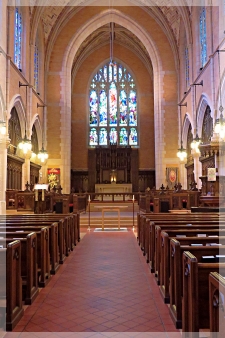
St. Paul's Cathedral - MNSince we both attended liturgical churches as girls, my friend and I were trying to recall the terms for the various parts of a traditional church building. We knew the foyer is called the narthex and the congregation sits the church’s nave. We also knew the altar rail usually separated the nave from the chancel in the front. It’s from the chancel that the service is conducted and where the altar, pulpit, and lectern are located. We even recalled that the sacristy was the room holding Communion supplies and linens. Since we were worshipping in a park that morning, my friend asked the location of our sanctuary. In historic usage, sanctuary and chancel were synonymous but, in modern usage, a sanctuary consists of the entire worship space of a church. With no building, we had no narthex, nave, or chancel but we did have a worship space; our sanctuary was a gazebo in a county park.

As God would have it, my next morning’s reading took me to today’s verse from 1 Corinthians. The Greek word usually translated as “temple” was naós, meaning a sanctuary, a divine dwelling-place, a temple, or place of divine manifestation. In Paul’s day, naós referred to the Temple proper, from the inner courts to the Holy Place with the seven-branched candlestick, golden incense altar, and showbread table all the way to the innermost area called the Holy of Holies—a place so sacred that it could be entered only by the High Priest once a year, on the Day of Atonement.

Having recently written about the lack of respect and reverence now common in a church sanctuary, Paul’s words gave me pause. The Temple and all its utensils—from the Ark, altars, and lamps to the snuffers, basins, oil, incense, and priest’s garments—were considered holy. Dedicated solely to serving God, they were not to be used for common or profane uses. If we are God’s sanctuary, a place of worship and the divine dwelling place of the Holy Spirit, do we treat ourselves with the reverence and respect due God’s temple? Are we solely dedicated to serving God? Are we ever used for vulgar, disrespectful, or profane purposes?

Do we ever desecrate our sanctuary by not treating our bodies properly? Do we treat them with the same care and regard we would Communion wafers, altar linens, or a Baptismal font? God’s sanctuary, however, is more than our physical bodies; it’s our entire being, our hearts and minds. Do we speak, read, look at, find humor in, think about, or do things we wouldn’t if we were in church? Do we always serve as a worship space of our amazing Triune God or just during prayers or worship service? Do we reflect the dignity, sanctity, and holiness that comes with being the house of God?

A great deal of responsibility comes with being God’s dwelling place. Just as the Temple was defiled in 168 BC when Antiochus Epiphanes sacrificed a pig on the altar of incense, our sins defile us. They are like obscene graffiti on a church walls, vandalism of the altar, defacement of the Bible, or leaving excrement on the pews. Preacher Harry Ironside reminds us, “How careful you and I ought to be that we grieve not that blessed One who dwells within, that we do not bring dishonor upon the name of the Savior who has sent His Spirit to live in our body.”

The Jews were so zealous about maintaining the purity of God’s sanctuary that a low fence  separated the court of the Gentiles from the rest of the Temple mount complex. Gentiles and ritually unclean Israelites were forbidden, on pain of death, from passing through its gates to the interior areas—the sanctuary of the Temple. Are we that zealous about keeping His dwelling place within us—His sanctuary—pure and undefiled?

For that matter, our brothers and sisters in Christ also serve as a dwelling place of God. Do we treat them with the same reverence and respect due God’s sanctuary? We should!

Don’t you realize that all of you together are the temple of God and that the Spirit of God lives in you?… All of you together are Christ’s body, and each of you is a part of it. [1 Corinthians 3:16,12:27 (NLT)]

Copyright ©2023 jsjdevotions. All rights reserved.