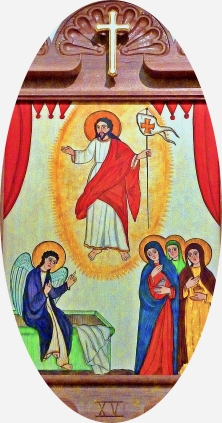
THANK YOU, JESUS!

For even the Son of Man came not to be served but to serve others and to give his life as a ransom for many. [Matthew 20:28 (NLT)]

During Lent, I journeyed toward Jesus’ death and resurrection with a Lenten devotional. For each of the season’s forty days, there was a Scripture reading from John, a short devotional, an inspiring quote, interesting facts about Lent’s history, and a unique fast for the day. Each day’s reading also provided journaling space for the reader. For the fortieth day’s journal entry, readers were asked to write a brief letter of thanks to Jesus for all He endured to lead them into eternal life.

More than a week after Good Friday, however, the journal page was blank. Using Christianese words like expiation, redemption, propitiation, and reconciliation, along with born again, forgiveness, salvation, and everlasting life, I easily could have filled that page with a list of what His sacrifice provided. But my mother, who insisted I write a personal note of thanks before enjoying any gift, wouldn’t have approved of such a cursory, let alone tardy, “thank you” note! Jesus certainly deserved better!

Since then, I have pondered all He did for me—not for the world—but for me personally. He provided joy, peace, purpose, and meaning to my life but He did so much more! Jesus loved me! He loved me enough to fast for me—and not just for those forty days in the wilderness. He loved me enough to fast from being God for more than thirty years. Humbling and emptying Himself, the second member of the Trinity traded His Godness for mortal flesh. The One who was there before the world began fasted from the worship of angels, omnipotence, omnipresence, omniscience, sovereignty, and self-existence. He fasted from being God to suffer pain, hunger, thirst, betrayal, discomfort, insults, accusations, humiliation, and the excruciating death of a criminal. That was done for me! Thank you, Jesus!

Because He gave me the gift of His Holy Spirit, Jesus remains with me and continues to lead, guide, guard, comfort, and provide for me. His Spirit helps me understand Scripture, hear His voice, and feel His presence. He guides my prayers—and when I have no words, He prays for me! He gave me a spiritual gift and enables me to bear spiritual fruit. Although He convicts me of my sin, rather than shame me, Jesus forgives me. Thank you, Jesus!

Jesus has been my good shepherd. When I strayed, He found me and brought me home. When I was hurt, he comforted me and dressed my wounds. When danger threatened, He protected me; when I was running on empty, He filled me; and, when I ran myself ragged, He brought me to a place of rest. Because He put people in my life who acted as His hands and voice, I received help, guidance, counseling, encouragement, love, and “sharpening” from His earthly angels. Thank you, Jesus!

As my shepherd, Jesus has been at my side in my darkest moments (as well as my best). He loved me when I was at my worst, when I hated myself, or considered ending my life. When I was angry with Him and turned away, He never abandoned me. He held me when I lost those I loved or was hurt by those who should have protected me. He encouraged me when I was sure I could go no further, lifted me when I fell, and carried me when I couldn’t take another step. He safely brought me through every dark valley into His light. There are times I don’t even like myself, but Jesus loved me enough to die so that I could live!  He did that for me! Thank you, Jesus!

Your story is different from mine. Nevertheless, Jesus loves you as much as He loves me! Just as He lived, suffered, died, and rose for me, He lived, suffered, died, and rose for you. What would you write in your letter?

Now, most people would not be willing to die for an upright person, though someone might perhaps be willing to die for a person who is especially good. But God showed his great love for us by sending Christ to die for us while we were still sinners. [Romans 5:7-8 (NLT)]

Copyright ©2024 jsjdevotions. All rights reserved.

SATURDAYS (Easter Monday)

Afterward he appeared to the eleven themselves as they were reclining at table, and he rebuked them for their unbelief and hardness of heart, because they had not believed those who saw him after he had risen. [Mark 16:14 (ESV)]

red admiral butterflyMost of us probably spent Saturday preparing for Easter. We may have done last minute grocery shopping, prepped for Easter dinner, purchased an Easter lily, decorated eggs, assembled Easter baskets, snacked on jelly beans, or hidden plastic eggs around the yard. The previous day’s service on Good Friday had been a somber one but we knew the following day’s worship would be one of joy and celebration. While we may have sung “Were you There When They Crucified My Lord?” on Friday, we knew that we’d be singing “Christ the Lord is Risen Today” on Sunday.

Because we know how Good Friday’s story ends, we don’t mourn, feel abandoned, or fear being arrested on Saturday. The disciples, however, didn’t know that Sunday would reveal an empty tomb. Having been unable to finish preparing Jesus’ body and offer a proper hepsed (eulogy), there must have been a feeling of unfinished business and, when the Sabbath ended, the women purchased burial spices. Scripture, however, is strangely silent about that Saturday and the narrative does not resume until Sunday morning.

Did His followers tear their clothes in grief as did Jacob when he thought Joseph was dead?  Did they wear sack cloth as did David upon Abner’s death? To show their grief and anguish, did they fast and cover themselves with ashes in sorrow and anguish as did the Jews when they learned that King Xerxes had ordered their death? Did they tear their robes, cover their heads with ashes, and silently sit shiva with Mary as Job’s friends had done for him?

Their sense of despair and defeat must have been unbearable. How could they make sense of all that happened? Thinking they’d never again see Jesus, was there regret or anger that they’d given up their homes and livelihoods for what now seemed a failed Messiah? Consider their heartache and the many “would’ves, could’ves, and should’ves” as they remembered Thursday night. Think of their remorse for having fallen asleep while Jesus prayed, the shame of abandoning Him in the garden, and Peter’s self-reproach for denying Him three times in the courtyard.

The disciples never fully understood when Jesus spoke of his impending death. Not expecting God’s plan to be the crucifixion, death, and burial of His only Son, they didn’t expect Jesus to return. When their rabbi said, “It is finished!” they didn’t know what Jesus finished. Seeing no future, the disciples lost hope and didn’t even believe the women when they reported the empty tomb.

Perhaps the gospel writers chose not to tell us about that gloomy Saturday because the disciples weren’t especially proud of it. Yet, they reported things like Peter’s denials, Thomas’ doubt, and James and John wanting places of honor. Perhaps there’s no mention of Saturday because we’re not meant to dwell in the Saturdays of our lives.

I’m not talking about the day we get the chores done, take the kids to soccer practice, or watch Saturday Night Live. I’m speaking of the times when disaster, despair, regrets, or anguish assault us and we can’t see tomorrow because of the darkness of today. The disciples’ Saturday lasted less than 48 hours but our Saturdays often last much longer.

The disciples didn’t know that Saturday was simply a day between despair and joy, but we do. Because Jesus rose from the dead on Sunday, we know that we have not been abandoned. Because Jesus gave us His Holy Spirit, we know that we’ll never be alone. No matter how long our Saturdays are, we have no reason for despair, fear, or anxiety. Whether in this world or the next, a glorious Sunday eventually will come.

Weeping may tarry for the night, but joy comes with the morning.… You have turned for me my mourning into dancing; you have loosed my sackcloth and clothed me with gladness, that my glory may sing your praise and not be silent. O Lord my God, I will give thanks to you forever! [Psalm 30:5,11-12 (ESV)]

Copyright ©2024 jsjdevotions. All rights reserved.

THE NEW COVENANT (MAUNDY THURSDAY)

And he took bread, and when he had given thanks, he broke it and gave it to them, saying, “This is my body, which is given for you. Do this in remembrance of me.”  And likewise the cup after they had eaten, saying, “This cup that is poured out for you is the new covenant in my blood.” [Luke 22:19-12 (ESV)]

holy communionToday is Maundy (or Holy) Thursday—the day many Christians throughout the world will observe the institution of the Lord’s Supper/Eucharist/Holy Communion by coming to the Lord’s table. Regardless of what you call this sacrament, Jesus’ mention of a “new covenant” probably will be part of your service. Not a word commonly used today, what is a covenant and how does it differ from a contract?

Both covenants and contracts are binding agreements but, in a contract, the parties negotiate from fairly equal bargaining positions and are free not to sign. Although both parties are expected to abide by its terms, a contract has contingencies. If either party fails to hold up their end of the bargain, the contract is null and void and the relationship ends.

A covenant, however, is not between equals. With no negotiation, it is more like an agreement between the conquering king and the conquered people! While contracts can be amended, covenants are unalterable. In a covenant, the parties agree to hold up their end of the deal even if the other party doesn’t. While a failure on one side or the other will yield consequences, it will not negate the relationship. In Scripture we find covenants between God and Adam, Abraham, Moses, Noah, and David. In them, God promised to provide, protect, and bless his people while they promised to trust and obey him and repent when they didn’t.

God’s standard is perfection but, regardless of how hard we try, we can’t be perfect. As we know from the Old Testament, the people repeatedly failed to keep their promises. In a contractual relationship, that failure would have ended their relationship with God. Fortunately, it was a covenant relationship and, while the Israelites incurred God’s judgment for their disobedience, they never were abandoned. The Hebrew Scriptures promised a new covenant in God’s words to Jeremiah—a covenant uniting God with His people—a covenant of grace in which God fulfilled both sides of the agreement.

When Jesus blessed the bread and wine in that upper room in Jerusalem some 2,000 years ago, a new covenant with God began. Jesus did not negate the law. There was nothing wrong with the law; the problem was with the people who couldn’t abide by it. In the old covenant, people were told what to do (and not to do) to get right with God but, in the new covenant, the getting right with God was done for us by Jesus.

The old covenant required the blood of animals and yearly atonement; the new covenant is for eternity and was satisfied with the sacrifice of God’s only Son. The old covenant was one of the law and works but the new one is one of grace and faith. Instead of the law being written on tablets, it is written on our hearts. The old covenant was signified by circumcision but the new covenant is shown by a change of heart. The old covenant found God in the Temple in Jerusalem but the new finds Him in the temple of the Spirit. The old covenant was one of bondage and the new is one of liberty. The old covenant was established on Mt. Sinai for Israel alone; the new was established on the cross and is for all mankind. It was with Jesus that the old covenant ended and it was with Him that the new covenant began. What was the Last Supper of the old covenant became the First Supper of the new one!

Behold, the days are coming, declares the Lord, when I will make a new covenant with the house of Israel and the house of Judah, not like the covenant that I made with their fathers on the day when I took them by the hand to bring them out of the land of Egypt, my covenant that they broke, though I was their husband, declares the Lord. For this is the covenant that I will make with the house of Israel after those days, declares the Lord: I will put my law within them, and I will write it on their hearts. And I will be their God, and they shall be my people. And no longer shall each one teach his neighbor and each his brother, saying, ‘Know the Lord,’ for they shall all know me, from the least of them to the greatest, declares the Lord. For I will forgive their iniquity, and I will remember their sin no more.” [Jeremiah 31:31-34 (ESV)]

Copyright ©2023 jsjdevotions. All rights reserved.

HE WAS BETRAYED

On the way, Jesus told them, “All of you will desert me. For the Scriptures say, ‘God will strike the Shepherd, and the sheep will be scattered.’ But after I am raised from the dead, I will go ahead of you to Galilee and meet you there.” [Mark 14:27-28 (NLT)]

Church of our Lady - Netherlands

In the days leading up to his crucifixion, the people who claimed to love Jesus the most failed him in many ways. We know about Judas—the disciple trusted enough to carry the money bag who betrayed Jesus for thirty pieces of silver. That last night, the deceitful man had the audacity to have his feet washed by the Lord and to drink from His cup! But what of the other disciples? During that same meal, Peter vowed he’d never deny Jesus, even if it meant his death and the rest of the disciples echoed his pledge. Yet, within a matter of hours, those brave disciples would desert Jesus and Peter would deny Him three times. Even though Jesus asked Peter, James, and John to pray and keep watch with him in the Garden of Gethsemane, they fell asleep, not once but twice!

Where were the disciples when the mob shouted for Barabbas to be freed? For that matter, where were all of those people who had been healed or fed by Jesus? Just a few days earlier, a crowd had shouted, “Hosanna! Blessed is he who comes in the name of the Lord!” Where were they? Why were they silent? Instead of calling for Jesus’ freedom, the mob called, “Crucify him! Crucify him!”

The disciples weren’t even there to carry the cross for Jesus; that task fell to Simon, a stranger from Cyrene. Only John, Mary the mother of Jesus, Mary Magdalene, and some other women followers were at the foot of the cross when Jesus was crucified. Disillusioned and fearful for their lives, the other disciples were absent in His dying hours.

Rather than a disciple, it was a dying criminal who attested Jesus’ innocence, showed his faith, and asked the Lord, “Remember me when you come into your Kingdom.” When Jesus took His last breath and died, it was a Roman soldier and not a disciple who declared, “This man truly was the son of God!” The eleven remaining disciples didn’t even help bury their beloved rabbi. That responsibility was taken by Joseph of Arimathea and Nicodemus, members of the Jewish high council and secret followers of Jesus.

The disciples, confused and frightened, failed Jesus both as disciples and as friends. Nevertheless, despite the way they failed Him, Jesus didn’t fail them. Instead, after His resurrection, Jesus greeted them with words of peace and forgiveness. He then opened their minds to understand the Scriptures and charged these men—the same men who once failed Him—with the task of spreading the good news of His resurrection. Jesus knew it is better to be a believer who sometimes fails than not to believe at all.

Be assured, if you walk with Him and look to Him, and expect help from Him, He will never fail you. [George Mueller]

Jesus came and told his disciples, “I have been given all authority in heaven and on earth. Therefore, go and make disciples of all nations, baptizing them in the name of the Father, and the Son and the Holy Spirit. Teach these new disciples to obey all the commands I have given you. And be sure of this: I am with you always, even to the end of the age.” [Matthew 28-18-20 (NLT)]

Copyright ©2024 jsjdevotions. All rights reserved.

HOSANNA IN THE HIGHEST! – Palm Sunday

So they took branches of palm trees and went out to meet him, crying out, “Hosanna! Blessed is he who comes in the name of the Lord, even the King of Israel!” [John 12:13 (ESV)]

saw palmettoIt was the week before the Passover and Jerusalem was teeming with pilgrims who’d come for the celebration. News of the rabbi who’d brought Lazarus back to life was spreading through the crowd. As the people prepared to celebrate their deliverance from slavery in Egypt, they hoped for the promised Messiah who would deliver them from the tyranny of Rome. Could Jesus be the one to do that?

Jesus rode into the city on a donkey as the people waved palm branches, a traditional symbol of victory for the Israelites. As they had done years earlier when Jehu was declared king, the people laid their cloaks on the ground in front of Him. Sort of like laying out a red carpet for royalty, this certainly wasn’t the typical way a rabbi was greeted; it was the way a conqueror or king was welcomed. Indeed, Jesus was both conqueror and king, but the people didn’t understand what He’d conquer or that His kingdom extended far beyond Judea.

There were shouts of “Hosanna!” from the crowd. Not a word we use today, “hosanna” is a transliteration of the Hebrew word, hoshi’a na. A combination of yasha, meaning to save or deliver, and annah, meaning to beg or beseech, David used those two words together in Psalm 118:25 when he said, “Save us, we beseech thee, O Lord! O Lord, we beseech thee …” Originally, hoshi’a na was a call of distress. It was an appeal for deliverance much like “Help me!” or “I beg you to save me!” Over the centuries, however, hoshi’a na was also used as an expression of joy and praise for deliverance. For example, one might shout “Hosanna!” if they fell out of a boat into the raging sea but they also could shout it when saved and pulled back into the boat! Both plea and praise in one word, those shouts of “Hosanna” tell us the people wanted to be saved and saw the promise of deliverance in Jesus.

The crowd rightly shouted “Hosanna!” but for all the wrong reasons. Seeking deliverance from the tyranny of the Roman Empire rather than the tyranny of sin, they saw a champion who would free them from Rome’s rule, not Satan’s. They wanted a mighty warrior who would conquer Rome, not one who would conquer death! Preferring to kill their enemies than love them, they sought revenge for their oppression, not a Prince of Peace who preached forgiveness and prayer for one’s enemies. They wanted a king who would establish a new kingdom on earth, not the Kingdom of God. Their shouts of deliverance were because they wanted a messiah on their terms, not God’s.

The people shouting and waving their palm branches on the streets of Jerusalem that day didn’t understand, but we do! Let us continue to sing our “Hosannas” in praise and thanksgiving for our deliverance—not just this coming Sunday, but every day of our lives!

All glory, laud, and honor, to thee, Redeemer, King, to whom the lips of children made sweet hosannas ring. [All Glory, Laud, and Honor (Theodulph of Orleans/tr. John Mason Neale)]

Rejoice greatly, O daughter of Zion! Shout aloud, O daughter of Jerusalem! Behold, your king is coming to you; righteous and having salvation is he, humble and mounted on a donkey, on a colt, the foal of a donkey. [Zechariah 9:9 (ESV)]

Save us, we pray, O Lord!  O Lord, we pray, give us success! Blessed is he who comes in the name of the Lord!  We bless you from the house of the Lord. [Psalm 118:25-26 (ESV)]

Copyright ©2024 jsjdevotions. All rights reserved.

NEW TERRITORY – New Year’s Day 2024

The land that you are going over to possess is a land of hills and valleys, which drinks water by the rain from heaven, a land that the Lord your God cares for. The eyes of the Lord your God are always upon it, from the beginning of the year to the end of the year. [Deuteronomy 11:11-12 (ESV)]

The Israelites were camped on the east side of the Jordan River, in view of Canaan, when Moses addressed them. After spending the last forty years as nomads in the wilderness of the Sinai Peninsula, can you imagine their excitement at the thought of finally having a place to call their own and their eagerness for a new beginning in a new land? There must have been some apprehension, as well. They weren’t naïve; they knew there would be conflict, battles, and even loss before Canaan was conquered.

Moses was not addressing the original generation of adults he brought out of Egypt—they died in the wilderness because of their disobedience the first time Israel approached Canaan. This was the second generation of adults—the ones who had been under twenty when their parents refused to enter the Promised Land. This generation were eye-witnesses to God’s power and provision. As children, they witnessed the plagues God visited on Egypt. They were there when the waters of the Red Sea parted and watched Pharaoh’s soldiers drown. They experienced Israel’s defeat of the Amalekites at Rephidim, enjoyed God’s provision of quail, and observed water pouring out of a rock more than once. They beheld the glory of the Lord fill the Tabernacle and knew that God faithfully provided them with manna for forty years.

At the same time, this generation also knew the consequences of disobedience. They survived the plague God sent because Israel worshiped the golden calf, saw the earth split open and swallow the men (and their families) who rebelled against Moses, and spent most of their lives as nomads because of their parent’s defiance. They had first-hand knowledge of God’s discipline as well as His faithfulness, provision, compassion, and mercy.

As Canaan was for the Israelites, so a new year is for us. Like a new land, the new year means a fresh start but, like the Israelites, we wonder what trouble the year may bring. Will there be more dark valleys than sunny hilltops? Will our journey be challenging or easy, rocky or smooth, crooked or straight? Will obstacles or detours cause us to lose our way? Will we encounter times of plenty or famine, profit or loss? Will there be storms or sunshine, floods or drought, abundance or scarcity? Rather than being attacked by Amorites, Hittites, or Jebusites, will cancer, divorce, or job loss strike? Just as those Israelites knew that both challenges and blessings lay ahead in Canaan, we know that the new year will bring its share of both grief and joy, chaos and calm, hardship and ease, loss and gain.

Moses told the people not to fear the inhabitants of Canaan because God was with Israel. They didn’t go into new territory alone and neither do we. God was with them and He is with us. While we haven’t gathered manna in the morning, seen bitter water become sweet, experienced God’s victory over Midian, or followed a pillar of cloud or fire through the Sinai wilderness, we know God did all that and more for Israel. Moreover, we have firsthand experience of the many ways He has been faithful to us. In previous years, He transformed discord into harmony, heartbreak into joy, chaos into order, defeat into victory, unhappiness into contentment, and scarcity into enough! God’s faithfulness and power in the past tells us there is nothing to fear in the days ahead!

While we don’t know what 2024 holds, we do know the One who holds the new year in His hands. Let us stride confidently into the challenges of the future knowing that, “The eyes of the Lord your God are always upon it, from the beginning of the year to the end of the year.”

New Year’s Day is a good time to fix one’s eyes on the only One who knows what the year is to hold. [Elisabeth Elliot]

Be strong and courageous. Do not fear or be in dread of them, for it is the Lord your God who goes with you. He will not leave you or forsake you. [Deuteronomy 31:6 (ESV)]

Copyright ©2024 jsjdevotions. All rights reserved.