
He will lay both of his hands on the goat’s head and confess over it all the wickedness, rebellion, and sins of the people of Israel. In this way, he will transfer the people’s sins to the head of the goat. Then a man specially chosen for the task will drive the goat into the wilderness. As the goat goes into the wilderness, it will carry all the people’s sins upon itself into a desolate land. [Leviticus 16:21-22 (NLT)]
 While the year is 2024 on most calendars, it is year 5785 on the Hebrew calendar and the tenth day of Tishri begins at sunset tomorrow. For our Jewish brothers and sisters, it will be the Day of Atonement or Yom Kippur. With its themes of atonement and repentance, it the holiest day of the year for a Jew.
The book of Leviticus describes the rituals the Israelites were to perform on this holy day every year. In ancient Israel, this was the only time the high priest could come into the Holy of Holies (the innermost sacred area of the tabernacle or temple) where the Ark of the Covenant was housed. But, before coming into the presence of God and the Ark and beginning the ritual of atonement, he had to ritually cleanse himself from sin by bathing and dressing in spotless plain linen garments. The high priest then atoned for his own sins and those of his family with the sacrifice of a bull.
Two unblemished male goats were taken from the community and lots were cast to determine which goat would be given to the Lord. The first goat was sacrificed and its blood sprinkled on the mercy seat of the Ark. This was the sin offering and made to appease the wrath of God and atone for the sins of the people. Then, having received forgiveness, the second goat was brought before the altar. As a way of transferring the sins of the people to the goat, the priest laid his hands on its head and confessed all the peoples’ sins and transgressions. This goat, the “scapegoat,” was then sent out into the wilderness to carry those sins into the wasteland. In this ancient ritual, the blood of the first goat provided propitiation by appeasing God’s wrath and the second goat provided expiation by atoning for and removing those sins. This atonement ritual was to be repeated year after year.
Without a temple in Jerusalem, there no longer are animal sacrifices or scapegoats. Nevertheless, Jews throughout the world continue to observe this holy day. When a fast day occurs on the Sabbath, it is postponed until Sunday but Yom Kippur is the exception to that rule. Referred to as the Shabbat Shabbaton (the Sabbath of Sabbaths), our observant Jewish friends will fast from all food and drink (including water) from just before sunset Friday until after sunset Saturday. Along with fasting, many Jews will abstain from wearing leather footwear, washing or bathing, applying lotions and creams, or having marital relations. Most of Yom Kippur is spent in the synagogue in intensive prayer, introspection, and the asking of God’s forgiveness for the past year’s sins. The day ends with a single blast of the shofar (ram’s horn trumpet) followed by the proclamation, “Next year in Jerusalem.”
Unlike the yearly sacrifice of goats, the sacrifice of Jesus upon the cross needed to be done only once. Christ was both our sinless high priest and the unblemished sacrifice. When He gave himself up for us, Jesus took God’s wrath upon himself as His blood dripped on the ground beneath Him. When He suffered and died on the cross, Jesus was both the propitiation and expiation of our sins for all time. By dying, this sinless man took on God’s wrath—the wrath we sinners deserved. Rather than take our transgressions into the wilderness, He “removed our sins as far from us as the east is from the west” for all time. [Psalm 103:12] Thank you Jesus!
If you are ready to partake of grace you have not to atone for your sins—you have merely to accept of the atonement. All that you want to do is to cry, “God have mercy upon me,” and you will receive the blessing. [D.L. Moody]
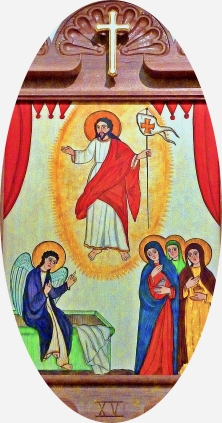 “Happy Easter,” said the Pastor as she welcomed us to worship. She was neither a week late nor four weeks early for Greek Orthodox Easter. While it’s no longer Easter Sunday and all the jelly beans, chocolate bunnies, and hard-boiled eggs have been eaten, it is Eastertide (“tide” just being an old-fashioned word for “season” or “time”). The Christian or liturgical calendar designates Eastertide as the fifty days from Easter/Resurrection Sunday to Pentecost (when we celebrate the outpouring of the Holy Spirit and the birth of the church).
 During Lent, I journeyed toward Jesus’ death and resurrection with a Lenten devotional. For each of the season’s forty days, there was a Scripture reading from John, a short devotional, an inspiring quote, interesting facts about Lent’s history, and a unique fast for the day. Each day’s reading also provided journaling space for the reader. For the fortieth day’s journal entry, readers were asked to write a brief letter of thanks to Jesus for all He endured to lead them into eternal life.
 Most of us probably spent Saturday preparing for Easter. We may have done last minute grocery shopping, prepped for Easter dinner, purchased an Easter lily, decorated eggs, assembled Easter baskets, snacked on jelly beans, or hidden plastic eggs around the yard. The previous day’s service on Good Friday had been a somber one but we knew the following day’s worship would be one of joy and celebration. While we may have sung “Were you There When They Crucified My Lord?” on Friday, we knew that we’d be singing “Christ the Lord is Risen Today” on Sunday.
 Today is Maundy (or Holy) Thursday—the day many Christians throughout the world will observe the institution of the Lord’s Supper/Eucharist/Holy Communion by coming to the Lord’s table. Regardless of what you call this sacrament, Jesus’ mention of a “new covenant” probably will be part of your service. Not a word commonly used today, what is a covenant and how does it differ from a contract?
 Devotions of the Heart