HE WEPT – PALM SUNDAY

The next day, the news that Jesus was on the way to Jerusalem swept through the city. A large crowd of Passover visitors took palm branches and went down the road to meet him. They shouted, “Praise God!  Blessings on the one who comes in the name of the Lord! Hail to the King of Israel!” [John 12:12-13 (NLT)]

All glory, laud, and honor to you, Redeemer, King,
to whom the lips of children made sweet hosannas ring.
You are the King of Israel and David’s royal Son,
now in the Lord’s name coming, the King and Blessed One.
[Theodulph of Orleans (820)]

palm - ncp7943awWe are people of physical signs and symbols and rituals help us connect with events. As a little girl, I loved Palm Sunday and not just because it meant my Lenten fasting would soon end and jelly beans would be in my Easter basket the following week. I loved the way our liturgical church observed it. The hymns of the day were filled with hosannas (a welcome relief from the more somber hymns of the Lenten season). Typically, the opening hymn was “All Glory, Laud, and Honor” and we children would follow the choir into the church while waving our palm branches. Even as a small child, I knew this day commemorated Jesus’ triumphal entry into Jerusalem.

Like the people of Jerusalem, I was filled with joy on this day. Having sung that “the wee little” Zacchaeus had to climb a tree to see the Lord, I pictured people lining the streets and jostling one another for the best view as they might for a parade. I wondered if little children sat on their parents’ shoulders so they could see Jesus. Between the palms I waved and the day’s joyful music, I felt like I was there in Jerusalem and watching the promised Messiah approach on his donkey.

Today, in preparation for Palm Sunday, rather that thinking about those joyful cries of “Hosanna!” and the royal welcome given to our Lord, I thought about Jesus and what He must have been thinking. As Jesus neared the city, Luke tells us that He wept. Jesus, however, wasn’t just a little teary-eyed. Luke used the word eklausen which meant to sob or wail loudly, as one who mourns the dead! As He rode triumphantly into Jerusalem, Jesus was in tears!

Having already told his disciples He would suffer and die, we know Jesus saw what lay at the end of the parade and it’s easy to think His tears were because of the horror awaiting Him. Those sobs, however, weren’t for Him—they were for His people and the city of Jerusalem.

Jesus knew that, in spite of their hosannas, He would be rejected. The people didn’t want their Messiah to be a Prince of Peace—they wanted him to be a conquering king. As He rode into town, Jesus pronounced judgment on the city that was blind to the true nature of God’s kingdom and prophesized its siege and destruction. Thirty-seven years later, the Romans laid siege to Jerusalem, the city was burned, the Temple destroyed, and over one million Jews were slaughtered. While palms waved and people cheered, the grief-stricken Jesus saw Jerusalem’s future and sobbed. It would be nearly 19 centuries before the Jews again had a homeland.

On that Sunday so long ago, the Prince of Peace arrived in the city whose name meant peace. The first part of Jerusalem’s name is yiroo, meaning “they will see” or “they will feel awe,” and core of the word is shalem, meaning completeness and wholeness. Shalem is the root of the Hebrew word for peace—shalom. Jerusalem’s name literally meant, “They will see wholeness” or “They will feel the awe of completeness.” That day they saw the wholeness of God but, sadly, they didn’t understand!

But as he came closer to Jerusalem and saw the city ahead, he began to weep. “How I wish today that you of all people would understand the way to peace. But now it is too late, and peace is hidden from your eyes. Before long your enemies will build ramparts against your walls and encircle you and close in on you from every side. They will crush you into the ground, and your children with you. Your enemies will not leave a single stone in place, because you did not recognize it when God visited you.” [Luke 19:41-44 (NLT)]

Copyright ©2021 jsjdevotions. All rights reserved.

BE ON THE LOOKOUT – ST. PATRICK’S DAY

That night Paul had a vision: A man from Macedonia in northern Greece was standing there, pleading with him, “Come over to Macedonia and help us!” So we decided to leave for Macedonia at once, having concluded that God was calling us to preach the Good News there. [Acts 16:9-10 (NLT)]

hope cloverI can’t say that I’ve ever had a dream or vision as clear cut as was Paul’s. If I ever did, I’m not sure I’d be as quick as he and his companions were to trust it. In Paul’s case, however, the dream helped him understand why the Holy Spirit previously prevented the men from preaching in the provinces of Asia and Bithynia (modern day Turkey). After hearing the Macedonian man’s plea, Paul finally had a clear sense of God’s direction. Paul, Silas, Timothy, and Luke headed west to Troas, set sail across the Aegean Sea, and made their way to Philippi in the Roman province of Macedonia (northern Greece). Paul’s obedience to that call took the gospel west toward Europe and changed Western civilization forever!

Nearly 300 years later, Irish history was changed when the man we know of as St. Patrick had a similar dream. Born Maewyn Succat around 387 in Roman Britain (Scotland), Patrick was kidnapped by Irish marauders at the age of sixteen. Taken to Ireland, the boy was sold into slavery and labored at herding and tending sheep. According to his memoirs, as Patrick prayed several times a day during his captivity, his faith grew and he felt the presence of the Holy Spirit. After six years of enslavement, he had a dream in which God told him, “Your ship is ready.” The young man escaped, walked 200 miles to the coast, and found some sailors who took him back to Britain. Once home, Patrick had another dream in which he was given a letter titled “The Voice of the Irish.” Upon opening it, he heard the voices of the people who’d once enslaved him calling, “We appeal to you, holy servant boy, to come and walk among us.” Initially reluctant to answer the call because of his lack of education, Patrick began religious training. He returned to Ireland about 15 years after his dream and the man known for explaining the Trinity with the three-leaved single stalk shamrock evangelized all over the land for the next thirty plus years. Patrick is said to have converted over 135,000 people, established 300 churches, and consecrated 350 bishops.

While we’re not likely to have such vivid dreams as Paul and Patrick, we should listen for the “Voice of the Irish” and be looking for a “man from Macedonia” in the people who cross our paths every day. They’ll probably look and sound much like everyone else and yet they’ll have a pressing need to know Jesus. May we respond as readily as did Paul and Patrick. We probably won’t change the world as did they, but we surely can change the world for someone.

God’s plan for enlarging his kingdom is so simple – one person telling another about the savior. Yet we’re busy and full of excuses. Just remember, someone’s eternal destiny is at stake. The joy you’ll have when you meet that person in heaven will far exceed any discomfort you felt in sharing the gospel. [Charles Stanley]

For “Everyone who calls on the name of the Lord will be saved.” But how can they call on him to save them unless they believe in him? And how can they believe in him if they have never heard about him? And how can they hear about him unless someone tells them? And how will anyone go and tell them without being sent? That is why the Scriptures say, “How beautiful are the feet of messengers who bring good news!” [Romans 10:13-14 (NLT)]

Copyright ©2021 jsjdevotions. All rights reserved.

WHAT WILL YOU DO FOR THE NEXT SIX WEEKS? (Ash Wednesday)

That is why the Lord says, “Turn to me now, while there is time. Give me your hearts. Come with fasting, weeping, and mourning. Don’t tear your clothing in your grief, but tear your hearts instead.” Return to the Lord your God, for he is merciful and compassionate, slow to get angry and filled with unfailing love. [Joel 2:12-13 (NLT)]

monarch butterflyAlthough its customs and rituals have changed over time, Lent has been observed in some way by believers for centuries. In the early years of the church, the days leading up to Easter were a time of fasting and prayer in preparation for Easter baptisms and as penance for those who’d been excluded from communion. Irenaus of Lyons (c.130-200) wrote of such a season that lasted only a few days (or forty hours) and commemorated what was believed to be the duration of Christ’s time in the tomb. By the mid-third century, Bishop Dionysius spoke of a six-day fast practiced by the devout in Alexandria and, according to the Byzantine historian Socrates, the Roman Christians kept a pre-Easter fast of three weeks.
It wasn’t until the Council at Nicaea in 325 that the observance of Lent formally began. Starting six Sundays (42 days) before Easter, it ended on Holy Thursday eve. Even though people fasted on Good Friday and Holy Saturday, those days were not considered part of Lent. Whether this Lenten observance was initially intended just for those preparing for baptism or for everyone is unclear but the whole church adopted the practice in some way or another.

Even in the early church, Sunday (as a sort of mini-Easter celebrating the victory of the resurrection) was considered a feast day. In the 6th century, finding it inappropriate to fast on a feast day, Pope Gregory the Great declared that there should be no fasting on the six Sundays of Lent. This, however, cut the Lenten observance back to 34 days and the people wanted to reenact the forty days Jesus spent in the wilderness. Eventually, to make up for the missing Sundays, four more days were added to the beginning of Lent (now starting on Ash Wednesday) and the two fasting days of Good Friday and Holy Saturday were added to the end of the season, making Lent forty days long. Although fasting from food was the emphasis in the beginning, new practices evolved over time and the concept of personal sacrifice eventually became Lent’s focus. In preparation for Easter and crossing denominational lines, Lent has now become a season of self-examination, penitence, self-denial, and spiritual growth.

Lent, like Christmas and Easter, is without scriptural basis. Man-made, not God-ordained, it is a matter of choice as to if and how we keep this season. If we choose to observe Lent, we shouldn’t think of Lent’s self-denial or fasting as a second chance to keep our failed New Year’s diet resolutions. Moreover, no Lenten practice should be thought of as a way to earn salvation or score brownie points with God. We are saved by God’s grace through faith, not works! Pastor Eric Ferris reminds us that, “You could observe 1,000 Lents and it won’t ever accomplish in your life what the cross of Jesus has.”

The purpose of Lent is self-reflection, self-denial, repentance, and seeking to live more for Christ and less for self. Rather than asking what we’re going to give up for Lent, the better questions would be ones like, “What can I do to draw nearer to God?” and “How can I grow more like Christ?” Asking the questions, of course, is not enough; the next step is doing those things! In preparation for Easter, what will you do for the next six weeks?

Search me, O God, and know my heart; test me and know my anxious thoughts. Point out anything in me that offends you, and lead me along the path of everlasting life. [Psalm 139:23-24 (NLT)]

Teach me to do your will, for you are my God. May your gracious Spirit lead me forward on a firm footing. [Psalm 143:10 (NLT)]

Copyright ©2021 jsjdevotions. All rights reserved.

DAILY MAINTENANCE – VALENTINE’S DAY

Relish life with the spouse you love each and every day of your precarious life. [Ecclesiastes 9:9 (MSG)]

in the hammock

When getting out a chip n’ dip bowl for some Super Bowl noshing, I noticed the heavy tarnish on the silver candle holders. Because COVID and social distancing have kept us from entertaining, they’ve been ignored in the back of the cupboard for nearly a year. Feeling guilty about letting them get so black, I started polishing off the tarnish. They were a wedding gift to my parents more than 80 years ago and my thoughts turned to marriage as I worked. It’s easy it is to allow our marriages to grow as dull as those candlesticks had. Marriages, like silver, shouldn’t be ignored or neglected.

A pastor friend once remarked that the relationship we have with our spouse is probably the one thing in our lives about which we truly care but which we regularly neglect. We care about our houses, so we paint, repair, renovate, remodel, vacuum, dust, mop, and mow the lawn to maintain them. When we value our health, we take vitamins, get vaccinated, eat healthy food, and exercise. If our children’s education is important to us, we volunteer at school, help with homework, drill them on their spelling, and shuffle them to assorted activities. When we care about our community, we vote, attend meetings, volunteer, or even run for office. If church is important, we tithe, regularly worship, attend Bible study, and serve on committees. Although we usually work at preserving or bettering anything we hold precious, we tend to take the relationship with our spouse for granted.

Marriage is the second most important relationship we have (God, of course, being first) and yet it’s often neglected. Unless we’re experiencing serious marital difficulties, most of us do little to consciously improve it. In fact, we probably spend more time perusing the catalogues and magazines that fill our mailboxes, watching our favorite television programs, or browsing the internet than we do on consciously bettering our marriages. Just because we’re secure in a relationship doesn’t mean we shouldn’t put a little shine on it.

It isn’t that we’re not spending time with one another! Because of this pandemic, couples probably spend more time together than they ever expected. Instead of kissing each other before leaving for work, they just clear off the kitchen counter or move to the dinner table and open their computers. The lines between jobs, home, school, family, entertainment, and leisure have become blurred. Yet, in spite of all the time we’re spending with our loved one (or perhaps because of it), we may have settled into a routine where we’ve stopped noticing one another. We don’t have to ask how their day went or what they did because we already know! Even though we’re together all day in the same house, our lives are more parallel than intersecting.

Sunday is Valentine’s Day—a day we traditionally celebrate romance and love. Even a marriage of more than 50 years needs some tweaking occasionally. Candlelight dinners aren’t just for newlyweds or guests and celebrating pandemic style doesn’t have to be fancy. Like shining silver, it just takes a little effort to shine up a relationship. It can be as simple as grocery store flowers, playing a game together, an unexpected kindness, changing out of the sweat pants, a love note, shaving or putting on make-up, skipping Netflix for a night, taking a walk together while holding hands, having a picnic in the park (or in front of the fireplace), or dancing to slow music (even if it’s in the kitchen and the kids are there). It’s noticing, listening, caring, encouraging, sharing and praying together and often takes less effort than polishing silver. Marriages may be made in heaven but their maintenance work is done here on earth!

Rather than put those now polished candlesticks back into the cupboard, I put them out on the table. They’ve gotten a few dents over the years, just as marriages do, but the dents remind me that marriage is beautiful even when it’s less than perfect. Any tarnish that appears on them will remind me that a good marriage takes effort. While God should be our first priority, our spouse needs to be our second one and not just on Valentine’s Day! Our significant others should be of significance every day; let us be sure to let them know it!

 Remember that children, marriages and flower gardens reflect the kind of care they get. [H. Jackson Brown, Jr.]

Summing up: Be agreeable, be sympathetic, be loving, be compassionate, be humble. That goes for all of you, no exceptions. No retaliation. No sharp-tongued sarcasm. Instead, bless—that’s your job, to bless. You’ll be a blessing and also get a blessing. [1 Peter 3:8-9 (MSG)]

Copyright ©2021 jsjdevotions. All rights reserved.

LOST AND FOUND

After three days they found Jesus sitting in the Temple with the teachers, listening to them and asking them questions. … When Jesus’ parents saw him, they were astonished. His mother said to him, “Son, why did you do this to us? Your father and I were very worried about you and have been looking for you.” Jesus said to them, “Why were you looking for me? Didn’t you know that I must be in my Father’s house?” [Luke 2:46-49 (NCV)]

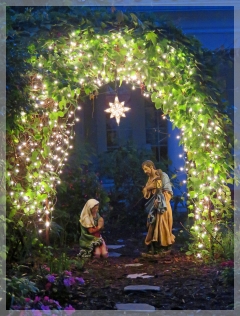
nativity

Last month, during my pre-dawn walks, I enjoyed seeing the bright holiday lights decorating many of our community’s homes. One morning, I passed by a beautifully lit arbor surrounding a nativity scene. Even though the twinkle lights and star didn’t fully illuminate the figures below them, I took a photo and hoped that a little Photoshop magic would result in a picture for a future devotion. When I finally got around to editing the photo, I discovered that Jesus was missing from the scene!

The missing baby reminded me of when my daughter’s family visited us several years ago. The young cousins were playing together at my son’s home. While the adults talked, the girls investigated the many toys in Mali’s toy chest. When Bree discovered parts from the Fisher Price Noah’s ark and nativity sets, she and Mali started rummaging through the box to find their various pieces. Bree started explaining the two stories to her younger cousin as they organized the figures. After digging to the bottom of the box, they realized one figure was missing. The girls jumped up and frantically dashed through the house toward Mali’s bedroom shouting, “We’ve lost baby Jesus!” Fortunately, after a thorough search, the missing baby was found among a few dust bunnies under Mali’s bed.

Mary and Joseph lost Jesus after they’d been in Jerusalem to celebrate the Passover. The city’s population had quadrupled as caravans of Jews from all over came to observe the holiday. Somehow, in the mayhem of people gathering to return to Nazareth, Mary and Joseph lost track of their boy and left Jerusalem without Him. Perhaps the people with the missing figure in their nativity had overlooked Jesus in a dark corner of their attic or lost him in the confusion of cartons and crates when they came to Florida. Like Mary, Joseph, and the little cousins, they didn’t notice they’d lost Jesus until they wanted Him! The same thing can happen to us in the challenges and chaos of our busy lives. Sometimes, we forget to bring Jesus with us and don’t even notice He’s missing until we need Him.

It’s important to remember that even though Mary and Joseph lost Jesus, they didn’t lose their relationship with Him. He remained their son but, by leaving Him behind, they lost His presence. The same thing can happen with us. When we lose Jesus, we don’t lose the salvation that comes with our relationship but we do lose His fellowship, our sense of His presence, and His peace and joy.

When the sheep can’t find the shepherd, it’s not the shepherd who is lost. The good shepherd is exactly where He belongs; it’s the sheep that have strayed. In actuality, Mary and Joseph were the ones who were lost, not Jesus. He was where He belonged—in His Father’s house studying God’s word. Our Lord promises He’ll never leave us but that pesky thing called free will allows us to leave Him and walk off on our own. When we feel empty or alone, when we wonder where Jesus is in our trouble, Jesus hasn’t forgotten about us. We are the ones who forgot and lost Him!

Yesterday, I walked by the house with the missing baby Jesus and was pleased to see that he’d been found and was in his rightful place. When Jesus is missing in our lives, like Joseph, Mary, Bree, Mali, and the people with the nativity scene, we must search until we find Him. Rather than looking in dark corners or under the bed, the first place to look might be where we’d expect to find Him—in His Father’s house and in His word.

If you look for me wholeheartedly, you will find me. I will be found by you,” says the Lord. [Jeremiah 29:13-14a (NLT)]

Search for the Lord and for his strength; continually seek him. [Psalm 105:4 (NLT)]

Copyright ©2021 jsjdevotions. All rights reserved.

LAMB OF GOD

He was oppressed and treated harshly, yet he never said a word. He was led like a lamb to the slaughter. And as a sheep is silent before the shearers, he did not open his mouth. [Isaiah 53:7 (NLT)]

The next day John saw Jesus coming toward him and said, “Look! The Lamb of God who takes away the sin of the world!” [John 1:29 (NLT)]

lamb of godAs I put away our various nativity sets until next December, I noticed they all include at least one lamb. Since shepherds came to see Jesus, it’s logical there would be a lamb or two in most depictions of Christmas. Nevertheless, as I packed up the figures, I thought about the shepherds and sheep visiting the child who was both the Good Shepherd and the Lamb of God. That Jesus took on both roles is a bit of a paradox. The shepherd may have watched over the sheep but, in the end, his lambs were destined to be slaughtered for food or ritual sacrifice.

Nowadays, the whole concept of animal sacrifice seems alien and primitive to us but lambs were sacrificed to God as far back as Abel. Israel’s history as a nation began that first Passover in Egypt when they smeared lamb’s blood on the doorframes of each house. The sacrifice of a lamb as atonement for sin appears frequently in the Hebrew Bible and, of the 151 Old Testament references to lambs in my NLT, 125 are about their sacrifice to God. By Jesus’ time, the priests in the temple sacrificed a lamb every morning and night, on every Sabbath, and at the feasts of the New Moon, Trumpets, Tabernacles, Pentecost, Passover, along with other occasions. The purpose of these animal sacrifices was sanctification (to purify the people from sin), righteousness (to obtain right standing with God), and forgiveness. Being a perfect lamb without blemish did not bode well for a lamb and being the sinless Lamb of God who would take away the sin of the world did not foreshadow a good ending for Jesus. Yet, “Lamb of God” is what John the Baptist called Him.

John’s words pointed to Jesus as being the perfect sacrifice for mankind’s sins but I don’t think he grasped the full implication of those words. Until the very end, even Jesus’ own disciples didn’t understand that being the Lamb of God meant that Jesus would willingly submit and go “like a lamb to the slaughter” to suffer and die on the cross. There was however, only one way the Lamb could take away the sin of the world. For the one perfect and final sacrifice to remove man’s guilt and open the way to God, the Lamb’s blood had to be shed and His life relinquished.

Earlier I mentioned that being both the Good Shepherd and Lamb of God seems a bit of a paradox—that the one who cares for the flock couldn’t also be the sacrificial lamb. Jesus, however, turns our expectations upside down. In His world, the week are strong, the first must be last, we reign by serving, the greatest is the least, and we find our lives by losing them. Jesus is both the Good Shepherd and the Lamb of God because, “The good shepherd sacrifices his life for the sheep. …I am the good shepherd; I know my own sheep, and they know me, just as my Father knows me and I know the Father. So I sacrifice my life for the sheep.” [John 10:11,14-15]

Next December, when we set out our nativity sets and place the shepherd and lamb around the crèche, let us remember that, as the Good Shepherd, Jesus tends, protects and guides us and, as the Lamb of God, He defeated Satan by dying on the cross and taking away the sins of the world. The Lamb, however, is more than a sacrificial victim. In Revelation, John describes the victorious and very much alive Lamb, enthroned with God, serving as judge of God’s opponents, and praised by all creation!

For you know that God paid a ransom to save you from the empty life you inherited from your ancestors. And it was not paid with mere gold or silver, which lose their value. It was the precious blood of Christ, the sinless, spotless Lamb of God. [1 Peter 1:18-19 (NLT)]

And they sang in a mighty chorus: “Worthy is the Lamb who was slaughtered—to receive power and riches and wisdom and strength and honor and glory and blessing.” And then I heard every creature in heaven and on earth and under the earth and in the sea. They sang: “Blessing and honor and glory and power belong to the one sitting on the throne and to the Lamb forever and ever.”  [Revelation 6:12-13 (NLT)]

Copyright ©2021 jsjdevotions. All rights reserved.