
 Lord, I trust in you. You are my God. My life is in your hands. [Psalm 31:14-15a (ERV)]
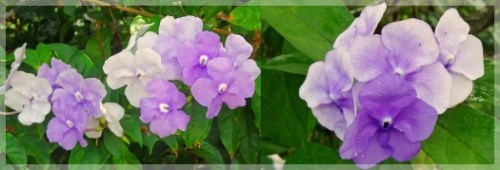
Going by the popular name of “Yesterday, Today and Tomorrow,” the Brunfelsia is one of my favorite Florida flowers. Three colors of pansy-like fragrant flowers can be seen on the one plant at the same time: the deep purple of the new flower, the pale lavender that appears shortly thereafter, and the pure white just before the flower falls off. Although we get to see what this flower looked like yesterday, looks like today and will look like tomorrow, we don’t get to see the past, present and future of our lives all at once. God, however can.
This lovely flower was brought to mind last week when I had my yearly exam at the dermatologist’s. In honor of Thanksgiving, one wall of the waiting room displayed brown, orange, red, and yellow construction paper leaves scattered under a banner that asked, “For what are you thankful?” While reminiscent of an elementary school classroom bulletin board, the answers written on those leaves by both patients and staff weren’t like those of the average grade-schooler who knows little of things like death, biopsies, addiction, loneliness, strokes, cancer, conflict, bankruptcy, job loss, homelessness, violence, or struggle. While a fourth-grader might have written her dog’s name on a leaf, only a mature adult would have said, “I’m thankful for the troubled times because, without them, I wouldn’t be the person I am today!”
Indeed, I can’t say I was thankful for my troubles when they occurred but, like that person, I am thankful for what God did with them in my life. The hurdles, pain, injury, loss, and trouble that seemed so random and senseless at the time make sense in retrospect. I can see how God brought those difficult yesterdays together to bring me to a better and more beautiful today and how today’s challenges will lead me into an even more amazing tomorrow. Having no crystal ball to see how it all will come together at some point in the future, however, we simply must trust God with our tomorrows and settle on only seeing the past, present, and future at one time in the lovely flowers of the Brunfelsia.
Another name for the Brunfelsia is “Kiss Me Quick Before I Fade,” but I tend to think of it as the Carpe Diem flower. The phrase comes from the Roman poet Horace and was part of his injunction to “carpe diem quam minimum credula postero” meaning “pluck the day, trusting as little as possible in the next one.” Horace, who died in 8 BC, was a pagan but, had he been born at a later date and become a follower of Jesus, the poet could have trusted in his tomorrows because he would have known they were in God’s hands.
As for me, while thanking God for the blessings of yesterday (even though I didn’t appreciate many of them at the time), I will pluck this day with enthusiasm and joy while trusting God with the next one. He planted us right here and at this time for a reason and He will faithfully cultivate, prune, water, and nurture us. Trusting that God knows what He’s doing, what He wants for us, where He’s taking us, and how He will get us there, let us release to Him all of our yesterdays, todays, and tomorrows.
God promises a safe landing but not a calm passage. [Bulgarian Proverb]
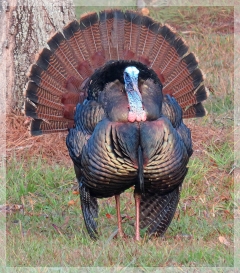 We’re hosting family and friends for Thanksgiving dinner and I’m still planning the menu. One guest won’t eat anything green, another doesn’t eat seafood, one dislikes turkey, and two are vegetarians. While I’m still working on appetizers, salad, main course and sides, dessert is a given. Between the sweets our guests are bringing and my pecan pumpkin pie topped with caramel sauce and whipped cream, even the pickiest eater will be happy! I probably could please everyone with just desserts!
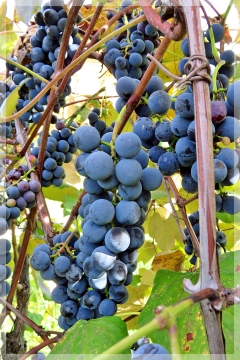 When explaining to some of John the Baptist’s followers why His disciples didn’t fast, along with the illustration of patching an old garment, Jesus compared His new way with winemaking. While many of us have sewn patches on clothing, few of us are experienced winemakers. Nevertheless, we know that today’s vintners ferment their wine in oak, stainless, concrete, or clay barrels rather than wineskins. Our only experience with wineskins may hearken back to college football games and ski trips when some fellows carried a wineskin filled with an alcoholic beverage hidden under their coats.
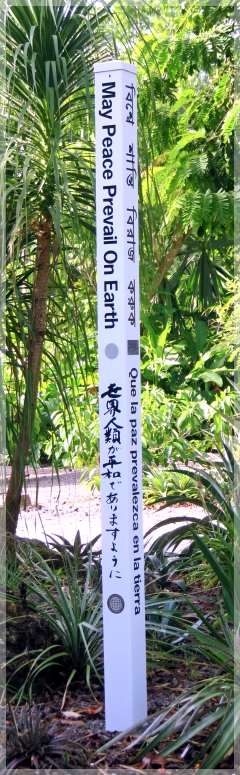 COVID kept us from the Botanic Gardens for well over a year. When we finally returned to one of our favorite places, we came upon a peace pole planted among the palms, bamboo and bromeliads. Although a similar pole is in the city park downtown, I don’t remember seeing one here when last we visited. These poles are just two of the more than 250,000 that have been erected in over 180 nations. Symbolizing the oneness of humanity, the words “May Peace Prevail on Earth” are written in eight different languages. The languages chosen for this pole were English, Arabic, Bengali, Chinese, Hawaiian, Hindi, Japanese, and Spanish—the languages of people who, like us, live at the 26th parallel north. Peace poles stand as a visual reminder to pray for peace on earth and to think, speak and act in the spirit of harmony and peace.
 While the Jews to whom Jesus was speaking were thinking of political freedom and enslavement to people, Jesus was speaking of spiritual freedom and the enslavement of people to sin. Yet, even then, the Jews were wrong. They’d forgotten about being Pharaoh’s slaves in Egypt; being captives of the Moabites, Canaanites, Philistines, Midianites, Mesopotamians, and Ammonites during the time of the Judges; their Babylonian exile; Persian rule; Alexander the Great; the Ptolemies and Seleucids; and Rome’s occupation of their homeland. They hadn’t had freedom from foreign domination for centuries. Jesus’ answer, however, made it clear that He was speaking of spiritual freedom. His listeners’ hope for spiritual freedom wouldn’t be found in their ancestry; it would be found in Him—He was the Son who could set them free.
 In 2018, a woman posted a video on Facebook that was shared over 400,000 times in the next six days. It was of a little boy who had a unique way of reciting his ABCs—each letter was followed by a Bible verse that began with it. Rather than “A is for apple,” the youngster started with “Ask and it will be given to you; seek and you will find,” [Matthew 7:7] and finished with “Zion hears and rejoices.” [Psalm 97:8] In spite of the boy’s dark brown hair and East Texas drawl, the woman mistakenly identified him as blond-haired Prince George, third in line to the British throne. Originally posted in October of 2016, the video actually was of four-year-old Tanner Hemness from Tyler, Texas.
