NATIONAL DAY OF PRAYER – 2021

I urge, then, first of all, that requests, prayers, intercession and thanksgiving be made for everyone – for kings and all those in authority, that we may live peaceful and quiet lives in all godliness and holiness. [I Timothy 2:1-2 (NLT)]

Without God, there is no virtue because there’s no prompting of the conscience. And without God, democracy will not and cannot long endure. If we ever forget that we are One Nation Under God, then we will be a nation gone under. [Ronald Reagan]

In 1775, the Continental Congress proclaimed that “a day of public humiliation, fasting, and prayer” be created and, since then, a president has called for over 140 national days of prayer. In 1795, for example, George Washington declared a day of public thanksgiving and prayer and, in 1863, Abraham Lincoln signed a resolution making April 30 a day of fasting and prayer. It was in 1952, during the Korean War, that Reverend Billy Graham challenged our nation’s leaders with these words: “What a thrilling, glorious thing it would be to see the leaders of our country today kneeling before Almighty God in prayer. What a thrill would sweep this country. What renewed hope and courage would grip the Americans at this hour of peril.”

In response to Graham’s challenge, a bill proclaiming an annual National Day of Prayer “on which the people of the United States may turn to God in prayer and meditation at churches, in groups, and as individuals” was unanimously passed by both houses of Congress. President Truman signed the bill requiring each subsequent president to proclaim a National Day of Prayer on the date of his choice. The original law was amended in 1988 when the first Thursday in May was designated as our nation’s National Day of Prayer.

The National Day of Prayer isn’t just a “Christian only” holiday and people of all faiths are encouraged to put aside their differences to pray for our nation. The day’s purpose is to unite people of all religions in prayer and to renew respect for God. Over 40,000 prayer gatherings at churches, parks, mosques, synagogues, temples, courthouses, and schools are held on this day every year. Of course, even though the law doesn’t establish or mandate a religion, its constitutionality has been challenged several times. The day has been found legal because it simply acknowledges the role of religion in the United States and can be ignored if one so wishes.

”Lord, pour out your love, life, and liberty,” is this year’s prayer theme and, other than being sure to pray, there are no guidelines for the day’s observance. This past year has been an extremely challenging one for our nation—the lives and health taken by COVID-19, chaos in our capitol, political polarization, isolation from friends and family, on-line learning, business closures, working from home, immigration issues, a troubled economy, church services suspended, unemployment, and escalating racial tensions to name just a few. We could spend the entire day in prayer and not cover them all. Regardless of your politics, I think we all can agree that divine intervention is desperately needed if our nation is to heal. The president’s call to prayer on this day, however, is merely a symbolic gesture unless we collectively fall to our knees in heartfelt prayer! Let us pray, not just today but every day, for our nation.

It is our prayer today and throughout 2021 that the Spirit of the Lord, pour out, pour through us across America, to fill our lives, families, churches, workplace, education, military, government, arts, entertainment and media, with Biblical, not cultural, not worldly, but Spirit-empowered, Spirit-filled LOVE, LIFE and LIBERTY as designed and defined by our Creator and Savior. [Kathy Branzell, President, National Day of Prayer Task Force]

What joy for the nation whose God is the Lord, whose people he has chosen as his inheritance. … We put our hope in the Lord. He is our help and our shield. In him our hearts rejoice, for we trust in his holy name. Let your unfailing love surround us, Lord, for our hope is in you alone. [Psalm 33:12,20-22 (NLT)]

Copyright ©2021 jsjdevotions. All rights reserved.

KEYSTONES – EARTH DAY (April 22)

God spoke: “Earth, generate life! Every sort and kind: cattle and reptiles and wild animals—all kinds.” And there it was: wild animals of every kind, cattle of all kinds, every sort of reptile and bug. God saw that it was good. [Genesis 1:24-25 (MSG)]

When the grands visit, we usually take them to a nearby preserve where we walk the boardwalk and hope to catch sight of one of the more than 150 gopher tortoises living there. We watch them lumber through the sand, munch on prickly pear cactus, or sun on the apron of their burrows.

The gopher tortoise is what’s called a “keystone species,” meaning it plays a unique and crucial role in holding together a habitat. A keystone species can be a plant, animal, fungi, or even bacteria. It isn’t necessarily the largest or most plentiful species in an ecosystem but, if it were to disappear, the ecosystem would be dramatically different or cease to exist altogether.

Gopher tortoises are considered keystones because they are ecosystem engineers capable of digging tunnels forty feet long and ten feet deep. Their burrows provide refuge for some 350 to 400 other species, including snakes, rodents, armadillos, rabbits, lizards, worms, spiders and bugs. Some animals use the burrows as homes and others hide there from predators. In the case of fire, animals can escape the blaze in the deep tunnels.

Although these prehistoric looking creatures have lived on the earth millions of years, their survival is now endangered by predators, herbicides, and habitat destruction (better known as “progress”). Their population has declined by 80% in the last century and the gopher tortoise’s extinction is a real possibility. Sadly, its disappearance would lead to the disappearance of those other species that share its habitat. The gopher tortoise carries more than a carapace on his back—he carries the future of his ecosystem!

Other keystone species include sea otters, mangroves, prairie dogs, wolves, salmon, saguaro cactus, and bees. Not all are ecosystem engineers like the gopher tortoise but each is essential to its specific habitat and fulfills a critical ecological role that no other species can accomplish. It’s amazing how intricate God’s creation is and how interdependent various species are. Every living thing seems to uniquely mesh with others, much like the pieces of a jigsaw puzzle. When a piece goes missing, however, the puzzle ceases to come together as it should.

Although mankind clearly has a huge impact on the environment, we’re not a keystone species. In fact, some scientists argue that, if we were to disappear, the environment would improve! With the cessation of so many human activities because of COVID lockdowns, greenhouse gas emissions reduced, water quality improved, noise pollution lessened, air quality improved, and nature began healing. The break, however, was short-lived and now that many restrictions have been lifted, pollution has returned to pre-pandemic levels in most areas.

After God created the world and everything in it, He found it all to be good. He then gave mankind the responsibility for His beautiful creation. I wonder if He is as pleased with the state of our world today as he was when He turned its care over to us. Let us remember that each one of God’s creatures (whether bee, gopher tortoise, or mangrove) is His handiwork and precious to Him. Today (and everyday), let us consider what we can do to keep His creation functioning as He meant it to do!

Father of all, Creator and ruler of the universe, You entrusted your world to us as a gift. Help us to care for it and all people, that we may live in right relationship—with You, with ourselves, with one another, and with creation. [From the United States Conference of Catholic Bishops]

God spoke: “Let us make human beings in our image, make them reflecting our nature So they can be responsible for the fish in the sea, the birds in the air, the cattle, And, yes, Earth itself, and every animal that moves on the face of Earth.” God created human beings; he created them godlike, Reflecting God’s nature. He created them male and female. God blessed them: “Prosper! Reproduce! Fill Earth! Take charge! Be responsible for fish in the sea and birds in the air, for every living thing that moves on the face of Earth.” [Genesis 1:26-28 (MSG)]

Copyright ©2021 jsjdevotions. All rights reserved.

WHAT CHANGED THEM? (Easter – Part 2)

But beware! For you will be handed over to the courts and will be flogged with whips in the synagogues. You will stand trial before governors and kings because you are my followers. … Then Jesus said to his disciples, “If any of you wants to be my follower, you must give up your own way, take up your cross, and follow me.” [Matthew 10:17-18,16:24 (NLT)]

rabbitThe Federal Trade Commission is charged with enforcing truth-in-advertising laws so that all advertisements are truthful, not misleading, and backed by scientific evidence. Although drug companies abide by the FTC’s regulations by listing their products’ side effects, between the fine print and the announcer’s fast talk, most consumers don’t understand them. Jesus didn’t resort to fast talk, deceit, or ambiguity when he told His disciples the cost of following him. He was brutally honest and told the disciples they would arrested, persecuted and hated because of Him.
While the disciples may not have comprehended completely, they couldn’t say they weren’t warned and Jesus told them the possibility of losing their lives was very real. Nevertheless, I imagine they thought He was speaking figuratively when He spoke of them carrying a cross. Even though He’d predicted His own death, I suspect his followers really didn’t understand what lay ahead until that fateful night when Jesus was arrested. Once He’d been tried, sentenced, and crucified, I’m sure the Lord’s cautionary words echoed in their minds and they finally understood the reality of that cross they’d be expected to carry! No wonder they cowered together in a locked room. The next step after arresting a revolutionary was to arrest his followers.

It was only John and a few women followers at the foot of the cross and it was a stranger, not a follower, who carried the cross for Christ. Jesus’ disciples, the men with whom he’d lived for three years, weren’t there to carry his heavy load or share his final hours. Rather than His friends, it was a secret follower of Jesus, Joseph of Arimathea, who placed Him in a borrowed tomb. Rather than a day of rest, the disciples’ Sabbath probably was a day of mourning, disappointment, confusion, and fear. Sunday morning, with the Sabbath over, some followers returned home while the rest continued to cower together in fear.

What turned a veritable group of despondent deserters into men who bravely spread the good news of Christ the Savior? These are the same men who fled from Jesus when He was arrested and Peter publicly denied knowing Him three times that night. What caused the two disheartened men from Emmaus to return to Jerusalem and the disciples in that locked room? What turned Jesus’ followers into people who courageously faced persecution and martyrdom? Of the disciples, all but John are thought to have been martyred. They had nothing to gain from a lie but everything to lose with the truth. What turned a bunch of deserters into evangelists? They saw the risen Christ! They spoke with Him, touched his scars, and broke bread with Him. They knew it to be the truth!

We haven’t walked with Jesus, but we’ve read the words of those who have. We haven’t been in the same room with Him, but we’ve heard His voice. We’ve not touched Him, but He has touched us. We haven’t seen his wounds, but He’s healed ours. We didn’t see His ascent into heaven, but we’ve experienced his Holy Spirit. No—we haven’t actually seen the risen Christ but, as Jesus people, “We live by believing and not by seeing.” [2 Corinthians 5:7]

You can kill us. But you cannot hurt us. [Justin Martyr (c. AD 150)]

During the forty days after he suffered and died, he appeared to the apostles from time to time, and he proved to them in many ways that he was actually alive. And he talked to them about the Kingdom of God. [Acts 1:3 (NLT)]

Then Jesus told him, “You believe because you have seen me. Blessed are those who believe without seeing me.” [John 20:29 (NLT)]

WHEN GOD MOVES A STONE (Easter – part 1)

On the way they were asking each other, “Who will roll away the stone for us from the entrance to the tomb?” But as they arrived, they looked up and saw that the stone, which was very large, had already been rolled aside. [Mark 16:3-4 (NLT)]

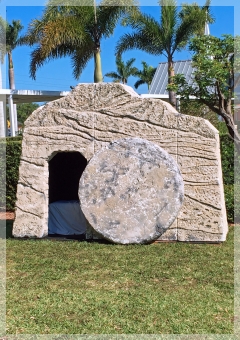
Easter tombAlthough Jesus repeatedly predicted that He’d rise from the dead, the women didn’t bring clean clothes for a living man that Sunday morning when they went to the tomb. Instead, they brought burial spices of their own with which to anoint His dead body. Because of the Sabbath, Jesus’ burial was rushed and His body laid in a borrowed tomb. Although Joseph and Nicodemus had anointed Him, perhaps the women were concerned that, in the men’s haste to finish before sunset, they hadn’t done a proper job of preparing the body. The spices they brought would conceal the stench of decay and, out of love for Jesus, they wanted to complete the burial rites properly.
Not knowing about the guards Pilate had posted at the tomb, the women wondered how they would manage entry into it. Many Judean tombs were caves. The opening was covered by a large disc-shaped stone set into a groove cut in the bedrock. Getting the stone in place was fairly easy as it was rolled down a slight incline to cover the tomb’s opening. Several men, however, would be needed to roll it up the incline. “Who will roll the stone away?” they asked. Even though the women didn’t know how it would be done, they trusted that it could be done and proceeded in faith.

For a moment, consider that heavy stone at the cave’s opening. It was impossible to remove from within the tomb but it wasn’t removed so Jesus could exit the tomb. The Messiah who raised the dead, walked on water, and healed the sick certainly didn’t need anyone to move the stone for Him. Regardless of size, no boulder could block the way of the one whose resurrection meant that death had been conquered. That stone wasn’t moved so He could get out; it was moved so that His followers could get in, find the tomb empty, and share the good news!

The women didn’t let their reservations about moving the stone stop them from going to the burial site and serving their Lord. What about us? When we are called to serve Him, do we worry about the stones that might block our way and allow them to stop us? Let the Easter story remind us that, just as that stone was removed for the women so they could tell the good news, God will remove the barriers blocking our way from sharing the resurrected Christ!

Then the angel spoke to the women. “Don’t be afraid!” he said. “I know you are looking for Jesus, who was crucified. He isn’t here! He is risen from the dead, just as he said would happen. Come, see where his body was lying. And now, go quickly and tell his disciples that he has risen from the dead, and he is going ahead of you to Galilee. You will see him there. Remember what I have told you.” [Matthew 28:5-7 (NLT)]

Copyright ©2021 jsjdevotions. All rights reserved.

SHE DIDN’T KNOW – GOOD FRIDAY

You will conceive and give birth to a son, and you will name him Jesus. He will be very great and will be called the Son of the Most High. The Lord God will give him the throne of his ancestor David. And he will reign over Israel forever; his Kingdom will never end! [Luke 1:31-33 (NLT)]

Then Simeon blessed them, and he said to Mary, the baby’s mother, “This child is destined to cause many in Israel to fall, but he will be a joy to many others. He has been sent as a sign from God, but many will oppose him. As a result, the deepest thoughts of many hearts will be revealed. And a sword will pierce your very soul.” [Luke 2:34-35 (NLT)]

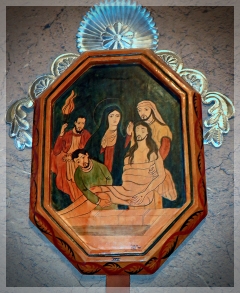
Golindrinas - 14 Station of the CrossSeveral years ago, my mother-in-law was despondent when my brother-in-law’s deteriorating health necessitated hospice care. Parkinson’s disease had taken a terrible toll on him and a mother’s heart breaks when she sees her child’s life disintegrating before him. Yet, that’s what happened to Mary.

My sister was distraught when her son was diagnosed with inoperable cancer; his promising future was cut short and she grieved as she saw him in pain. In the prime of his life, he wasn’t much older than was Jesus when He walked to Calvary. Any mother’s heart breaks when she sees her child suffer. Yet, that’s what happened to Mary.

At a funeral many years ago, I remember the mourning mother speak to me of her child’s death. “It’s not right!” she protested, “I’m the one who is supposed to go first. A mother isn’t supposed to bury her child.” No, a mother isn’t supposed to watch her child suffer and die nor should she witness him laid in his grave. Yet, that’s what happened to Mary.

Like any mother, Mary had high hopes for her special child. The angel’s words more than thirty years before led her to think He’d reign over Israel. That horrible Friday, as her beloved son hung on the cross, did she remember Simeon’s prophetic words and feel that sword pierce her soul?

Did Mary know that Isaiah’s prophecies were about her boy Jesus—that it was her son who would be beaten and whipped, unjustly condemned, “led like a lamb to the slaughter,” and have his life “cut short in midstream?” [Isaiah 53:5-8] Could she possibly have understood how this miraculously conceived son—the infant she nursed at her breast whose birth was heralded by angels, the babe given costly gifts and worshipped by magi from the East, the child Simeon said would be the glory of Israel, the boy smart enough to converse with rabbis, the young man who turned water into wine—would end up dying a criminal’s death?

Standing at the foot of the cross, her hopes for her boy were dashed as He was spat upon and mocked. As He struggled to take His last few breaths, Mary heard his anguished cries and she watched her baby boy die a tortuous death. Her mama’s heart broke as He was placed in a borrowed tomb. Mary didn’t know what Sunday would bring.

When the grief-stricken women went to the tomb that Sunday morning, they didn’t bring clean clothes for a resurrected man; they brought spices for the anointing of a dead body. They weren’t expecting an empty tomb. Like Mary, the mother of Jesus, they didn’t know.

He had done no wrong and had never deceived anyone. But he was buried like a criminal; he was put in a rich man’s grave. [Isaiah 53:9 (NLT)]

Copyright ©2021 jsjdevotions. All rights reserved.

WASHING THE FEET – MAUNDY THURSDAY

If any of you wants to be great, he must be your servant. If any of you wants to be first, he must be the slave of all. That’s how it is with the son of man: he didn’t come to have servants obey him, but to be a servant – and to give his life as “a ransom for many.” [Matthew 20:26b-28 (NTE)]

tri-colored heronWhile the accounts of the anointing of Jesus’ feet in Luke 7:36-50 and John 12:1-8 are similar, they are different events and different people were involved. Luke tells of an unnamed woman and John tells of Mary of Bethany. Although both women wiped Jesus’ feet with their hair, the unnamed woman, a notorious sinner, was an uninvited and unwelcome guest in the Pharisee’s home. Mary was a well-respected and devout friend of Jesus and welcome in her sister’s house. Pharisees were present at one and Christ’s disciples at the other. Where the Pharisees saw a sinful woman’s bad character, Jesus only saw a repentant sinner. Where the disciples saw an extravagant waste of money, Jesus saw a woman who offered a gift of love. He defended one woman’s actions by pointing out that she’d done what His host had failed to do. He defended the other woman’s extravagance by reminding his disciples that she was preparing Him for burial.

They were different times and different places but both women humbled themselves at Jesus’ feet. Both women took on a job that belonged to servants and, while most people chased after Jesus because they wanted something from him, neither woman asked anything of Him. Instead, they offered all they had. One woman’s old life died as she washed His feet and the other woman’s brother, who died, now lived. Their generous acts declared the women’s faith in Jesus as the Messiah. We may come to Jesus as a repentant sinner or we may come to him with praise and thanksgiving but, like both of these women, we must always come with a humble heart that is ready to serve.

The most radical act of humility and service, however, occurred shortly after the disciples argued over who among them was the greatest. That night, in the room where they’d gathered for their Passover meal, Jesus (the greatest of them all) knelt at the feet of His disciples. Knowing full well that soon one of them would betray Him, another would deny him, and all would desert him, Jesus humbly washed their feet. That was God incarnate kneeling in front of them and washing their feet but we don’t read of any of the disciples offering to wash His!

Today is Maundy Thursday and several Christian denominations will have communion services in remembrance of that last supper. As a visual reminder that loving Christ means service and there is dignity in serving others, some churches also will observe a religious rite called Washing of the Feet. As members of the Body of Christ, we are to follow His example by serving one another in humility and love. Like the unnamed woman, Mary of Bethany, and Jesus, we must have the heart of a servant.

One of the principal rules of religion is, to lose no occasion of serving God. And, since he is invisible to our eyes, we are to serve him in our neighbour; which he receives as if done to himself in person, standing visibly before us. [John Wesley]

“Do you know what I’ve done to you?” he asked. “You call me ‘teacher,’ and ‘master,’ and you’re right. That’s what I am. Well, then: if I, as your master and teacher, washed your feet just now, you should wash each other’s feet. I’ve given you a pattern, so that you can do things in the same way that I did to you.” [John 13:12-15 (NTE)]

Copyright ©2021 jsjdevotions. All rights reserved.