
Together they will go to war against the Lamb, but the Lamb will defeat them because he is Lord of all lords and King of all kings. And his called and chosen and faithful ones will be with him. [Revelation 17:14 (NLT)]
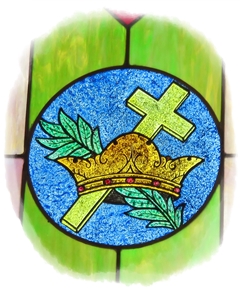 Seeing the rise of secularization, communism, fascism, and atheism following World War I, Pope Pius XI instituted the Feast of Christ the King in 1925. He wanted to remind Christians who their only King was and that it was Christ (and Christ alone) who should reign in our hearts! Originally celebrated the last Sunday in October, the feast day was moved to the last Sunday of the liturgical year in 1969. In spite of being created by the Roman Catholic Church, many Protestants including Episcopalians, Methodists, Lutherans, and Presbyterians celebrate the day.
This year, Christ the King Sunday was yesterday. Celebrating Christ’s second coming, His messianic kingship, and His sovereign rule over all creation, it marked the end of the church year. Next Sunday, the first Sunday in Advent, begins the new liturgical year. Advent means “the arrival or coming of something” and, for Christians, Advent is a time of preparing to celebrate Christ’s first arrival (his incarnation) and also a time of anticipating His second coming “when the glory of our great God and Savior, Jesus Christ, will be revealed.” [Titus 2:13].
While our children or grands might have candy filled Advent calendars to help them count down to Christmas, many adults observe this season of anticipation with a spiritual discipline, such as memorizing Scripture or Bible reading. Although no Christmas Eve service would seem complete without hearing the account of Christ’s birth in Luke 2, there are twenty-three other chapters in Luke’s gospel! If you started December 1 by reading one chapter in Luke and read another chapter every day until the 24th, you’d wake up Christmas morning having read the entire gospel. As we busy ourselves in preparation for the holidays, reading Christ’s story and words might keep our minds on the reason for Jesus’s birth in Bethlehem some 2,000 years ago.
The last week before Christmas, when life gets busier and it’s harder to keep centered on Jesus, Luke’s narration can keep us grounded in Christ as we see God’s plan fulfilled. On the 18th, Jesus will predict His death for the third time. In the next day’s reading, before taking His triumphant entry into Jerusalem, Jesus will tell His followers what is expected of them between His departure and second coming. We’ll read of His conflict with the religious leaders on the 20th. On the 21st, Jesus warns the disciples about the future: the persecution, the tribulation, and second coming. It will be Judas’ betrayal, the last supper, and Peter’s denial on the 22nd and Jesus’s trial, crucifixion, death and burial on the 23rd. Finally, on the 24th, we’ll read of His resurrection and ascension. Hopefully, as Luke’ words take us from annunciation to ascension, Christmas morning will be a more meaningful to us all.
May we always remember that Jesus is the only reason for the season!
The immense step from the Babe at Bethlehem to the living, reigning triumphant Lord Jesus, returning to earth for his own people–that is the glorious truth proclaimed throughout Scripture. As the bells ring out the joys of Christmas, may we also be alert for the final trumpet that will announce his return, when we shall always be with him. [Alan Redpath]
 Two weeks ago, in recognition of Reformation Day (commemorating Martin Luther’s posting of his Ninety-Five Theses in 1517), the minister at our liturgical church spoke about needed reforms in today’s church. By definition, reformation is changing or improving something by correcting its faults, removing inconsistencies and abuses, and imposing modern methods and values. While I firmly believe in correcting errors, removing contradictions and misuses, and even using modern methods, I would suggest caution about adopting modern values.
 Your word is a lamp to guide my feet and a light for my path. … Give discernment to me, your servant; then I will understand your laws. [Psalm 119:105,125 (NLT)]
 Twenty-one of the twenty-seven books of the New Testament are letters (epistles) written by Paul, James, Peter, John, and Jude. While the gospels tell us about the life, death, and resurrection of Jesus, the epistles are letters of instruction, clarification, encouragement and, sometimes, caution to the new Christian community. I can’t help but wonder if those early letter writers realized the scope of their writing. Did they have any idea how fast and wide Christianity would spread? Did they envision how many people would come to know both their names and words? While they expected their messages to be read aloud to the members of the 1st century church, did they even dare hope that 2,000 years later their letters still would be read aloud regularly in many churches, that some of their words would even be used in Christian liturgy, or that people around the world would gather together to study their messages?
 It’s a common misconception that Saul became known as Paul when Jesus transformed the Christian hater into a Christ follower on the road to Damascus. Saul, however, was always named Paul. As a Roman citizen, he would have had a three part Roman name. While we don’t know the first two parts, the third (the cognomen) and commonly used name was Paullus (which becomes Paul in English). As devout Jews, however, his parents also would have given him a Hebrew name. They named him Saul, a good name for a boy from the tribe of Benjamin (King Saul’s tribe). Understandably, when among Jews, Saul would have used his Hebrew name and Luke, the writer of Acts, refers to him as Saul until Acts 13, about fifteen years after his conversion. Saul (and Luke) started using his Roman/Gentile name of Paul around the time he moved further into the Roman Empire on his first missionary journey. As he moved into Gentile territory, Paul’s Roman name was more appropriate. The Apostle was not alone in having both a Roman and Hebrew name. One of the candidates to replace Judas had two Jewish names, Joseph and Barsabbas, along with the Roman one of Justus.
 The early church encountered difficulty in trying to reconcile the humanity and divinity of Jesus. In the 5th century, one group, from Alexandria, referred to the Virgin Mary as Theotokos, the one who gave birth to God, while the group from Antioch insisted that she was merely Anthropotokos, the one who gave birth to the human nature. Trying to bring about a compromise but pleasing no one, the bishop Nestorius suggested that the term Christotokos, the one who gave birth to Christ. The controversy, however, wasn’t about Mary; it was about the nature of Jesus. Did Mary give birth to a man who also was God or did Mary give birth to a man who later became God? The debate continued until 451 when the Chalcedonian Creed was adopted which confirmed the two natures of Christ (human and divine) in one person.
