
Then Jesus was led by the Spirit into the wilderness to be tempted there by the devil. For forty days and forty nights he fasted and became very hungry. [Matthew 4:1-2 (NLT)]
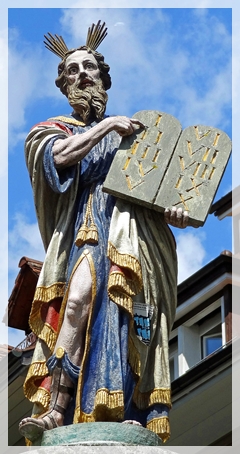 In Scripture, the number forty often appeared in the context of preparation, judgment, or testing. The rain poured down upon Noah for forty days and nights. After spending forty years in Egypt and another forty as a shepherd, Moses twice spent forty days with the Lord on Mt. Sinai. The Israelite scouts spent forty days exploring the land of Canaan and, because the people lost heart and rebelled at their report, they spent an extra forty years wandering the wilderness (one year for each day the men explored). Jonah warned Nineveh their destruction would take place in forty days, Ezekiel lay on his right side for forty days because of Judah’s sins and, before being slain by David, Goliath taunted Saul’s army for forty days.
The number forty has significance in the life of Jesus, as well. After His baptism by John, the Spirit led Jesus into the wilderness for forty days of testing and, after His resurrection, Jesus remained on earth for forty days. Just because the number forty frequently appears in the context of trials, however, does not mean that forty is merely symbolic. Remembering that God is the One who chose the time, forty days probably means forty days.
Although people like David, John the Baptist, and Moses spent a time of testing in the wilderness, we wonder why Jesus, the son of God, would have to undergo a period of testing before beginning His ministry. Moreover, we wonder how Jesus, being God in flesh, could be tempted. Although both wholly God and wholly man, it was Jesus the man who grew, walked, talked, and was crucified for our sins, and it was Jesus the man who demonstrated His humanity by undergoing temptation. Obedience really isn’t obedience if disobedience is impossible and it’s impossible for our good God to sin. As God, Jesus couldn’t be tempted to sin but, as a man, He could. The sinless Lamb of God had to remain sinless, not as God, but as man and out of obedience to God the Father.
It’s how Jesus resisted temptation that is most telling. As God, he easily could have rebuked Satan and sent him scampering with a wave of His hand. As a man, however, Jesus relied on Scripture to defeat the evil one. God has provided us with His word as a way to withstand temptation. Of course, we have to know His word before we can use it against the enemy! I suppose we could spend the next forty days doing just that!
 You may have celebrated the Feast of the Presentation of Christ in the Temple (or Purification of Mary) at church yesterday. Also known as Candlemas, this day commemorates an incident found in Luke 2 when, forty days after the birth of Jesus, three important events occurred: the ceremonial purification of Mary, Joseph and Mary’s dedication of their firstborn son to God, and Jesus’ first entrance into the Temple. It was then that Simeon and Anna recognized Jesus as the Messiah for whom they’d patiently waited. The association of candles with this event in Jesus’ life is understandable; upon seeing Jesus, Simeon declared him to be the light that would reveal God to the nations. Traditionally, a candle-lit procession preceded the Mass and all of the candles that would be used in the church that year were blessed. Candlemas night, people would place lit candles in their windows.
 After his wife complained about the roaches that had invaded their garden and begged him to destroy their underground nest, a Brazilian man poured gasoline into the hole he believed to be the source of the infestation and then tossed in lit matches! Within seconds, a massive explosion destroyed his yard while his home security camera captured the entire thing. “I had no idea that this could happen!” he said. Although the man did destroy the roaches, he destroyed his yard in the process! I’m not sure where he got his bright idea but I would guess that his Smartphone was involved. A quick search with mine told me that pouring gasoline on a roach colony is an effective way to eliminate the pests. Assuming a certain amount of common sense among its readers, however, the site had no warning about the explosive nature of gasoline vapors!
 Every Tuesday, we begin our afternoon Bible study with prayer and by saying the Pledge of Allegiance to the Bible. The words we use are attributed to Homer Grice, a Southern Baptist minister, who wrote them for Baptist Vacation Bible Schools in 1925. He combined two verses from Psalm 119 into this simple vow and versions of it continue to be used by Vacation Bible and Sunday Schools, Christian homeschoolers, and even adult Bible studies. Because it reminded me of elementary school and standing by my desk with my hand across my heart, starting class with this pledge seemed rather childish at first. Once I carefully considered the words, however, I realized that saying this pledge always reminds me that the Bible is at the center of a Christian’s devotion to Jesus Christ. It was in Him that the Word became flesh and, through Scripture, God continues to speak to us today.
 Broken people were drawn to Jesus but Mary Magdalene was not as broken as many people think. Magdalene was not her last name; it simply means “from Magdala” and the Gospels’ writers added it to distinguish her from the many others Marys: Jesus’ mother, Martha’s sister, the wife of Clopas, and the mother of James and Joseph.
 In the comic strip Peanuts, drawn by Charles Schultz, Linus and Lucy van Pelt are brother and sister who, like many siblings, often fight. For several days last week, Lucy tried to convince Linus to give her a Christmas gift. When she insisted the giving of Christmas presents is in the Bible, he called her bluff saying, “You can’t fool an old theologian.” Two days later, while Lucy searched in the Bible, she exclaimed, “I found it!…The word ‘sister’ in the Bible!…That proves you have to give me a Christmas present!” Her little brother merely sighed, “Oh, good grief.” While not as blatant as Lucy, we often find people taking Scripture out of context to justify their own meaning.
