THE APOSTLE PAUL (Part 2)

Let God’s curse fall on anyone, including us or even an angel from heaven, who preaches a different kind of Good News than the one we preached to you. I say again what we have said before: If anyone preaches any other Good News than the one you welcomed, let that person be cursed. [Galatians 1:8-9 (NLT)]

chickoryIn his letter to the Galatians, Paul refutes the message of those who preached that adherence to Jewish laws was required of all believers. His are harsh judgmental words from a man who never even walked with Jesus on earth. Why was Paul’s Gospel the definitive one rather than the one the Galatians heard preached by the Judaizers? For the first two chapters of his letter, Paul explains the source of his apostolic authority.

Paul clearly states the divine origin of his message in verse 12: “I received my message from no human source, and no one taught me. Instead, I received it by direct revelation from Jesus Christ.” Saying that he came to the Gospel neither by his own understanding nor by another person’s teaching, Paul claimed his message came from a divine source—the Lord Himself! Indeed, nothing but divine intervention can explain Paul’s incredible conversion from a fanatical persecutor of Christians into an equally fanatical evangelist for Christ’s church! No one with Paul’s background and personality could have been convinced and converted by anyone other than the Lord! He is the poster boy for the Holy Spirit’s transforming power!

To emphasize that he didn’t get the gospel from any man, Paul explained that he spent three years in Arabia after his conversion before returning to Damascus and finally going to Jerusalem to meet Peter. Strict chronology seemed unimportant to Scripture’s writers and, without any punctuation or breaks between words, sentences, paragraphs, or chapters in the original writing, it often is unclear. As best as scholars can figure, Paul’s time in Arabia probably began in Acts 9 between verses 19 and 20. Since any part of a year was considered a year, Paul spent anywhere from as little as 14 months to as much as 36 months in Arabia.

In Paul’s day, Arabia referred to Nabatea, a large and prosperous kingdom east of Galilee extending as far north as Damascus and beyond Petra to the south. When considering those three years, I used to picture a confused Saul retreating into the Nabatean desert to study Scripture and try to reconcile the Christian-hating, Gentile-detesting Pharisee he’d been with the Christ-loving, Gentile-welcoming evangelist he became! I was wrong!

Although it resulted in temporary blindness, Saul’s conversion didn’t result in confusion; meeting Jesus brought clarity to the man. From the moment of his conception, God had been preparing Saul to meet Jesus on that road to Damascus! When that happened, everything he’d learned in the Hebrew Scriptures finally made complete sense! The Apostle has been described as a man who wouldn’t learn to swim by reading about it. He’d jump in the deep end and start paddling and that’s exactly what Saul did following his conversion. Acts tells us he “immediately began preaching about Jesus in the synagogues.” [9:20]

To further emphasize that his message did not come from men, Paul told the Galatians that, when he finally went to Jerusalem (after his time in Arabia), he stayed only two weeks and met just Peter and James. It was some fourteen years after his conversion that Paul went to Jerusalem and finally met with the leaders of the church. At that time, he shared with them the message he was preaching to the Gentiles “to make sure that we were in agreement…and the leaders of the church had nothing to add to what I was preaching.” [Galatians 2:2,6] Independent of the other Apostles, Paul preached the very same gospel they did because, like them, he learned it from Jesus! Paul’s apostolic authority came from God Himself!

“Who are you, lord?” I asked. “And the Lord replied, ‘I am Jesus, the one you are persecuting. Now get to your feet! For I have appeared to you to appoint you as my servant and witness. Tell people that you have seen me, and tell them what I will show you in the future.’” [Acts 26:15-16 (NLT)]

Copyright ©2023 jsjdevotions. All rights reserved.

THE APOSTLE PAUL (Part 1)

I used to believe that I ought to do everything I could to oppose the very name of Jesus the Nazarene. Indeed, I did just that in Jerusalem. Authorized by the leading priests, I caused many believers there to be sent to prison. And I cast my vote against them when they were condemned to death. Many times I had them punished in the synagogues to get them to curse Jesus. I was so violently opposed to them that I even chased them down in foreign cities. [Acts 26:9-11 (NLT)]

red-shouldered hawkOf the twenty-seven books of the New Testament, thirteen are attributed to the Apostle Paul. We know he wrote another letter to the Corinthians and the prolific letter writer probably wrote letters to believers in places like Damascus, Caesarea, and Jerusalem, but these thirteen are all that remain. Considering Nero’s persecution of Christians, the violence during the Jewish revolt, and Domitian’s persecution of Jews and Christians, all of which happened before the end of the 1st century, it’s a wonder that any of Paul’s letters survived! God, however, saw to it that these thirteen ”God-breathed” epistles were preserved and became part of the Christian canon.
What do we know about this man who founded more than a dozen churches—the man scholars consider second only to Jesus in his contribution to Christianity? When we first meet him, he is known by his Jewish name of Saul. As a free-born Roman citizen, he had a commonly used Roman name which was Paullus (Paul). But, as the son of devout Jewish parents, he also had a Hebrew name—Saul—a fitting name for a boy from King Saul’s tribe. It was not until about 15 years after Saul’s conversion, when he moved further into Gentile territory on his first missionary journey, that Saul (and Luke) began using his Roman name of Paul.

Although he was born to Jewish parents in Tarsus, the capital city of Cilicia (modern day Turkey), Paul claimed Jerusalem was his boyhood home and it is believed that his family moved to Jerusalem around 10 AD. As the son of a Pharisee, he would have strictly observed the law and oral traditions and, by the age of five, started studying Scripture and Jewish history. As the son of a tent-maker (or fabric/leather worker), he also would have learned his father’s trade.

Sometime between the ages of 10 and 15, Saul began his studies with the highly esteemed Rabbi Gamaliel, a leader in the Jewish Sanhedrin. As Gamaliel’s student, he would have memorized the Torah and rabbinical traditions. The Apostle’s ability to read, write, and clearly articulate his thoughts in Koine Greek (and quote from the Greek poets), tells us he was extremely well-educated.

As a Pharisee, Judaism consumed Saul’s entire life and he would have been passionate about preserving the faith and traditions he loved. As a result, Saul vehemently opposed the church. While we have no evidence of him killing Christians, he clearly approved of their executions! Wanting to eradicate followers of the Way, Saul zealously went into believers’ homes and dragged both men and women out so they could be imprisoned. He was so enthusiastic about preventing the church from spreading beyond Jerusalem that he requested permission to go Damascus to arrest any Christ followers who may have fled there to avoid persecution. It was on the road to Damascus that Saul literally “saw the light” when he saw the risen Jesus Christ before him. It was then that Saul became a new person in Christ Jesus and the persecutor became an evangelist!

As for Paul’s appearance—an early Christian document describes him as a partly bald, bow-legged, short man with large eyes, long nose, and a unibrow. In 2 Corinthians, Paul refers to having a “thorn” in his flesh but we don’t know the nature of his affliction. Some scholars speculate it may have been an eye problem while others that it possibly was epilepsy. Whatever it was, the condition never deterred the Apostle from his purpose!

With his exceptional education, extensive Biblical knowledge, and intense personality, Saul/Paul was uniquely qualified to become an evangelist for Jesus. Nevertheless, even the best credentials don’t automatically give someone authority. Unlike the twelve apostles, he hadn’t traveled with Jesus from His baptism until His death. He wasn’t there in the upper room or when Christ ascended into heaven. Nevertheless, by the end of the 1st century, Paul’s letters were regarded as authoritative for the church. Why? What gave this man who once mercilessly persecuted Christ’s followers the apostolic authority to preach the gospel, clarify doctrine, or correct the false teachings of others? That question is answered in Part 2.

My old self has been crucified with Christ. It is no longer I who live, but Christ lives in me. So I live in this earthly body by trusting in the Son of God, who loved me and gave himself for me. [Galatians 2:20 (NLT)]

Copyright ©2023 jsjdevotions. All rights reserved.

THE LAW AND THE PROPHETS

Don’t misunderstand why I have come. I did not come to abolish the law of Moses or the writings of the prophets. No, I came to accomplish their purpose. I tell you the truth, until heaven and earth disappear, not even the smallest detail of God’s law will disappear until its purpose is achieved. [Matthew 5:17-18 (NLT)]

You search the Scriptures because you think they give you eternal life. But the Scriptures point to me! [John 5:39 (NLT)]

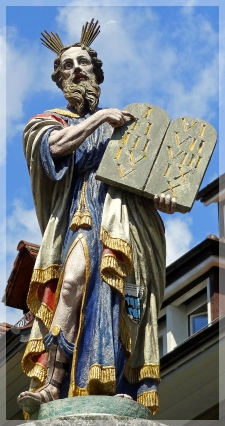
Moses Fountain - Bern - SwitzerlandOur Colorado church had a large worship center with excellent acoustics so, when the local Jewish congregation wanted to present a concert of Jewish music by a well-known Jewish performer, we were happy to offer our venue to them. The Christians in attendance never expected the evening to end with Jews and Christians joining hands and dancing the hora around the church while singing “Hava Nagilah” (Let Us Rejoice). What the Jews hadn’t expected were the Bibles on the back of every chair. Before the concert began, many intently looked through them and, after the concert, they expressed their surprise at finding their Hebrew Scriptures in our Christian Bibles!
While we call it the Old Testament, it isn’t called that by a Jew. When “testament” appears in the New Testament, it is a rendering of the Greek word diatheke, meaning covenant. While Christians recognize the old covenant God made with the Israelites, we also believe He made a new covenant (or testament) with the followers of Jesus. For a Jew, however, there’s nothing “old” about that covenant because there hasn’t been a new one. As a result, they much prefer the term Hebrew Bible or Hebrew Scriptures. The other term used for the Hebrew Bible is Tanakh—an acronym for its three categories: Torah (Law), Nevi’im (Prophets), and Ketuvim (Writings).

Even though the Hebrew Bible has 24 books divided into those three categories and our Old Testament has 39 books and four categories (Law, History, Wisdom and Poetry, and Prophecy), they both tell the same story, but in a different order. The number of books differs because the Hebrew Bible combines the first and second books of Samuel, Kings, and Chronicles, the books of Ezra and Nehemiah, and the 12 books of the minor prophets. Instead of ending with the Prophets as does our Old Testament, the Hebrew Bible ends with the Writings and the book of Chronicles.

The 1st century Jewish historian Flavius Josephus (37/38 – 100 AD) reported that there was an authoritative list of the twenty-two books Jews called “holy scriptures” that was determined by the time of Artaxerxes (464-424 BC). The book number differs because Ruth was attached to Judges and Lamentations to Jeremiah at that time. We know that the Scripture our Lord read, studied, and memorized as a boy in Galilee is the same Scripture we have today.

Jesus made frequent references to the Scriptures throughout His ministry and his enemies soon learned that they couldn’t argue the Word of God with the One who breathed that word! He defeated Satan’s temptations with words from Deuteronomy and, during his frequent confrontations with the Jewish rulers, Pharisees, and Sadducees, He made specific references to verses in Genesis, Leviticus, Deuteronomy, Exodus, Samuel, Isaiah, Hosea, and Psalms. He quoted from Malachi when speaking of John the Baptist and frequently quoted from Scripture to show how He would fulfill prophecies. He explained the writings of Moses and the prophets to Cleopas on the road to Emmaus. According to Liberty University’s Harold Willmington, of the 1,800 verses reporting Jesus’ words in the gospels, 180 verses are Old Testament quotes or allusions.

While I can understand a Jew’s unfamiliarity with a Christian Bible and surprise at finding the Hebrew Scriptures in it, I can’t understand why those of us who claim to follow Jesus are so unfamiliar with the words our Lord read, studied, quoted, and believed while He walked the earth! If it was important to Him, shouldn’t it be important to us?

Then he said, “When I was with you before, I told you that everything written about me in the law of Moses and the prophets and in the Psalms must be fulfilled.” Then he opened their minds to understand the Scriptures. [Luke 24:44-45 (NLT)]

Copyright ©2023 jsjdevotions. All rights reserved.

HIS SANCTUARY

Don’t you realize that your body is the temple of the Holy Spirit, who lives in you and was given to you by God? You do not belong to yourself, for God bought you with a high price. So you must honor God with your body. [1 Corinthians 6:19-20 (NLT)]

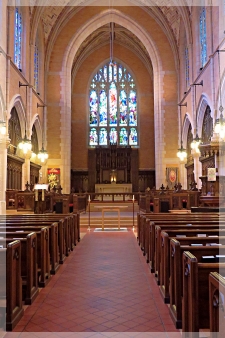
St. Paul's Cathedral - MNSince we both attended liturgical churches as girls, my friend and I were trying to recall the terms for the various parts of a traditional church building. We knew the foyer is called the narthex and the congregation sits the church’s nave. We also knew the altar rail usually separated the nave from the chancel in the front. It’s from the chancel that the service is conducted and where the altar, pulpit, and lectern are located. We even recalled that the sacristy was the room holding Communion supplies and linens. Since we were worshipping in a park that morning, my friend asked the location of our sanctuary. In historic usage, sanctuary and chancel were synonymous but, in modern usage, a sanctuary consists of the entire worship space of a church. With no building, we had no narthex, nave, or chancel but we did have a worship space; our sanctuary was a gazebo in a county park.

As God would have it, my next morning’s reading took me to today’s verse from 1 Corinthians. The Greek word usually translated as “temple” was naós, meaning a sanctuary, a divine dwelling-place, a temple, or place of divine manifestation. In Paul’s day, naós referred to the Temple proper, from the inner courts to the Holy Place with the seven-branched candlestick, golden incense altar, and showbread table all the way to the innermost area called the Holy of Holies—a place so sacred that it could be entered only by the High Priest once a year, on the Day of Atonement.

Having recently written about the lack of respect and reverence now common in a church sanctuary, Paul’s words gave me pause. The Temple and all its utensils—from the Ark, altars, and lamps to the snuffers, basins, oil, incense, and priest’s garments—were considered holy. Dedicated solely to serving God, they were not to be used for common or profane uses. If we are God’s sanctuary, a place of worship and the divine dwelling place of the Holy Spirit, do we treat ourselves with the reverence and respect due God’s temple? Are we solely dedicated to serving God? Are we ever used for vulgar, disrespectful, or profane purposes?

Do we ever desecrate our sanctuary by not treating our bodies properly? Do we treat them with the same care and regard we would Communion wafers, altar linens, or a Baptismal font? God’s sanctuary, however, is more than our physical bodies; it’s our entire being, our hearts and minds. Do we speak, read, look at, find humor in, think about, or do things we wouldn’t if we were in church? Do we always serve as a worship space of our amazing Triune God or just during prayers or worship service? Do we reflect the dignity, sanctity, and holiness that comes with being the house of God?

A great deal of responsibility comes with being God’s dwelling place. Just as the Temple was defiled in 168 BC when Antiochus Epiphanes sacrificed a pig on the altar of incense, our sins defile us. They are like obscene graffiti on a church walls, vandalism of the altar, defacement of the Bible, or leaving excrement on the pews. Preacher Harry Ironside reminds us, “How careful you and I ought to be that we grieve not that blessed One who dwells within, that we do not bring dishonor upon the name of the Savior who has sent His Spirit to live in our body.”

The Jews were so zealous about maintaining the purity of God’s sanctuary that a low fence  separated the court of the Gentiles from the rest of the Temple mount complex. Gentiles and ritually unclean Israelites were forbidden, on pain of death, from passing through its gates to the interior areas—the sanctuary of the Temple. Are we that zealous about keeping His dwelling place within us—His sanctuary—pure and undefiled?

For that matter, our brothers and sisters in Christ also serve as a dwelling place of God. Do we treat them with the same reverence and respect due God’s sanctuary? We should!

Don’t you realize that all of you together are the temple of God and that the Spirit of God lives in you?… All of you together are Christ’s body, and each of you is a part of it. [1 Corinthians 3:16,12:27 (NLT)]

Copyright ©2023 jsjdevotions. All rights reserved.

PUT AWAY YOUR CALCULATORS AND CALENDARS! (Revelation – Part 3)

blood moon - lunar eclipse

Photo Courtesy Dennis Johnson


However, no one knows the day or hour when these things will happen, not even the angels in heaven or the Son himself. Only the Father knows. [Matthew 24:36 (NLT)]

I couldn’t finish writing about Revelation without a caution to beware of end times predictions. If someone claims to have secret knowledge or frightens you with their teaching—abandon them ASAP! If Jesus didn’t know when the end would occur, I can guarantee that no mortal will!

Nevertheless, in 1994, radio evangelist Harold Camping predicted the world would end on September 6. When it didn’t, explaining his mistake was a mathematical error, Camping got out his calculator again and predicted the apocalypse would begin precisely at 5:59 PM, May 21, 2011. At that time, those chosen by God would ascend to heaven in the Rapture and cataclysmic earthquakes would rock the earth. After finding himself still here May 22, Camping admitted his understanding of God’s plan was slightly off but continued predicting the world’s end on October 21. When October 22 dawned, the evangelist confessed such predictions were “incorrect and sinful” and finally conceded that God might not tell people the date of Christ’s return. Camping’s apology, however, was little comfort to his followers who’d given up jobs and families to warn people of God’s coming judgment!

Because Joel 2:31 and Revelation 6:12 describe the sun growing dark and the moon turning red as blood before the great day the Lord arrives, we frequently read of “blood moon” predictions! A “blood moon” is a total lunar eclipse during which we see the moon slowly darken and change color from bright white to an orange-red coppery color. Not a rare event, one occurred last November and another will in 2025. On September 28, 2015, however, the fourth such lunar eclipse occurred within two years (a “tetrad event”) and coincided with the Jewish celebration of Sukkot. The concurrence isn’t surprising since Sukkot always occurs on the first full moon following the autumn equinox. Nevertheless, this caused some Christian evangelists to warn of imminent world-shaking events or that the Four Horsemen of the Apocalypse would reveal their missions. They didn’t! Nevertheless, we’ll probably hear more tribulation prophecies in 2033 when the last full moon in the tetrad occurs on October 8—the first day of Sukkot!

Because Revelation calls “666” the number of the Beast, people try to use 666 to predict the end. Although Revelation’s message shouldn’t frighten believers, many Christians in 17th-century Europe feared the world’s end in 1666. When the Great London Fire that year destroyed much of the city, they thought it the end of the world but, since it lasted only four days and left only ten dead, that wasn’t much of an end!

To determine the Beast’s name, some people use gematria (a system of assigning numeric values to letters or words in the Hebrew language). Although originally limited to Hebrew, they also use Greek, Latin, English, or whatever suits them. Depending on the language, whether first and/or last name is used, and the number of mathematical applications employed, just about any name can be made to total 666 (including Nero Caesar, Julius Caesar, Domitian, Vespasian, Caligula, Mohammed, Pope Benedict IX, Luther, Ronald Reagan, and Mikhail Gorbachev). Don’t fret about 666 or its meaning. We aren’t going to know the Beast’s identity until it appears but we’ll recognize the Beast by the mark!

Last week I wrote about the Episcopal priest Jeopardy contestant and his easy dismissal of Revelation. His dismissal is understandable. False prophecies, outlandish predictions, and farfetched interpretations of Revelation bring shame and ridicule to John’s vision and, by extension, to Jesus. False rapture and end-of-the-world predictions do more than embarrass and discredit the false prophet, they dishonor the Lord and the Christian doctrine of Christ’s return!

It is only by studying Revelation that we can maintain both our hope in the return of Jesus and dispel the doomsday delusions of today’s false prophets. Let us remember that God doesn’t want us to speculate about the timing of His return; He wants us to remain faithful, righteous, watchful, and ready. In the meantime, rather than being sign watchers, we should be disciple makers!

So when the apostles were with Jesus, they kept asking him, “Lord, has the time come for you to free Israel and restore our kingdom?” He replied, “The Father alone has the authority to set those dates and times, and they are not for you to know. But you will receive power when the Holy Spirit comes upon you. And you will be my witnesses, telling people about me everywhere—in Jerusalem, throughout Judea, in Samaria, and to the ends of the earth.” [Acts 1:6-8 (NLT)]

Copyright ©2023 jsjdevotions. All rights reserved.

LITERAL OR FIGURATIVE (Revelation – Part 2)

Above all, you must realize that no prophecy in Scripture ever came from the prophet’s own understanding, or from human initiative. No, those prophets were moved by the Holy Spirit, and they spoke from God. [2 Peter 1:20-21 (NLT)]

columbineThe Apostle Peter tells us that true prophecy isn’t a product of the prophet—prophets only speak God’s revelation. Directed by the Spirit, their words communicate the message the Lord wants sent. Sometimes, however, prophecy is difficult to understand and interpretations of Revelation go from one extreme to the other. Some, like that priest in Monday’s devotion, dismiss it as completely symbolic. To them, Revelation is an allegory about the conflict between good and evil with good winning in the end. On the other extreme, we find obscure theories, convoluted correlations, and implausible explanations of every symbol and metaphor along with sensationalism and unchecked speculation connecting Revelation to current events.

A simple rule of thumb in hermeneutics (the interpretation of Scripture) is, when it obviously is literal, we should accept it as such. The key to understanding Revelation is to interpret it as literally (and simply) as possible. Extra meaning shouldn’t be given to words or phrases if they can be understood as written. For instance, we shouldn’t assume 1,000 years means anything else. Moreover, when a description is of something we’ve never seen, such as cherubim or heaven, we shouldn’t immediately dismiss it as totally figurative. Nevertheless, we can’t read Revelation as we might a newspaper. When a passage clearly uses figurative language or obviously is symbolic, we should interpret it as such.

At the same time, we should be careful about finding extra meaning in John’s figurative descriptions. For example, Revelation 4:3 describes the One sitting on the throne “like a jasper stone and a sardius in appearance; and there was a rainbow around the throne, like an emerald in appearance.” Although the word “like” clearly indicates a simile, many commentators ascribe extra meaning to the descriptions, e.g. the stones allude to the high priest’s breast plate, the red sardius signifies God’s righteous anger or Jesus’ blood, the green denotes God’s mercy and grace, or the rainbow means God’s won’t depart from His covenant with Israel. To understand John’s words, we don’t need to get bogged down in possible symbolic meanings when what we’re being told clearly is that there was a spectacular radiance to the One (God) sitting on the throne.

Revelation, like other apocalyptic prophecy, often has bizarre imagery. John describes such things as locusts wearing armor with wings that roared like an army of chariots and horses with heads like lions with fire, smoke, and burning sulfur coming from their mouths. While these horrifying things may have been living demonic creatures, they also could be weaponry like helicopters, drones, missiles, or tanks. Prophecy describes the future and, not knowing what he saw, John may have used metaphors to describe their size, power, and noise. Whatever he saw was unfamiliar, frightening, and capable of mass destruction and his imagery conveys that perfectly.

While meant for all believers, John specifically wrote to the seven churches in Asia and many of his allusions make sense in historical context. When he describes a woman sitting on seven hills, his 1st century readers easily would have known he was referring to Rome (a city built on seven hills). Moreover, because concepts and symbols from the entire Bible echo throughout Revelation, John’s allusions must be put in scriptural context. Without ever making a direct quote, 278 of Revelation’s 404 verses make at least one allusion to the Old Testament. For example, after one of the elders points out “the lion from the tribe of Judah, the Root of David,” John sees a “Lamb, standing as if slaughtered.” John’s original readers easily would have recognized Messianic descriptions found in Isaiah and Genesis.

With events taking place simultaneously in heaven and on earth, Revelation doesn’t follow a strict chronology and can be challenging to follow. With its wars, famine, and disasters, it can be distressing and, with its allusions and figurative language, it can be confusing. But, as God’s word, Revelation can’t be ignored or treated as fictional fantasy.

Because Revelation was written for the servants of Christ (that’s us), it seems unlikely that God expected us to have theology degrees to understand its message. Nevertheless, understanding Revelation is easier with a good study Bible, a commentary or two, and a study guide or group, along with prayers for the Spirit’s guidance.

Revelation shows us God’s amazing patience as He gives mankind opportunity after opportunity to repent and plenty of reasons to do so! For those who choose not to believe, Revelation is a book of dire warning but, for those who believe, it is a beautiful book of hope. Spoiler alert—Jesus wins!

The big picture of Revelation is clear: Jesus returns, people must be ready, evil is defeated…. With the rest of the details, there is room for disagreement. [Scott McConnell]

Then the angel said to me, “Everything you have heard and seen is trustworthy and true. The Lord God, who inspires his prophets, has sent his angel to tell his servants what will happen soon.” [Revelation 22:6 (NLT)]

Copyright ©2023 jsjdevotions. All rights reserved.