RETRIBUTION THEOLOGY CONTINUED

The Lord curses the house of the wicked, but he blesses the home of the upright. [Proverbs 3:33 (NLT)]

The godly eat to their hearts’ content, but the belly of the wicked goes hungry. [Proverbs 13:25 (NLT)]

Backsliders get what they deserve; good people receive their reward. [Proverbs 14:14 (NLT)]

blue flag irisWhen writing about the faulty theology of Job and his friends, I thought of when Jesus’s disciples questioned why a man had been born blind. Showing their belief in retribution theology and never considering that sin might have nothing to do with it, they asked whether the man’s blindness was because of his sins or those of his parents. Jesus’s answer, however, makes it clear that no one’s sins were the cause: “This happened so the power of God could be seen in him.” [John 9:3] After Jesus restored his sight, the man testified before the Pharisees that, “If this man were not from God, he couldn’t have done it.” [John 9:33] Disliking that answer, retribution theology reared its ugly head again when the Pharisees accused the once blind man of being born a sinner and threw him out of the synagogue.

People made wrong assumptions about the Apostle Paul’s troubles when he was shipwrecked on the island of Malta. A snake bit him as he gathered sticks and laid them on the fire. Seeing the viper hanging from his hand, the islanders automatically assumed he was an escaped murderer and that dying from a snake bite would be exactly what he deserved. Paul shook the snake into the fire and, when the snake’s venom didn’t kill the Apostle, he proved their first assumption wrong. Then, because Paul survived unscathed, they assumed he was a god! Wrong on both counts: neither snake bite nor miraculous recovery indicate sinner or saint!

A quick reading of the blessings and curses in Proverbs can make us think that retribution theology is correct. Rather than God’s promises, however, Solomon’s proverbs give us wide-ranging wisdom on life. Generally speaking, godly living usually results in a good life and what goes around often comes around when it comes to wickedness, but there’s no guarantee of either on this side of the grass. That sightless man didn’t deserve to be born blind any more than Job deserved his suffering, Joseph deserved being sold into slavery, Jeremiah deserved getting thrown into a mud-filled cistern, Naomi and Ruth deserved widowhood, James deserved beheading, Stephen deserved stoning, or Paul deserved the snake bite, imprisonment, beatings, or the “thorn in his flesh.”

Although the concept of sowing and reaping is Biblical, we must be wary of being like the people of Malta, the disciples, and Job’s friends by judging people’s righteousness (or unrighteousness) by their external circumstances. There is no easy explanation for human suffering and we can’t possibly see into people’s hearts to know the depth of either their wickedness or righteousness. We must never presume guilt before innocence, assign blame without reason, assume people have caused their own troubles, or make presumptions based on stereotypes. Let us never forget that bad things happen to good people and good things happen to the bad. Someday, God will judge the world and there will be perfect justice. A day will come when every man will reap exactly what he’s sown but, until then, let’s be cautious in our assumptions about guilt and innocence.
Don’t be misled—you cannot mock the justice of God. You will always harvest what you plant. Those who live only to satisfy their own sinful nature will harvest decay and death from that sinful nature. But those who live to please the Spirit will harvest everlasting life from the Spirit. So let’s not get tired of doing what is good. At just the right time we will reap a harvest of blessing if we don’t give up. [Galatians 6:7-9 (NLT)]

Copyright ©2019 jsjdevotions. All rights reserved.

WHY? 

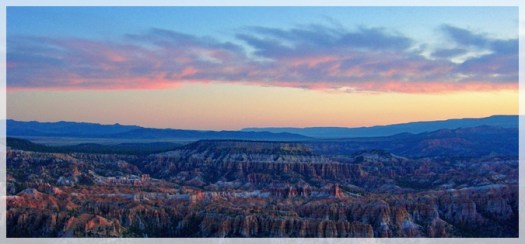
Bryce canyon - sunriseEverything I did was honest. Righteousness covered me like a robe, and I wore justice like a turban. I served as eyes for the blind and feet for the lame. I was a father to the poor and assisted strangers who needed help. I broke the jaws of godless oppressors and plucked their victims from their teeth. I thought, “Surely I will die surrounded by my family after a long, good life.” [Job 29:14-18 (NLT)]
No one enjoys reading the book of Job; it’s difficult to read about someone who, through no fault of his own, loses family, wealth, reputation, and health in one fell swoop. Complicating matters is that, while six voices are heard, only God’s voice is completely correct and we don’t hear from Him until the end. As for the rest of the speakers, while there are nuggets of truth in every speech, much of what is said both by Job and his friends, is incorrect and based on faulty assumptions. Eliphaz, for example, is correct when he says it is a joy to be disciplined by God when we’ve done wrong, but his belief that Job’s troubles are because he’s done wrong is incorrect. Although they make different points, Eliphaz, Bildad, Zophar and Elihu all base their arguments on the assumption that Job’s suffering is because he’s a sinner. Urging him to repent and turn back to God, Job doggedly maintains his innocence.

While Job is correct that his suffering is not because of his sinfulness, like his friends, he is operating on a retribution theology: that we get what we deserve. Because he’s been righteous, Job believes he doesn’t deserve his trials. Sure that his suffering is in error, Job is determined to speak with God to defend himself. Neither Job nor his friends have the right answer; good fortune is not necessarily because of righteousness any more than misfortune is necessarily because of sin. When Job eventually repents, he does not repent of any sin that led to his suffering because sin wasn’t the cause. Instead, Job repents of questioning God’s wisdom and falsely accusing Him of injustice.

Like Job, it is easy to question God when troubles rain down, but do we ever question God when blessings are showered upon us? Do we really think we deserve only the good and never the bad? God doesn’t owe us blessings for righteousness. Good times are undeserved and hard times often come to those who least deserve them. Just as we are unable to fathom God’s omnipotence and generosity in his blessings to us, we are incapable of comprehending why our almighty and loving Father allows evil to shatter lives. We no more deserve God’s grace and blessings than Jesus deserved to suffer on that cross!

Suffering and hardship happen because we live in a fallen world; God offers no more explanation to us or to Job. The only answer is to put our hope and faith in God, secure in the knowledge that He is in control. Evil wins only when we turn away from God in pain and confusion and stop trusting in His infinite power and wisdom.

If I ask, “Why me?” about my troubles, I would have to ask, “Why me?” about my blessings. … I take the good with the bad, and I try to face them both with as much calm and dignity as I can muster. [Arthur Ashe (tennis champion, winner of both Wimbledon and the U.S. Open, who died of AIDS after being infected by a blood transfusion)]

Then the Lord said to Job, “Do you still want to argue with the Almighty? You are God’s critic, but do you have the answers?” Then Job replied to the Lord, “I am nothing—how could I ever find the answers? I will cover my mouth with my hand. I have said too much already. I have nothing more to say.” [Job 40:1-5 (NLT)]

Copyright ©2019 jsjdevotions. All rights reserved.

GOOD FRIDAY: ON THIS HOLY DAY

Simeon…took the child [Jesus] in his arms and praised God, saying, “I have seen your salvation, which you have prepared for all people. He is a light to reveal God to the nations, and he is the glory of your people Israel!” Jesus’s parents were amazed at what was being said about him. Then Simeon blessed them, and he said to Mary, the baby’s mother, “This child is destined to cause many in Israel to fall, but he will be a joy to many others. He has been sent as a sign from God, but many will oppose him. As a result, the deepest thoughts of many hearts will be revealed. And a sword will pierce your very soul.” [Luke 2:28,31-35 (NLT)]

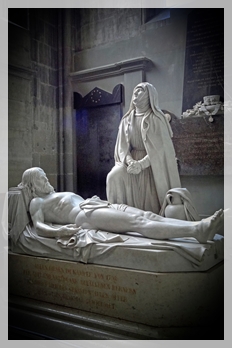
Munster - Bern CathedralAs Mary stood in the shadow of the cross, did she recall Simeon’s words when he held the infant Jesus in his arms? His prophecy came true that day at Calvary; as she watched her son endure such torture, it truly must have felt as if a sword had pierced her very soul. Jesus was supposed to be the glory of His nation but there He was—dying the death of a criminal. Mary didn’t understand why her beloved boy had to perish and she certainly didn’t know that He’d be back in three days. Imagine her sorrow and the emptiness in her heart as she witnessed her son’s agony.

Mary knew she loved her son but I wonder if that day she questioned God’s love for Him. She didn’t know that from the moment Jesus was planted in her womb her boy was headed to Calvary or that His death on the cross was all part of God’s perfect plan. How could she understand that her Son’s death was a deliberate choice: that He was dying for the very people who had placed Him on that cross? How could she know that His death proved the enormity of God’s love for all of humanity?

Like Mary, we don’t know the reason why our loved ones suffer or what will result from their suffering. Unlike Mary, however, we do know the rest of the story. Without the crucifixion, there would have been no resurrection. But, because of Jesus’s death and resurrection, there is another life waiting for us in God’s heavenly kingdom. Jesus’s resurrection means that hope overpowered desperation, love claimed victory over hate, forgiveness prevailed over condemnation, joy conquered despair, and life triumphed over death.

Jesus, the Son of God, was ignored, denied, betrayed, falsely accused, demeaned, scorned and scourged, and finally crucified on a cross. He suffered and died like a common criminal and was buried in a borrowed tomb like a vagrant. The sinless One paid the sinners’ debts. He didn’t have to, but he did. Thank you, God, for your loving redemption.

…death was not Jesus’ penalty; it was His destiny. It was not His lot in life; it was His mission. It was not His unavoidable fate; it was His purpose statement for coming to earth that first Christmas: “Born to die.” [Bill Crowder, from“The Path of His Passion”]

But he was pierced for our rebellion, crushed for our sins. He was beaten so we could be whole. He was whipped so we could be healed. All of us, like sheep, have strayed away. We have left God’s paths to follow our own. Yet the Lord laid on him the sins of us all. [Isaiah 53:5-6 (NLT)]

Copyright ©2019 jsjdevotions. All rights reserved.

BEYOND OUR UNDERSTANDING

How great is our Lord! His power is absolute! His understanding is beyond comprehension! [Psalm 147:5 (NLT)]

Trust in the Lord with all your heart; do not depend on your own understanding. [Proverbs 3:5 (NLT)]

Koreshanity - Cellular CosmogonyJust north of us is a state park that once was home to a group called the Koreshan Unity. In 1894, Dr. Cyrus Teed, known as the Prophet Koresh, brought about 250 of his followers to the banks of the Estero River where they hoped to establish a “New Jerusalem.” The Koreshans believed that the Bible needed prophets to interpret it and that Teed was the seventh in a line of biblical prophets. As the designated prophet, Teed would reveal everything about the universe that Jesus failed to explain. Taking verses out of context from both testaments of the Bible, the Koreshans believed in reincarnation, communal living, heaven and hell, immortality, and celibacy.
The most curious belief of the Koreshans was that of Cellular Cosmogony: that the earth is a hollow shell about 8,000 miles in diameter and that the entire universe exists on the inside of this shell. Although the earth’s surface appears convex, Teed claimed that was an optical illusion and the earth’s surface actually was concave. Picture a globe but, instead of having the land and sea on the outer side, they are on the inner side; instead of life existing on the outer surface, it exists on the inside of the shell. The universe rotates inside the earth’s shell rather than the earth rotating in the universe and the sun is a giant electromagnetic battery in the middle of the sphere. Rather than gravity, centrifugal force is what holds us down.

Teed felt that God had revealed to the first six prophets (Adam, Enoch, Noah, Moses, Abraham, and Jesus) only what they (and their followers) were capable of understanding. As the most evolved of the prophets, Teed believed that God would reveal everything to him and, once God had done so, Teed would then usher in the age of Koreshanity.

For Teed, living on the inside of a hollow sphere meant that the universe and everything in it was knowable and finite—all wrapped up in a hollow sphere. Pictures of the earth from space easily tell us his Cellular Cosmogony is wrong and Scripture tells us he was in error with his theology—Jesus had the last word, not Teed! His biggest mistake may have been the same one we often make ourselves: wanting the world and God to be limited, explainable, and understandable.

Although Jesus and Scripture have given us all we need to know, there still remains much that we’ve not been told or that we’ll never understand about God, our existence, eternity, and the universe. None of us truly comprehend how God could speak the universe into existence, can know what we want before we know it ourselves, or see our yesterdays, todays, and tomorrows all at the same time. No prophet can give us a satisfactory explanation as to why bad things happen to good people or evil people prosper while the righteous suffer. How can we possibly truly understand God’s grace, His unlimited love for us, or how God can be one Being containing three persons while remaining only one God? That God is infinite, having neither beginning nor end, is mind boggling!

A universe that is contained in a shell would be far less baffling than one that is continually expanding and infinite in scope! We all want to think that God is understandable, life makes sense and everything is explainable but it isn’t. In spite of Scripture (and even science), there is much that remains incomprehensible and will remain that way during our lifetimes. Teed tried to limit God and His creation to make the inexplicable explainable. God and our existence, however, can’t be nicely wrapped up in a neat package or a closed universe. The good thing for us is that, while fully understanding God may be impossible, knowing, trusting and loving Him is not!

Oh, how great are God’s riches and wisdom and knowledge! How impossible it is for us to understand his decisions and his ways! … For everything comes from him and exists by his power and is intended for his glory. All glory to him forever! Amen. [Romans 11:33,36 (NLT)

Copyright ©2019 jsjdevotions. All rights reserved.

THE LAMB OF GOD – ASH WEDNESDAY

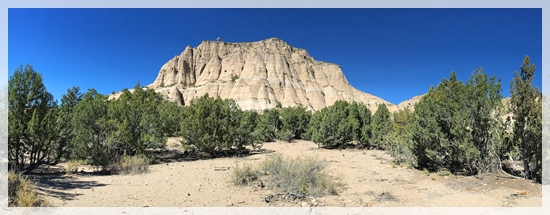
New mexicoThe next day John saw Jesus coming toward him and said, “Look! The Lamb of God who takes away the sin of the world! [John 1:29 (NLT)]
Today is the first day of Lent, a season in which we remember the time Jesus went into the wilderness and fasted for forty days and nights. Because Lent occurs in the weeks leading up to Good Friday and Easter, we tend to associate this period of Jesus’s life with the end of his ministry. It actually occurred early in His ministry, shortly after his baptism by John and his empowerment by the Holy Spirit.

During Jesus’s time in the wilderness, Satan visited and tempted Him. Jesus first was tempted to serve Himself—to alleviate his hunger by turning stones into bread. In the second temptation, Satan urged Jesus to jump off the Temple and reveal Himself in a spectacular display. This action would also test God’s love by coercing Him into saving Jesus. In the third test, Satan tempted Jesus to skip the cross altogether; all the kingdoms of the world would be His if only He’d worship the evil one.

Just because Jesus was divine doesn’t mean He couldn’t have fallen; He also was human and, like us all, susceptible to Satan’s wiles. He could have sinned as easily as Adam and Eve, but He didn’t! Resisting temptation was as essential to His mission as was suffering on the cross. Just as sin came into the world through one man, God would redeem the world through one man, but Jesus had to remain sinless for that to happen. If He hadn’t, there would have been no point to the cross; only a perfect sinless sacrifice could atone for mankind’s sins.

Because Jesus countered all of Satan’s temptations with Scripture, we tend to think of the temptation of Christ as sort of a “how to” manual on overpowering temptation. While it is that, it is so much more. Jesus didn’t go into the wilderness to teach us a lesson—He went into the wilderness to save us. He wasn’t just battling for His soul—He was fighting Satan for ours! He was defeating Satan by deliberating choosing to suffer for us as a man when He was God! He endured hunger when he could have spoken food into existence. He humbly chose to remain an obscure rabbi from Nazareth rather than use His power to win a following. Refusing to compromise with Satan, He chose obedience to God: to live, suffer and die as a man. Jesus, the spotless Lamb of God, chose to endure the cross for sinful selfish mankind: the very people who would put Him there!

For God made Christ, who never sinned, to be the offering for our sin, so that we could be made right with God through Christ. [2 Corinthians 5:21 (NLT)]

This High Priest of ours understands our weaknesses, for he faced all of the same testings we do, yet he did not sin. So let us come boldly to the throne of our gracious God. There we will receive his mercy, and we will find grace to help us when we need it most. [Hebrews 4:15-16 (NLT)]

Copyright ©2019 jsjdevotions. All rights reserved.

A MOUNTAINTOP EXPERIENCE – THE TRANFIGURATION

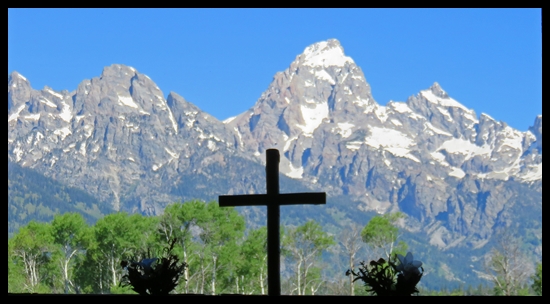
Chapel of the Transfiguration - Grand Teton National Park

Don’t misunderstand why I have come. I did not come to abolish the law of Moses or the writings of the prophets. No, I came to accomplish their purpose. [Matthew 5:17 (NLT)]

In the middle of Grand Teton Nation Park is a small log church, the Chapel of the Transfiguration. Built in 1925, it offers a beautiful view of the majestic Teton Mountain Range through a window behind the altar. When people gaze out that window, I wonder how many think of the amazing event—the transfiguration—that took place on another mountaintop more than 2,000 years ago.

About a week after Peter called Jesus “the Messiah sent from God!” and Jesus explained that He’d suffer, die, and be raised, Peter, John and James accompanied Him up a mountain to pray. While tradition says it was Mt. Tabor, both its height (only 1,800 feet) and location make that unlikely. While not as high as the 13,000 ft. Grand Teton, Mt. Hermon’s height (9,000 feet) and location make it the more likely location of this glorious event.

While praying, Jesus made a dramatic change: his face transformed and his clothes turned white and gleaming. Having only seen Jesus in his human form, His now glorious presence gave the disciples a greater understanding of his deity. Two men then appeared and spoke with Jesus about his exodus (or departure) from this world. They were Moses and Elijah—representing, at least symbolically, the Law and the Prophets. Jesus, as we know, was their fulfillment.

Amazed at what was the ultimate mountaintop experience, Peter foolishly suggested building three shelters for Jesus and his visitors. That, of course, was a mistake; neither the lawgiver not the prophet were Jesus’s equal. Furthermore, that Peter wanted this glorious event to continue would have kept Jesus from the mission He’d already explained to His disciples. A cloud then enveloped them all and a voice, unmistakably that of God, said, “This is my dearly loved Son, who brings me great joy. Listen to him.” [Matthew 17:5] The “Listen to him,” made it clear that the One who was new would be replacing the old way. After this powerfully dramatic event, the four men found themselves alone on the mountaintop.

Jesus commanded the disciples to keep silent as to what had taken place until after his resurrection. Looking for a Messiah who’d be a political deliverer rather than one who was a suffering servant, the world wouldn’t understand what had transpired. Even the disciples, the men who’d walked with Him for three years, didn’t fully understand the meaning of their mountaintop experience. It was not until Jesus joined them in that locked room on Easter that they finally understood that He’d come to conquer death rather than Romans.

The transfiguration was a foretaste of things yet to come and, someday, we all will see the fullness of Christ’s glory as did Peter, James, and John. Although Jesus told His disciples to keep his identity a secret, let us not forget that was only a temporary request. He later told them to “make disciples of all the nations.”

Jesus came and told his disciples, “I have been given all authority in heaven and on earth. Therefore, go and make disciples of all the nations, baptizing them in the name of the Father and the Son and the Holy Spirit. Teach these new disciples to obey all the commands I have given you. And be sure of this: I am with you always, even to the end of the age.” [Matthew 28:18-20 (NLT)]

Copyright ©2019 jsjdevotions. All rights reserved.