
Mary asked the angel, “But how can this happen? I am a virgin.” [Luke 1:34,38 (NLT)]
 Angels taking on bodily form and appearing to people certainly wasn’t an everyday occurrence. Although they are God’s messengers, the message angels bring can be good news or bad. While they may help God’s people as they did for Elijah and Daniel, angels also execute God’s judgment as they did when striking down the firstborn males in Egypt. I suspect Gabriel looked fiercer and more powerful than the elegant sweet angels hanging on our Christmas trees. When he arrived unannounced in the empty Temple sanctuary, Zechariah was overwhelmed with fear and, when he suddenly appeared in an empty room in Nazareth, Mary was troubled and perplexed. Not knowing whether he was on a mission of judgment or mercy, it’s no wonder both Zechariah and Mary were fearful. Gabriel began his visits by telling them both not to be afraid.
After being told his elderly barren wife would bear him a son, Zechariah’s response was one of doubt: “How can I be sure this will happen?” Rather than rejoicing at the divine promise of a son, Zechariah focused on the impossibility of such a thing happening. When Mary was given the startling news that she would conceive and give birth, she knew that babies weren’t brought by the stork or found in a cabbage patch. As a virgin, a pregnancy seemed impossible, but she didn’t question the veracity of the angel’s words. Although Zechariah questioned the truth of Gabriel’s revelation, Mary didn’t express doubt that she would bear a son. Her response was that of wonder. Wanting to know the process by which this miracle would happen, she simply asked “But how?”
After explaining that the Holy Spirit would come upon her, Gabriel told Mary that her elderly cousin Elizabeth was pregnant and that, “Nothing is impossible with God!” Knowing that her barren cousin was with child may have reassured Mary that what seems impossible can happen. Nevertheless, their situations were different; Elizabeth was married and Mary was not! Mary’s response, however, was that of willing submission. Putting her unknown future into God’s hands, she said, “I am the Lord’s servant. May everything you have said about me come true.” [Luke 1:38]
Our typical response when God calls us to His work is often one of disbelief. Abraham couldn’t see how his people would possess Canaan, Sarah couldn’t see how God could give her a child when her child-bearing days were over, Moses couldn’t believe he could convince both the Israelites and Pharaoh, Gideon even demanded signs before questioning his ability to rescue Israel, Samuel couldn’t see how he could anoint a new king without being killed by Saul, and Zechariah asked how he could believe the angel. Initially, none of them believed that our all-powerful God, the creator of the universe, can do the impossible!
Unlike Moses, Mary didn’t try to squirm out of this unexpected turn of events with excuses; unlike Sarah, she didn’t laugh in unbelief; unlike Gideon, she didn’t ask for a series of signs; unlike Samuel, she didn’t point out the problems she was sure to face; and, unlike Zechariah, she believed the angel’s words and left the details to the One for whom nothing is unachievable!
Do we forget that God doesn’t have the limitations we have? He can make manna appear, feed 5,000 with a few fish and loaves, part the sea, walk on water, still storms, restore sight to the blind, put babies in barren wombs, and raise the dead. Nevertheless, when called by God to serve, do we allow the unfeasibility, impracticality, or size of His task to keep us from stepping out in faith and doing His work? Could we be missing God’s blessings because we’re too busy focusing on the human problems instead of responding in faith and trusting God with the details? Let us never forget that nothing is impossible with God. He will work out the how; we just need to submit as readily as did Mary.

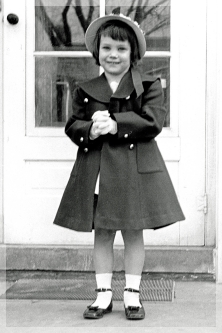 After being asked, “How different would the world look if everyone got what they deserved?” I started wondering. Even as a child, I knew people didn’t get what they deserved. When I was ten, I watched on television as nine black students tried to enroll in an all-white school in Little Rock, Arkansas; they were blocked by the National Guard and an angry mob of 400 angry whites. Two years earlier, on a bus in Montgomery, Alabama, Rosa Parks was arrested for refusing to give up her seat to a white woman. I grew up in Detroit and, while discrimination and segregation were more subtle than in the South, it existed. I lived in a large home with a big yard on a tree-lined street but any bus trip “downtown” told me that the people of color didn’t live in neighborhoods like mine. There may not have been “colored” drinking fountains or “white only” bathrooms but there was a six-foot high, one-foot wide, and half-mile long wall segregating one black community from a neighboring white one. Many other invisible and more impenetrable walls existed within our divided city.
 Back in 1957 (long before PETA existed), Curt Richter, a professor at Johns Hopkins, conducted a series of cruel and inhumane experiments to demonstrate the power of hope and resilience in overcoming difficult situations. In this case, the difficult situation was rats being put in a bucket of water with no means of escape and timing how long it took them to drown. After two preliminary experiments, Richter hypothesized that introducing hope to the rats would increase their survival times.
 Devotions of the Heart