GRIEVING HIM

In all their suffering he also suffered, and he personally rescued them. In his love and mercy he redeemed them. He lifted them up and carried them through all the years. But they rebelled against him and grieved his Holy Spirit. So he became their enemy and fought against them. [Isaiah 63:9-10 (NLT)]

appleMany years ago, my two boys were playing at their grandparents’ house. While Grandpa worked in the garden, the brothers climbed up into the apple tree and started to throw apples at him. A patient man, their grandfather told them to stop and, when more apples came whizzing at him, he offered a sterner warning. After briefly stopping their barrage, the rascals were unable to resist the temptation and chucked more apples at Grandpa. To their surprise, this gentle and loving man turned around, picked up some apples, and returned fire. Having played ball as a boy, Gramps had a strong throwing arm and excellent aim. He didn’t pull any punches as he pitched those apples back at his grandsons. The boys, unable to maneuver easily in the tree, quickly learned the meaning of “as easy as shooting fish in a rain barrel.” When they called, “Stop, Grandpa, it hurts!” he replied, “Yes, I know it does, but you needed to learn that!” It wasn’t until those hard apples hit their bodies that the youngsters understood how much their disobedience hurt their grandfather (both physically and emotionally).
This is one of my boys’ favorite stories about their grandfather. Rather than being angry that he hurled those apples back at them, they’re proud of him. Knowing he loved them enough to discipline them, they learned a variety of lessons that day and not just that being hit by an apple hurts or not to be caught up a tree. They learned to listen to and obey their grandfather, that disobedience brings reckoning, and (after they picked up the apples) that obedience can bring rewards like apple pies. They also learned that their naughtiness grieved their grandfather as much as their punishment hurt them.

We know that Jesus experienced both physical and emotional pain when He walked the earth as a man but what did God the Father experience? As a spirit, without a nervous system, I doubt that He felt physical pain, but what about emotional pain as He saw His son rejected, suffer, and die? Does God have feelings? There are two opposing theological schools of thought about this question (the doctrine of impassibility vs. the passibility of God) and a whole lot of middle ground in-between. Not being a theologian, I’m not addressing doctrine.

Nevertheless, Scripture tells us that God can grieve and the parables of the missing coin, prodigal son, and lost sheep also tell us that God can rejoice. Throughout the Bible, we find examples of God expressing emotions like love, joy, compassion, hate, jealousy, anger and grief. Like any parent, God’s heart is touched by His children; it seems that He can feel our pain and that we can cause Him emotional pain.

Although Scripture tells us that God is compassionate and gracious, slow to anger and abounding in love, like the boys’ grandfather, God eventually will get angry. Moreover, Scripture shows us that our disobedience aggrieves our heavenly Father as much as an apple on the noggin and my boys’ defiance hurt their grandpa. When we disobey God, disgrace His name, doubt His love, forsake our faith, reject His guidance, choose hate over love or callousness over compassion, we bring sorrow, grief, and pain to God. Rather than bringing grief to God, may we always do what pleases Him, for it is in the joy of the Lord that we find strength.

And do not bring sorrow to God’s Holy Spirit by the way you live. … Get rid of all bitterness, rage, anger, harsh words, and slander, as well as all types of evil behavior. Instead, be kind to each other, tenderhearted, forgiving one another, just as God through Christ has forgiven you. … Carefully determine what pleases the Lord. [Ephesians 4:30a, 31-23; 5:10 (NLT)]

Copyright ©2024 jsjdevotions. All rights reserved.

IT’S NOT FAIR

God saved you by his grace when you believed. And you can’t take credit for this; it is a gift from God. Salvation is not a reward for the good things we have done, so none of us can boast about it. [Ephesians 2:8-9 (NLT)]

Many years ago, while my son and his pals were playing baseball in the field next to the Miller house, the ball ended up going through the Miller’s window! When my son returned home, he asked me to call Mrs. Miller and ask for the return of his ball. Once I knew how the ball came to be in her possession, I told him he had to pay for the broken window before getting back his ball. So, for the next few weeks, the boy worked extra chores to pay off his debt.

Some people think of good works like the chores my son did to redeem his baseball. They picture a heavenly bookkeeper with a holy ledger who deposits their good deeds in the credit column and their sins in the debit. Whenever they err, a withdrawal is made from the works side to pay for the sin. It seems like a good plan. After all, my son worked off his debt so why can’t we just work off our sin debt?

If God used a balance scale with good works placed on one tray and sins on the other, how would the weight of good works and sins be determined? Would putting a dollar into the red kettle at Christmas be the same as being a hospice volunteer? Would petty theft weigh the same as grand larceny or adultery as much as mass murder? How many sins would be paid off by a mission trip? What would you need to discharge the sins of deceiving a spouse, gossiping about a neighbor, taking unfair advantage of someone, misappropriating funds, or cheating on your taxes?

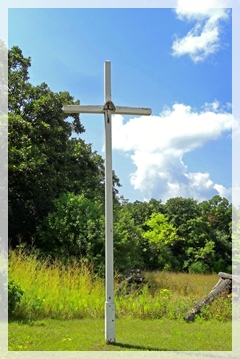
Salvation, however, cannot be earned nor is it for sale. That’s good news for me since I know my sins far outweigh my good works and there’s no way I could do enough to purchase my salvation. Moreover, we can’t stock up good turns, kindness, benevolence, generosity, and service to pay for future sins. Thinking our worth comes from our works undervalues God’s gift of grace because good works aren’t what save us from spiritual bankruptcy! Salvation comes from Jesus alone! He paid our sin debt in full with his blood when He died on the cross.

When my son told me about the mishap at the Millers, he insisted he wasn’t the one who hit the ball that broke their window. Claiming his innocence, he protested paying someone else’s debt. It may not have been fair but it was necessary. Someone had to pay the Millers for their busted window and no one else came forward.

As the sinless Lamb of God, Jesus was far more innocent of any wrongdoing than my son. Nevertheless, He paid both my debt and yours! The only one who was absolutely free of sin deliberately chose to take the full weight of God’s justice for sins He didn’t commit! Jesus paid a debt He didn’t owe because mankind owed a debt that couldn’t be paid! It wasn’t fair, but it was necessary.

The Gospel is good news of mercy to the undeserving. The symbol of the religion of Jesus is the cross, not the scales. [John Stott]

For the wages of sin is death, but the free gift of God is eternal life through Christ Jesus our Lord. [Romans 6:23 (NLT)]

He himself is the sacrifice that atones for our sins—and not only our sins but the sins of all the world. [1 John 2:2 (NLT)]

He personally carried our sins in his body on the cross so that we can be dead to sin and live for what is right. By his wounds you are healed. [1 Peter 2 (NLT)]

Copyright ©2024 jsjdevotions. All rights reserved.

ONCE AND FOR ALL – YOM KIPPUR

He will lay both of his hands on the goat’s head and confess over it all the wickedness, rebellion, and sins of the people of Israel. In this way, he will transfer the people’s sins to the head of the goat. Then a man specially chosen for the task will drive the goat into the wilderness. As the goat goes into the wilderness, it will carry all the people’s sins upon itself into a desolate land. [Leviticus 16:21-22 (NLT)]

While the year is 2024 on most calendars, it is year 5785 on the Hebrew calendar and the tenth day of Tishri begins at sunset tomorrow. For our Jewish brothers and sisters, it will be the Day of Atonement or Yom Kippur. With its themes of atonement and repentance, it the holiest day of the year for a Jew.

The book of Leviticus describes the rituals the Israelites were to perform on this holy day every year. In ancient Israel, this was the only time the high priest could come into the Holy of Holies (the innermost sacred area of the tabernacle or temple) where the Ark of the Covenant was housed. But, before coming into the presence of God and the Ark and beginning the ritual of atonement, he had to ritually cleanse himself from sin by bathing and dressing in spotless plain linen garments. The high priest then atoned for his own sins and those of his family with the sacrifice of a bull.

Two unblemished male goats were taken from the community and lots were cast to determine which goat would be given to the Lord. The first goat was sacrificed and its blood sprinkled on the mercy seat of the Ark. This was the sin offering and made to appease the wrath of God and atone for the sins of the people. Then, having received forgiveness, the second goat was brought before the altar. As a way of transferring the sins of the people to the goat, the priest laid his hands on its head and confessed all the peoples’ sins and transgressions. This goat, the “scapegoat,” was then sent out into the wilderness to carry those sins into the wasteland. In this ancient ritual, the blood of the first goat provided propitiation by appeasing God’s wrath and the second goat provided expiation by atoning for and removing those sins. This atonement ritual was to be repeated year after year.

Without a temple in Jerusalem, there no longer are animal sacrifices or scapegoats. Nevertheless, Jews throughout the world continue to observe this holy day. When a fast day occurs on the Sabbath, it is postponed until Sunday but Yom Kippur is the exception to that rule. Referred to as the Shabbat Shabbaton (the Sabbath of Sabbaths), our observant Jewish friends will fast from all food and drink (including water) from just before sunset Friday until after sunset Saturday. Along with fasting, many Jews will abstain from wearing leather footwear, washing or bathing, applying lotions and creams, or having marital relations. Most of Yom Kippur is spent in the synagogue in intensive prayer, introspection, and the asking of God’s forgiveness for the past year’s sins. The day ends with a single blast of the shofar (ram’s horn trumpet) followed by the proclamation, “Next year in Jerusalem.”

Unlike the yearly sacrifice of goats, the sacrifice of Jesus upon the cross needed to be done only once. Christ was both our sinless high priest and the unblemished sacrifice. When He gave himself up for us, Jesus took God’s wrath upon himself as His blood dripped on the ground beneath Him. When He suffered and died on the cross, Jesus was both the propitiation and expiation of our sins for all time. By dying, this sinless man took on God’s wrath—the wrath we sinners deserved. Rather than take our transgressions into the wilderness, He “removed our sins as far from us as the east is from the west” for all time. [Psalm 103:12] Thank you Jesus!

If you are ready to partake of grace you have not to atone for your sins—you have merely to accept of the atonement. All that you want to do is to cry, “God have mercy upon me,” and you will receive the blessing. [D.L. Moody]

We are made right with God by placing our faith in Jesus Christ. And this is true for everyone who believes, no matter who we are. For everyone has sinned; we all fall short of God’s glorious standard. Yet God, in his grace, freely makes us right in his sight. He did this through Christ Jesus when he freed us from the penalty for our sins. [Romans 3:22-24 (NLT)]

Copyright ©2024 jsjdevotions. All rights reserved.

HE NEVER DISAPPOINTS

Jesus told them, “Tonight all of you will desert me.” … Peter declared, “Even if everyone else deserts you, I will never desert you.” Jesus replied, “I tell you the truth, Peter—this very night, before the rooster crows, you will deny three times that you even know me.” “No!” Peter insisted. “Even if I have to die with you, I will never deny you!” And all the other disciples vowed the same. [Matthew 26:31a,33-35 (NLT)]

I think the worst thing my parents could say was that they were disappointed in me. Knowing I hadn’t lived up to their high expectations, I’d hang my head in shame as they added, “We expected far better from you.” I never wanted to disappoint them but, unfortunately, like every child, I often did.

While parents tend to envision having the perfect child—one who never disobeys, makes unwise choices, or gets a bad grade—God doesn’t operate under that delusion. Knowing us, He has realistic expectations of His fallen children. Nevertheless, while He understands that we can’t live up to His standard of perfection, God does expect us to do our best and He provides the guidance and power to do so. Even so, we’ll falter more times than we can count and, when that happens, rather than being disappointed in us, God is disappointed for us.

When they deserted the Lord that Thursday evening in Gethsemane, none of the disciples behaved much like true believers. Although the others also may have denied knowing Jesus that night, only Peter’s denials were recorded for posterity. While Jesus was being questioned, slandered, spit upon, blindfolded, and beaten, Peter was warming himself by a fire. Then the disciple who claimed to be ready to die for Jesus failed Him miserably by denying even knowing the Lord. Jesus wasn’t surprised in the disciples’ desertion and Peter’s betrayal; He expected it. In fact, He predicted it.

When Jesus appeared Easter morning, He didn’t tell the disciples how disappointed He was in them or shame them for their desertion. Instead, Jesus’ first words were words of love and reconciliation, “Shalom…peace be with you.” Then, instead of chastening them for their fear and doubt at His resurrected presence, Jesus ate with them! Rather than single out Peter and censure him for his denials, Jesus simply asked the disciple if he loved Him. Despite Peter’s previous failures, Jesus loved and forgave the man and appointed him to “feed my sheep.”

Peter’s failings didn’t define him and neither should ours. Peter denied Christ and yet he was in that room with the other disciples on Easter morning. A betrayal doesn’t have to send us away from Jesus into the depths of despair, as it did for Judas. A betrayal can bring us closer to Christ, as it did for Peter. Repentance and forgiveness turned Peter, the betrayer, into Peter, the Rock, the powerful preacher and fearless leader of the early Church!

Like Peter and the disciples, we are flawed people. As much as we want to honor and please God, there will be times we make poor choices and disappoint Him. The good news is that God never will disappoint us! Although He grieves for every one of our bad choices, He never will leave us, stop believing in us, or take His Holy Spirit from us.

And do not bring sorrow to God’s Holy Spirit by the way you live. Remember, he has identified you as his own, guaranteeing that you will be saved on the day of redemption. [Ephesians 4:30 (NLT)]

The faithful love of the Lord never ends! His mercies never cease. Lamentations 3:22 (NLT)]

Copyright ©2024 jsjdevotions. All rights reserved.

WEED OR FLOWER?

The land produced vegetation—all sorts of seed-bearing plants, and trees with seed-bearing fruit. Their seeds produced plants and trees of the same kind. And God saw that it was good. [Genesis 1:12 (NLT)]

Egyptian crowfoot grassWhen I saw a wildflower that looked like a helicopter’s rotors, I showed it to the park’s naturalist for identification. Not as impressive as Scarlet Hibiscus or as colorful as Butterfly Weed, she found the plant unworthy of name or notice and wrote it off as “just a weed!” What some people call “weeds,” I think of as wildflowers and a little research told me it was the floret of Egyptian Crowfoot Grass (Dactyloctenium aegyptium). Native to Africa and widely distributed throughout the tropics and subtropics, it is one of the most drought-resistant of grasses.

While Crowfoot Grass may be a weed to some people, it is relished by ruminants like sheep, cattle, deer, and their relatives. Suitable for silage, it makes valuable pasture, excellent hay, and its seeds are fed to poultry. The plant material is used for making paper and weaving mats and baskets. In traditional African and Asian folk medicine, decoctions of its seeds have diuretic, anti-inflammatory, analgesic, antipyretic, and antibacterial effects. Its highly nutritious seeds make it a “famine food” and, when food is scarce, those seeds are used to make porridge and cakes that can sustain people’s lives in times of need.

Ralph Waldo Emerson described a weed as “a plant whose virtues have not yet been discovered,” and the naturalist’s quick dismissal of the Crowfoot Grass was because she didn’t appreciate its unseen qualities. Nevertheless, some of God’s best work is evident in His unusual and underrated “weeds” and the same might be said about their human equivalents. Like the unimpressive and humble Crowfoot Grass, God’s prophets were out of the ordinary, overlooked, unappreciated, and rebuffed by many. Nevertheless, even though they were disregarded and disparaged as if they were weeds in a rose garden, they continued in faithful obedience to God.

Like Crowfoot Grass, Jesus didn’t meet people’s expectations or conform to the norm. To Pilate, Herod, Judah’s religious leaders, Rome, and many others in 1st century Palestine, Jesus was little more than a troublesome weed that needed to be eradicated. Appearances, however, are deceiving—that unpretentious weed was the Son of God, the Prince of Peace, and (like Crowfoot Grass) the Bread of Life!

Crowfoot Grass doesn’t look like much but appearances are deceiving. Just as the naturalist dismissed it as “just a weed,” I wonder if I ever do the same with people! Judging by appearance, do I fail to take the time to discover their hidden virtues? After all, a weed is simply a flower in disguise! Let’s never make the error of failing to look beneath the surface to appreciate the value and beauty of both the plants and people we encounter in God’s garden.

There is not a flower that opens, not a seed that falls into the ground, and not an ear of wheat that nods on the end of its stalk in the wind that does not preach and proclaim the greatness and the mercy of God to the whole world. [Thomas Merton]

O Lord, what a variety of things you have made! In wisdom you have made them all. The earth is full of your creatures. [Psalm 104:24 (NLT)]

Copyright ©2023 jsjdevotions. All rights reserved.

TRUE LOVE

Love is patient and kind; love does not envy or boast; it is not arrogant or rude. It does not insist on its own way; it is not irritable or resentful; it does not rejoice at wrongdoing, but rejoices with the truth. Love bears all things, believes all things, hopes all things, endures all things. Love never ends. [1 Corinthians 13:4-8 (ESV)]

I was married fifty-seven years ago today. When I promised to love, comfort, honor, cherish, forsake all others, and to have and to hold my husband “for better for worse, for richer for poorer, in sickness and in health” until we parted at death, I had no idea just how bad “for worse” could get, how little money “for poorer” might be, or that sickness could mean much more than a case of the flu. I certainly never pictured us growing old with wrinkles, white hair, hearing aids, bifocals, arthritis, and the limitations that come advanced years.

My husband and I had known each other for less than a year when we made our vows. Although we took them seriously and sincerely meant every word we said, at 20 and 24, neither of us had any inkling of the challenges that would accompany parenthood or how difficult it can be to cherish someone whose words or actions hurt us or with whom we disagree. With 43% of all first marriages ending in divorce, we’re not the only ones who entered into marriage so naively. Since 60% of second marriages fail and 73% of third ones do, some people never learn!

Like many couples, we had 1 Corinthians 13 read during the ceremony. Paul, however, wasn’t writing to young lovers or for a wedding—he was writing to the church in Corinth. The word he used for love wasn’t eros, the Greek word for romantic or sexual love, nor was it philia, meaning brotherly love, or storge, meaning familial love. It was agape and describes the kind of love that comes from God (who is love) and the kind of love believers are to have for all their fellow travelers on this planet. Agape is an unconditional love that doesn’t depend on appearance, physical attraction, or emotions. Unlike eros, agape isn’t something we fall into or out of. Agape is more than a feeling; it is a deliberate choice (and one that must be made daily if any marriage is to survive)!

Although Paul was addressing his words to the church and specifically speaking about the necessity of love when using spiritual gifts, his description of agape love holds true in marriage, as well. In the decades since our wedding, we’ve experienced good and not so good times. There have been periods of plenty and sparseness, illness and well-being, tragedy and joy, fullness and emptiness, anger and forgiveness, excitement and tedium, labor and leisure, vulnerability and security, loss and gain, turmoil and peace, discontent and satisfaction. Although eros brought us together, eros alone couldn’t have gotten us through those times. Only agape love could have kept us together all these decades.

Agape mirrors the love God showed us on Calvary and, by the grace of God, our marriage survives because of agape! While Jesus’ sacrifice saved mankind, the sacrifices made in marriage save the unity of the relationship! The unrestricted, unrestrained, unselfish, and sacrificial love of agape is a conscious choice. None of us are loveable all of the time; we can, however, choose to be loving all of the time!

The love that is affirmed at a wedding is not just a condition of the heart but an act of the will, and the promise that love makes is to will the other’s good even at the expense sometimes of its own good—and that is quite a promise. … A marriage made in heaven is one where they become more richly themselves together than the chances are either of them could ever have managed to become alone. [Frederick Buechner]

So now faith, hope, and love abide, these three; but the greatest of these is love. [1 Corinthians 13:13 (ESV)]

Copyright ©2024 jsjdevotions. All rights reserved.