
Then God said, “Let us make human beings in our image, to be like us.” … So God created human beings in his own image. In the image of God he created them; male and female he created them. [Genesis 1:26,27 (NLT)]
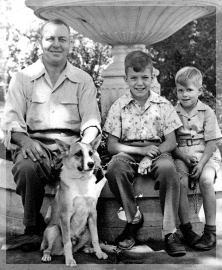 It’s often said, “Like father, like son,” and that was true of my father-in-law and his sons. Although they weren’t carbon copies of their dad, the boys shared several characteristics with the man who fathered them. In the same way, because God created us in His image, we share some of His characteristics. Of course, there are many important ways we are not like our Creator—He is all-knowing, eternal, all-powerful, and ever-present. Without a physical body, we don’t have things like God’s nose, hair color, or smile. Nevertheless, we do resemble Him in the spiritual, moral, and intellectual attributes of our nature that distinguish us from the rest of the animal world.
Although we share some of God’s attributes, we share them only to a limited extent. I can be a good person, be good-natured, be good at something, look good, feel good, do good, and even smell good. Nevertheless, I am not wholly good. Although I can be in love, love someone or something, act loving, profess my love, and be loved, I cannot be love. While my family claim that my recipes for barbecue sauce, California dream bars, and buttermilk pancakes are perfect, I am not (and never will be) perfect. I can distinguish righteousness from wickedness, have righteous indignation, act righteously, and feel both righteous and self-righteous, but I still sin. I can recognize wisdom, act wisely, and, on occasion, even give wise counsel, but I am not wisdom and, while I can know the truth, discern between truth and falsehood, and speak the truth, I am not truth.
On the other hand, God doesn’t stop at doing good, loving wholly, performing flawlessly, acting righteously, advising wisely, and speaking the truth—He is goodness, love, perfection, righteousness, wisdom, and truth personified! Nevertheless, imperfect as we mortals are, we should resemble our Creator in our words and actions. I’m not sure we always do.
God doesn’t play favorites. Every human being, regardless of race, nationality, ethnicity, politics, language, wealth, education, religion, social status, power, or gender has been created in the image of God. Do we treat our fellow image bearers with the respect, love, and compassion due to all of God’s children?
Since all people are in the image of God, all deserve to be treated with the dignity the image affords. [John H. Walton]
Every human life is a reflection of divinity, and…every act of injustice mars and defaces the image of God in man. [Martin Luther King, Jr.]
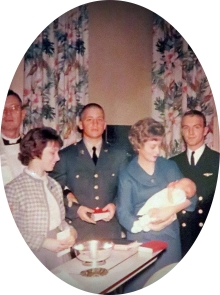 Earlier this week, I wrote about my nephew Johnny’s baptism in my mother’s hospital room. Because she was at death’s door, my brother took emergency leave and he and I served as the baby’s sponsors in Baptism (or Godparents).
 Mark tells of a time when a hungry Jesus cursed a fig tree and caused it to wither and die simply because it had no figs. As the only destructive miracle done by the Lord, His action is difficult to understand, especially since we’re told “it was too early in the season for fruit.” The same power that brought Lazarus back to life and turned water into wine easily could have given the tree ripe figs, so why did Jesus kill the fruitless tree?
 Do these verses mean I can’t wear my pearl earrings, diamond wedding ring, or gold cross to church? Do I have to say “farewell” to Nordstrom’s and start shopping solely at outlets and discount stores? Although my hair is short, it’s hard to believe my grand’s lovely French braids are inappropriate at church or anywhere else. What did Paul and Peter mean with their admonitions about women’s attire and modesty?
 Jeopardy introduced me to the word “performative” but, in an article about how scandals are hurting organized religion, the New York Times introduced me to another new word, “orthopraxy.” While “orthodoxy” means correct belief, doctrine, or teaching, “orthopraxy” has to do with correct practice, behavior, or action. Orthodoxy says, “Hear my words!” but orthopraxy says, “Watch my behavior!” With the flood of scandals throughout the Christian church, it’s easy to point our fingers at the disgraced Christian celebrities, megachurch pastors, and Roman Catholic priests whose orthodoxy didn’t match their orthopraxy—people who espoused devotion to God and adherence to His word while disregarding it in their own lives. Let’s remember, however, that whenever we point a finger at someone, three other fingers point at us! Although the Times article was about the disconnect between orthodoxy and orthopraxy in the church at large, there’s often a disconnect between the two in our personal lives, as well.
 Described as a “preaching genius…like no other preacher you have ever heard,” the late Rev. Fred Craddock was well-known for including stories in his sermons. He told one that took place during the early 60s in a diner in the deep South. Although the white Craddock sat in a booth and was served with courtesy and consideration, he silently watched the diner’s manager treat a Black man at the counter with rudeness, disdain, and open contempt. Although offended by the man’s racist behavior, Craddock remained silent. It was when he walked out of the diner after finishing his meal that the preacher heard a rooster crow. A signal of his betrayal, the crowing told the preacher that, by ignoring one of the “least of these”, he’d ignored Jesus! His silence was as much a betrayal of the Lord as were Peter’s denials!
 Devotions of the Heart