
He was oppressed and treated harshly, yet he never said a word. He was led like a lamb to the slaughter. And as a sheep is silent before the shearers, he did not open his mouth. [Isaiah 53:7 (NLT)]
The next day John saw Jesus coming toward him and said, “Look! The Lamb of God who takes away the sin of the world!” [John 1:29 (NLT)]
 As I put away our various nativity sets until next December, I noticed they all include at least one lamb. Since shepherds came to see Jesus, it’s logical there would be a lamb or two in most depictions of Christmas. Nevertheless, as I packed up the figures, I thought about the shepherds and sheep visiting the child who was both the Good Shepherd and the Lamb of God. That Jesus took on both roles is a bit of a paradox. The shepherd may have watched over the sheep but, in the end, his lambs were destined to be slaughtered for food or ritual sacrifice.
Nowadays, the whole concept of animal sacrifice seems alien and primitive to us but lambs were sacrificed to God as far back as Abel. Israel’s history as a nation began that first Passover in Egypt when they smeared lamb’s blood on the doorframes of each house. The sacrifice of a lamb as atonement for sin appears frequently in the Hebrew Bible and, of the 151 Old Testament references to lambs in my NLT, 125 are about their sacrifice to God. By Jesus’ time, the priests in the temple sacrificed a lamb every morning and night, on every Sabbath, and at the feasts of the New Moon, Trumpets, Tabernacles, Pentecost, Passover, along with other occasions. The purpose of these animal sacrifices was sanctification (to purify the people from sin), righteousness (to obtain right standing with God), and forgiveness. Being a perfect lamb without blemish did not bode well for a lamb and being the sinless Lamb of God who would take away the sin of the world did not foreshadow a good ending for Jesus. Yet, “Lamb of God” is what John the Baptist called Him.
John’s words pointed to Jesus as being the perfect sacrifice for mankind’s sins but I don’t think he grasped the full implication of those words. Until the very end, even Jesus’ own disciples didn’t understand that being the Lamb of God meant that Jesus would willingly submit and go “like a lamb to the slaughter” to suffer and die on the cross. There was however, only one way the Lamb could take away the sin of the world. For the one perfect and final sacrifice to remove man’s guilt and open the way to God, the Lamb’s blood had to be shed and His life relinquished.
Earlier I mentioned that being both the Good Shepherd and Lamb of God seems a bit of a paradox—that the one who cares for the flock couldn’t also be the sacrificial lamb. Jesus, however, turns our expectations upside down. In His world, the week are strong, the first must be last, we reign by serving, the greatest is the least, and we find our lives by losing them. Jesus is both the Good Shepherd and the Lamb of God because, “The good shepherd sacrifices his life for the sheep. …I am the good shepherd; I know my own sheep, and they know me, just as my Father knows me and I know the Father. So I sacrifice my life for the sheep.” [John 10:11,14-15]
Next December, when we set out our nativity sets and place the shepherd and lamb around the crèche, let us remember that, as the Good Shepherd, Jesus tends, protects and guides us and, as the Lamb of God, He defeated Satan by dying on the cross and taking away the sins of the world. The Lamb, however, is more than a sacrificial victim. In Revelation, John describes the victorious and very much alive Lamb, enthroned with God, serving as judge of God’s opponents, and praised by all creation!
 There are all sorts of halls of fame, honoring everything and everyone from astronauts to cowboys and hockey players, from blues music to rock and roll and country music. Even small town high schools have a wall of fame recognizing their outstanding graduates. The author of Hebrews selected a number of individuals to go in a Faith Hall of Fame. Pictured on its walls was an Old Testament all-star cast including Noah, Abraham, Joseph, Gideon, David, Samuel and Rahab. Hold it! What’s a prostitute doing in the company of kings, leaders, warriors, and prophets? It wasn’t their profession, however, that got these people selected for honor; it was their faith.
 When I was in college, most of the girls in my sorority house played bridge. After watching a few games, newcomers would sit in and learn from the more experienced players as they played. We novices lost a lot of games in the process but, eventually, we became good players. One friend, however, wanted to start as an expert. She sat alone in her room with a deck of cards and a bridge book trying to teach herself. Unwilling to make rookie mistakes, she wouldn’t play a hand until she was a skilled player; that day never came. She wasn’t much different from the people who say they’ll join a gym once they’ve gotten in better shape; rarely does that day come either.
 A suspicious spot was removed at my annual dermatology appointment. When the biopsy indicated cancer, I had Mohs surgery to remove it. In Mohs, the tissue is sliced off in stages and examined by the pathologist to determine if (and where) any cancerous tissue remains. If it does, the surgeon removes the next layer of tissue, the pathologist examines it, and the process continues until no cancer cells remain. While it’s a time-consuming process, Mohs spares healthy tissue while eradicating all of the cancer.
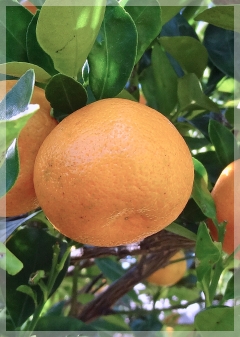 “What’s your orange?” the teacher asked her remote learning class. Before having them answer, she explained the “monkey trap.” In Southeast Asia, hunters capture monkeys by drilling a hole in a pumpkin. The hole is just large enough for a monkey’s hand but too small for his fist. They secure the pumpkin to a tree, put a piece of sweet juicy orange inside the gourd, then retreat and wait. Eventually, an unsuspecting monkey comes along, smells the orange, and reaches through that small hole into the pumpkin. Once he’s grabbed hold of the orange, however, his fist can’t get back through the same hole. The monkey pulls and pulls but can’t free his hand. While he’s struggling to pull out his orange-filled fist, hunters easily throw a net over him. Not understanding that he can’t have both his freedom and the orange, he loses them both. After telling this story, the teacher again asked her students, “What is your orange? What is it you can’t release?”
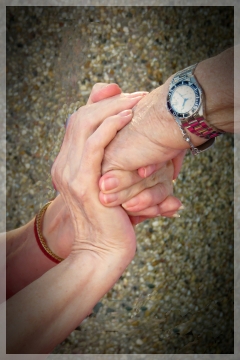 While social distancing has put an end to breaking bread with friends and holding hands while sharing a table blessing, I recall a dinner several years ago when I held the hand of our pastor’s wife during grace. For a small woman, her hands were larger and stronger than I expected. After grace, I looked at them and, comparing her youthful hands with mine, admit to feeling a twinge of envy. Like her, I played the piano but, unlike her, I could barely span an octave. Her sturdy hands had incredible reach and, unhampered by arthritis, there was power in her touch on the keyboard. I was overwhelmed by the strength of her hands and the beautiful way she uses them to praise the Lord as the worship leader at our mountain church.
 Devotions of the Heart