LETTING GO

Then Jesus said to his disciples, “If any of you wants to be my follower, you must turn from your selfish ways, take up your cross, and follow me. If you try to hang on to your life, you will lose it. But if you give up your life for my sake, you will save it. … Jesus told him, “If you want to be perfect, go and sell all your possessions and give the money to the poor, and you will have treasure in heaven. Then come, follow me.” But when the young man heard this, he went away sad, for he had many possessions. [Matthew 16:24-25,19:21-22 (NLT)]

Like any mother, I remember my children’s first steps. After hesitantly pulling themselves up and taking a few tentative steps, they soon realized they could cruise along while holding onto something or someone. Eventually, the tots became bold enough to let go of one piece of furniture and reach toward another to continue their adventures. A fair amount of parental urging, however, was usually needed to get them to finally let go of furniture, walls, or people and walk completely on their own. But, after taking those first solo steps, there was no stopping them. Off they went exploring a new, wonderful, and limitless world while I ended up chasing them and wondering why I’d been in such a rush have them walk.

Like a toddler learning to walk or the rich man in today’s verse, are we reluctant to let go of something that is keeping us from a new, wonderful, and limitless world in Christ? The rich man was unwilling to let go of his wealth—are we afraid to release our grip on possessions that encumber us? Could we value things more than a relationship with God? Is there an unhealthy relationship holding us from a relationship with Jesus or have we become too comfortable in old patterns of behavior or attitudes to face new ones? Are we hanging on to anger or loath to let go of resentment and forgive?

Are we simply afraid of the unknown—of trusting? Are we unwilling to cede control and give charge of our lives to Him? Are we more interested in our own version of happiness than God’s or more interested in following our plan than His? Are we afraid of what He might ask of us? Could we think we’re simply not worthy of His love? Once we release all that is holding us back, the Kingdom of God is waiting for us. It’s there for the asking! We just need to let go and take that first step to experience His unconditional love, forgiveness, hope, joy, and eternal life!

The difference between the toddler and the Christian, however, is that while the toddler learns to walk completely on his own, once a Christian releases all that is holding him back, he is never alone. God’s hand will hold and sustain him and he need never stumble or fall.

19th century evangelist (and publisher) D. L Moody called profit, pleasure, and preferment “the wicked man’s trinity.” What are we willing to release for the Holy Trinity?
I once thought these things were valuable, but now I consider them worthless because of what Christ has done. Yes, everything else is worthless when compared with the infinite value of knowing Christ Jesus my Lord. For his sake I have discarded everything else, counting it all as garbage, so that I could gain Christ and become one with him. [Philippians 3:7-9a (NLT)]

Copyright ©2022 jsjdevotions. All rights reserved.

NICODEMUS AND JOSEPH

Therefore, if anyone is in Christ, he is a new creation. The old has passed away; behold, the new has come. [2 Corinthians 5:17 (ESV)]

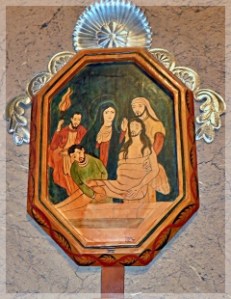
station of the cross - 13 - golindrinas NMNot all of the Sadducees and Pharisees were disinterested in the truth. Consider Nicodemus, a man who was both a Pharisee and a member of the Sanhedrin, the Jewish ruling council. Drawn to Jesus because of His miracles, the Pharisee visited Him alone during the night. That his approach seems furtive implies Nicodemus was hesitant to let others know of his visit. Nevertheless, he approached Jesus with respect, an open mind, and honest questions. Although some Pharisees said Jesus got His power from Satan, Nicodemus began by acknowledging that Jesus’ miracles testified He came from God. Recognizing that Jesus came from God, however, was not enough. Jesus’s response was, “Unless you are born again, you cannot see the Kingdom of God.” Jesus, of course, was speaking of spiritual rebirth but Nicodemus’ response implies he took Jesus’ words literally when he pointed out the impossibility of an old man re-entering his mother’s womb to be born again.

While most of us are familiar with this verse as saying “born again,” the word used was anóthen, meaning “from above,” so Nicodemus could have understood Jesus was speaking figuratively of a spiritual birth. The Pharisee may have wondered how an old man, set in his beliefs, habits, position, and attitude, ever could make such a radical change and start fresh. Being stuffed back into the womb is impossible but spiritual rebirth can seem as unfeasible. Jesus acted surprised that Nicodemus, a respected Jewish teacher, didn’t understand the things about which He spoke. His reference to Moses lifting up a bronze snake on a pole to heal (found in Numbers) and His words about water and the Spirit that echoed words written by Ezekiel [36:25-27] may have prompted the Pharisee to go back and re-study Scripture.

The next we read of Nicodemus is during a meeting of the Sanhedrin when he pointed out the illegality of convicting Jesus without a trial. During the sham trial that followed, however, neither he nor Joseph of Arimathea, another secret follower of Jesus, defended Jesus. Whether they still had doubts, were afraid, or simply thought no harm could come to the Messiah, they remained silent when others condemned Him. It may not have been until Calvary that the two Pharisees finally understood Jesus’ comparison of Moses raising the pole in the wilderness to heal the Israelites to the “Son of Man” being “lifted up, so that everyone who believes in him will have eternal life.” [John 3:14]

The next time we read of the two men, Jesus has been crucified. At great risk to position and reputation, Joseph asked Pilate for Jesus’ body. Rather than the disciples, it was Joseph and Nicodemus—men who once has been too afraid to speak for Jesus—who prepared His broken body for burial. They anointed the Lord with over 70 pounds of ointment, wrapped Him in sheets of linen, and placed Him in Joseph’s tomb. By doing so, the two men publicly declared their belief in Jesus. They were born anew!

While Scripture doesn’t tell us what happened to Nicodemus and Joseph, we do know what would have happened to any member of the Sanhedrin having done what they did—he’d be kicked off the High Council, lose his position as Pharisee, and probably be banished from his synagogue. There’s little doubt that both men lost their power, wealth, and position but, in return, they gained eternal life! All in all—not a bad trade!

Then Jesus told his disciples, “If anyone would come after me, let him deny himself and take up his cross and follow me. For whoever would save his life will lose it, but whoever loses his life for my sake will find it. For what will it profit a man if he gains the whole world and forfeits his soul? Or what shall a man give in return for his soul? For the Son of Man is going to come with his angels in the glory of his Father, and then he will repay each person according to what he has done.” [Matthew 16:24-27 (ESV)]

Copyright ©2022 jsjdevotions. All rights reserved.

DOUBT AND UNBELIEF

lilacWe reject all shameful deeds and underhanded methods. We don’t try to trick anyone or distort the word of God. We tell the truth before God, and all who are honest know this. If the Good News we preach is hidden behind a veil, it is hidden only from people who are perishing. Satan, who is the god of this world, has blinded the minds of those who don’t believe. They are unable to see the glorious light of the Good News. They don’t understand this message about the glory of Christ, who is the exact likeness of God. [2 Corinthians 4:2-4 (NLT)]

Yesterday, when writing about John the Baptist, I said that doubt was not the same as unbelief. In John’s question to Jesus, we have the doubts of a godly man but we see trickery and unbelief in most of the questions of the Pharisees and Sadducees.

Because the Sadducees interpreted Scripture literally and the Pharisees gave equal significance to their oral tradition, the groups frequently argued with one another over Jewish doctrine. They were, however, united in their hatred of Jesus. Unlike the Pharisees, the Sadducees did not belief in an afterlife or the resurrection of the dead. Nevertheless, they asked Jesus a question dealing with resurrection. Jewish law said that, if a woman’s husband died without having a son, the husband’s brother had the responsibility of marrying her. Using this law as their starting point, the Sadducees set up a bizarre scenario in which one brother dies without having children and his widow, who never bears a son, ends up marrying and burying brother after brother until she’s married and buried all seven brothers. The Sadducees want Jesus to tell them which of the seven will be her husband in the afterlife.

Since they didn’t believe in any afterlife, theirs was not an honest question and they’re sure Jesus can’t answer without looking foolish, offending people, or being caught in an inconsistency. He’ll appear arbitrary if he picks one brother over another and immoral if He says they all can have her! His other choice (and possibly the one for which they hope) is to admit that resurrection is a preposterous doctrine. Not only would they score a point against the Pharisees but Jesus would look like a fraud since He couldn’t be the “resurrection and the life” if there were no resurrection!

Imagine their consternation when Jesus corrected them by saying they’d misinterpreted Scripture and had underestimated God’s power with their assumption that resurrection meant a continuation of the same kind of bodies we have in this life. Jesus explained that people would be raised into bodies unlike their present ones and marriage and procreation would be unnecessary. When Jesus added that people will have bodies “like the angels in heaven,” He dug the knife deep into their absurd question because Sadducees didn’t believe in angels any more than they did resurrection.

In His final thrust, Jesus asked the Sadducees if they’d read about resurrection in the Scriptures. He then repeated these words from Exodus: “I am the God of Abraham, the God of Isaac, and the God of Jacob.” [3:6] Even though the patriarchs had been dead for more than four centuries, God’s words to Moses were in the present tense which showed that the men remained alive before Him. Jesus could have found scriptural support in words from Isaiah, Daniel, or Job but He chose a verse from part of the Pentateuch, the section the Sadducees found most authoritative. Having been out-argued by the Son of God, I imagine the Sadducees departed with their proverbial tails between their legs. The crowd that heard Jesus, however, was “astounded at his teaching.”

When comparing the questions posed by John’s disciples and the Sadducees, the differences between doubt and unbelief become clear. Where doubt seeks answers, unbelief isn’t interested in them. Doubt seeks enlightenment; unbelief prefers darkness. Doubt is receptive; unbelief is hostile. Doubt is straightforward; unbelief has ulterior motives. Doubt wants the truth; unbelief just wants to win.

There are those who insist that it is a very bad thing to question God. To them, “why?” is a rude question. That depends, I believe, on whether it is an honest search, in faith, for His meaning, or whether it is the challenge of unbelief and rebellion. [Elisabeth Elliot]

But when the Pharisees heard that he had silenced the Sadducees with his reply, they met together to question him again. [Matthew 22:34 (NLT)]

Copyright ©2022 jsjdevotions. All rights reserved.

JOHN THE BAPTIST – Part 2

On the following day, John saw Jesus coming towards him and said, “Look, there is the lamb of God who will take away the sins of the world! This is the man I meant when I said, ‘A man comes after me who is always in front of me, for he existed before I was born!’ It is true I have not known him, yet it was to make him known to the people of Israel that I came and baptised people with water.” [John 1:29-31 (PHILLIPS)]

mourning doveWe don’t know if John the Baptist recognized Jesus as his distant cousin when the two men met on the banks of the Jordan. Although they were the same age and their mothers were related in some way, with John in the desert and Jesus in Nazareth, it’s not likely they knew one another. If they did, Jesus probably seemed nothing more than an ordinary person to John at the time.
When Jesus walked toward him that day, however, John knew he was seeing someone who was more than a carpenter from Nazareth. In the same way that Elizabeth knew Mary was “the mother of my Lord” when the unborn John leapt in her womb, John recognized Jesus’ true identity as the Son of God. John seemed to have no doubt about Jesus when he testified to seeing the Spirit descend on Him like a dove and, throughout John’s ministry, he continued to point out Jesus as the “Lamb of God.”

After Jesus’ baptism, the gospel of John tells us that both John and Jesus carried on baptizing ministries. Perhaps out of jealousy, some of John’s disciples complained that more people were going to Jesus than coming to John. Again, John made it clear that he knew their different roles when he compared himself to the best man and Jesus to the bridegroom. “He must become greater and greater, and I must become less and less.” [3:30]

More than a year later, what happened to John’s confidence in Jesus’ identity? The man who once had been so sure about Jesus sent his disciples to ask, “Are you the Messiah we’ve been expecting, or should we keep looking for someone else?” [Mt 11:3] Languishing in Herod’s dungeon, John probably wondered why the conquering king from David’s line hadn’t released him. Why hadn’t Jesus taken the throne from Herod and Rome? Where was the end-time outpouring of the Spirit, the winnowing fork that would separate the chaff from the wheat, and the one who would burn the chaff with “never-ending fire”?

In truth, Jesus wasn’t the Messiah that John and his disciples were expecting; nevertheless, He was the Messiah! John, however, didn’t understand that Jesus had to teach, heal, suffer, die, resurrect, and ascend before returning a second time and executing final judgment. At first, it seems that Jesus ducks John’s question with a summary of his miracles but John understood. The miracles Jesus listed fulfilled the messianic promises in Isaiah; they were proof that He was the Messiah. Jesus’ final message for John is a beatitude that encouraged the Baptizer (and the rest of us) not to stumble in our faith just because Jesus doesn’t fit our expectations.

While we may not be languishing in a dungeon as was John, we may be in languishing in grief, infertility, depression, illness, addiction, chronic pain, money issues, infidelity, or family problems. Just as Jesus didn’t meet John’s expectations, He doesn’t always meet ours. He didn’t free John from Herod’s prison and He may not free us from ours and, like John, we may have doubts. Faith and doubt, however, are not antonyms and doubt and unbelief are not synonyms! We can be people of faith and still have questions; like John, we never should be afraid to ask those questions. John went to Jesus for the answers and, like him, we should look to the words and works of Jesus Christ for our ours. We’ll discover, as did John, that the Lord’s credentials will hold up to the toughest of questions!

Jesus gave them this reply, “Go and tell John what you see and hear—that blind men are recovering their sight, cripples are walking, lepers being healed, the deaf hearing, the dead being brought to life and the good news is being given to those in need. And happy is the man who never loses faith in me.” [Matthew 11:4-6 (PHILLIPS)]

Copyright ©2022 jsjdevotions. All rights reserved.

SONGS OF VICTORY – MAUNDY THURSDAY 2022

Praise the Lord! Yes, give praise, O servants of the Lord. Praise the name of the Lord! Blessed be the name of the Lord now and forever. Everywhere—from east to west—praise the name of the Lord. For the Lord is high above the nations; his glory is higher than the heavens. [Psalm 113:1-4 (NLT)]

The stone that the builders rejected has now become the cornerstone. This is the Lord’s doing, and it is wonderful to see. This is the day the Lord has made. We will rejoice and be glad in it. … Give thanks to the Lord, for he is good! His faithful love endures forever. [Psalm 118:22-24,29 (NLT)

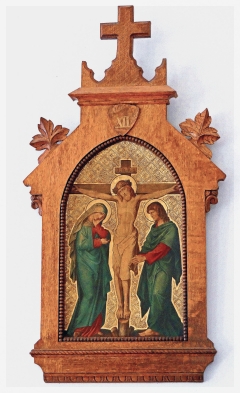
crucifixion - cathedral st. francis - santa feJesus knew that one would betray Him, another deny Him, and all desert Him. He knew the people He’d fed, healed, taught, and loved—the people who just a few days earlier had greeted him like a king with palm branches and shouts of “Hosanna”—soon would prefer a thief over Him. Because of His anguished prayers later that evening in Gethsemane, we know that He knew the suffering and torment that lay ahead for him. Nevertheless, he sang with the disciples during their Passover meal that last night and it wasn’t a sorrow-filled psalm of lament.

Because it was a Passover feast, at least twice during the evening they would have paused to sing the traditional Passover hymns commemorating Israel’s escape from slavery. Known as the “Egyptian Hallel” and consisting of Psalms 113 through 118, they are joyful hymns of praise and thanksgiving. Hallel literally means praise and the Hebrew phrase Hallelu Yah, meaning “praise the Lord,” is found frequently in these beautiful psalms. The sages understood that Psalm 118, the climax of the Hallel, was about the Messiah and that night in Jerusalem, nearly 2,000 years ago, the Messiah Himself sang those very words. As the disciples gathered in that upper room celebrating Israel’s release from bondage in Egypt, did they realize they really were celebrating man’s release from bondage to sin?

The following day, after three hours on the cross, Jesus cried out, “My God, my God, why have you abandoned me?” After the praise and thanks of the previous night, did He now doubt God? The question was rhetorical because Jesus knew exactly why He was suffering—He was bearing the weight of the sins of the world. What the gospels don’t include is the rest of Psalm 22, the psalm Jesus probably was reciting. Although the psalm begins with the complaint of unanswered prayers and abandonment by God, it is followed by a statement of confidence in Him. A complaint of being forsaken by men comes next but it also is followed by an expression of trust in the Lord.

Although the psalm was written by David, rather than reflecting his experiences, it prophetically presented the future suffering of the Messiah and the next several stanzas clearly depict the crucifixion of Jesus: people mocked and scorned Him, He was in pain, His strength ebbed, His mouth was dry, His hands and feet were pierced, He was dying, and His clothing was divided and lots cast for it. These lines are followed by a cry for deliverance.

By the psalm’s 22nd verse, however, its tone changes and the plaintive cries turn to praise and words of faithful confidence: “I will proclaim your name to my brothers and sisters. I will praise you among your assembled people. Praise the Lord, all you who fear him!” The praise and promises continue throughout the rest of the psalm. These are not the words of a defeated man but the words of the promised Messiah, the Anointed One, the one who fulfilled the promise made to Abraham in Genesis that, “through your descendants all the nations of the earth will be blessed.” Out of what seemed to be defeat came triumph.

The One who’d sung “Hallelu Yah,” the previous night with his disciples again praised the Lord with His last words as He hung on the cross. Hallelujah! Praise the Lord!

The cross was two pieces of dead wood; and a helpless, unresisting Man was nailed to it; yet it was mightier than the world, and triumphed, and will ever triumph over it. [Augustus William Hare]

I will praise you in the great assembly. I will fulfill my vows in the presence of those who worship you. The poor will eat and be satisfied. All who seek the Lord will praise him. Their hearts will rejoice with everlasting joy. The whole earth will acknowledge the Lord and return to him. All the families of the nations will bow down before him. For royal power belongs to the Lord. He rules all the nations. Let the rich of the earth feast and worship. Bow before him, all who are mortal, all whose lives will end as dust. Our children will also serve him. Future generations will hear about the wonders of the Lord. His righteous acts will be told to those not yet born. They will hear about everything he has done. [Psalm 22:25-31 (NLT)]

Copyright ©2022 jsjdevotions. All rights reserved.

PHILIP AND THE EUNUCH – Part 1

Now an angel of the Lord said to Philip, “Rise and go toward the south to the road that goes down from Jerusalem to Gaza.” This is a desert place. And he rose and went. And there was an Ethiopian, a eunuch, a court official of Candace, queen of the Ethiopians, who was in charge of all her treasure. [Acts 8:26-27 (ESV)]

firebushOnce day, the Holy Spirit told Philip to go south and then down the desert road between Jerusalem and Gaza. Although Scripture leads us to assume that Philip’s fortuitous encounter with the Ethiopian eunuch quickly followed, a look at the map tells us otherwise. At the time, Philip was in Samaria and, before he could walk the road from Jerusalem to Gaza, he had a 42-mile uphill trek south to Jerusalem before turning southwest onto the 50-mile stretch of road leading to Gaza, the southernmost of the five chief Philistine cities in southwest Palestine and the last settlement before the desert waste stretching away to Egypt. The trip to Jerusalem probably took at least two days and we don’t know how far down the Gaza Road he walked before the Apostle discovered his God-ordained task and met the treasurer of Ethiopia. In actuality, Philip was on this mission for several days before he knew why he’d been sent.

While most translations say the eunuch was from Ethiopia, he was not from the nation we know as Ethiopia. He was from a territory called Cush in the Old Testament and Nubia (meaning black) by the Romans. Present day Ethiopia (once called Abyssinia) is southeast of the ancient Nubia. This large kingdom was located in today’s southern Egypt and northern Sudan, an area considered by the Romans and Greeks to be the outer limits of the known world or “the end of the earth.” Referring to the dark skin of its inhabitants, the Greeks called any place south of Egypt Aithiopia, meaning the land of the “Burnt-Faced People.” When Wycliffe translated the Greek into English in 1382, he called this land Ethiopia and, until the late 1800s, Ethiopia was a general term referring to any of Black Africa.

The Ethiopian man was the Secretary of the Treasury/Chancellor Exchequer for Candace (Kandake in some translations). Rather than a given name, Candance was the title given to the queen mother. Her son, the king, was considered the child of the sun. As such, he was considered too holy to get involved in secular matters so the queen mother ruled the kingdom on his behalf. The Ethiopian is referred to as a eunuch because it was common in the ancient world to castrate trusted male servants in the royal household. It kept them out of the royal harem (or queen’s bed) and, since they were incapable of setting up a dynasty of their own, castration prevented them from plotting to overthrow the government.

Finally, this Philip is not the one from Bethsaida—the one who brought his friend Nathanael to Jesus and was one of the twelve apostles. This Philip is one of the seven men selected as deacons for the Jerusalem church. Following the martyrdom of Stephen and the persecution of Jesus’ followers, Scripture tells us that all the believers (“except the apostles”) fled Jerusalem and scattered. The deacon Philip went north to Samaria where he found his true calling—that of evangelist.

In Samaria, Philip “proclaimed Christ” and brought so many to believe in Jesus that “there was much joy in that city.” [Acts 8:8] Then, out of the blue, the Spirit told him to leave his thriving ministry in Samaria and start to Gaza. Did Philip question God’s reasoning? If he did, imagine his questions and the Spirit’s answers. Where exactly am I going? You don’t need to know. How will I know when I get there? I’ll tell you. What am I supposed to do? You’ll know when the time comes. How long will I be gone? As long as it takes. When do I leave? Now! We don’t know if Philip asked any of those questions but we do know that, when the Spirit said “Go!” he obeyed.

While it made no earthly sense for Philip to leave a successful ministry, it made sense to God because He’d arranged a divine appointment between Philip and the Ethiopian. God knew about the hunger for the Word of God that lay in the man’s heart and knew that Philip was the perfect choice to help fill it. People like Stephen, Peter and John brought the Gospel to Jerusalem and Judea. Philip took it to Samaria and, after he met with the Ethiopian, the Gospel would reach the last geographical sphere mentioned in the Great Commission—Ethiopia—the end of the earth!

Think of what we could do for the Lord if, like Philip, we went when the Spirit said, “Go!”

The Lord of all creation has ordained that he would do his work through us. Our seeking the Spirit’s guidance and obeying what he wants us to do and say is the way he works to bless the world. [Lloyd Ogilvie]

But you will receive power when the Holy Spirit has come upon you, and you will be my witnesses in Jerusalem and in all Judea and Samaria, and to the end of the earth. [Acts 1:8 (ESV)]

Copyright ©2022 jsjdevotions. All rights reserved