
He came into the very world he created, but the world didn’t recognize him. He came to his own people, and even they rejected him. [John 1:10-11 (NLT)]
 Scripture tells us that Jesus had at least six siblings: James, Joses, Simon, Jude, and two unnamed sisters. Can you imagine what it was like being a brother or sister to Jesus? Both his conception and birth were proclaimed by angels, a star announced His birth, and magi from the East presented Him with expensive gifts. It’s tough to top that sort of entrance into the world.
Having the Son of God as a half-brother couldn’t have been easy for any of them. Without sin, He probably never threw a temper tantrum or tossed a rock through a window. With no sassing, fighting, biting, or naughtiness, Jesus probably seemed the perfect child. While His brothers may have struggled with their religious studies, we know Jesus astounded the rabbis with his knowledge when He was twelve. Did His siblings think Jesus was Mary’s favorite? Such a blameless, intense, and devout elder brother was a tough act for anyone to follow and I suspect there may have been some resentment and jealousy on the part of his half-siblings.
Expecting a Messianic warrior king who would free the Jews from their bondage to Rome and restore Israel as an independent nation, Jews were expecting a very different Messiah from Jesus—one who would be a victorious political leader. No matter how pious and righteous Jesus was, His brothers had seen Him stub a toe, skin a knee, relieve himself, blow his nose, get a splinter, and break a sweat—hardly what one would expect of the promised Messiah. Jesus may have managed to turn water into wine but, to them, He was just a carpenter’s son from Nazareth.
When Jesus left home to become an itinerant rabbi, it appears that his family didn’t support His call. John tells us that, “even his brothers didn’t believe in him.” [7:5] Family honor was of utmost importance at the time. Considering His run-ins with the religious leaders, Jesus’ preaching may have been an embarrassment to the family, especially when he added tax collectors, prostitutes, and other sinners to His entourage.
Mark tells us Jesus’ family, thinking Him “out of his mind,” tried to take Him home. [3:21] Not understanding Jesus’ mission and divine authority, they probably saw His behavior as irrational. Their brother’s claims of divinity and messianic identity could be seen as blasphemous or delusional by the authorities and possibly dangerous to Him. Concerned both for their brother’s reputation and His well-being, Jesus’ family may have wanted a 1st century version of an intervention to protect Jesus from Himself and the Sanhedrin! It’s unlikely that Jesus’ brothers were even at the crucifixion. As He looked down from the cross, rather than entrusting Mary’s care to them, Jesus asked His beloved disciple John to care for her.
In spite of their absence from His ministry, in the first chapter of Acts, we find Jesus’ brothers meeting with the disciples and joining them in prayer after the crucifixion. [1:14] If they didn’t believe their brother before his death, why would they believe the words of His disciples after it? We can safely assume the reason for their change of heart from skeptics and doubters to believers was that they actually saw the resurrected Christ. The Apostle Paul specifically mentions that the risen Jesus appeared to James. [1 Cor 15:7] It was only after seeing their resurrected brother that His family finally believed in the truth of Jesus’ message. Accepting Jesus as the Messiah, they finally understood that He didn’t come to save the Jews from bondage to Rome but to save the world from bondage to sin—that He didn’t come to restore the old kingdom but to establish a new one. Instead of scoffers, His half-brothers became believers! James became a leader in the Jerusalem church and authored the book of James. History tells us that he died a martyr’s death in AD 62.
Jesus’ brothers had lived and worked with Him and yet they failed to see what was right in front of them. Like Thomas, they had to see the resurrected Christ before they could believe in Him. Seeing, however, is no guarantee of belief. Plenty of others saw Jesus and his miracles and never believed. As for us, unless we have a vision similar to Paul’s on the road to Damascus, we’re not likely to see the risen Christ in person. Nevertheless, if we believe in Him in this world, we will see Him in the next.
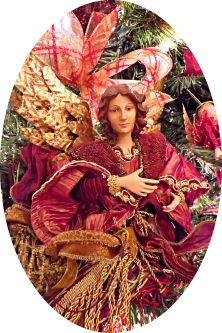 Angels taking on bodily form and appearing to people certainly wasn’t an everyday occurrence. Although they are God’s messengers, the message angels bring can be good news or bad. While they may help God’s people as they did for Elijah and Daniel, angels also execute God’s judgment as they did when striking down the firstborn males in Egypt. I suspect Gabriel looked fiercer and more powerful than the elegant sweet angels hanging on our Christmas trees. When he arrived unannounced in the empty Temple sanctuary, Zechariah was overwhelmed with fear and, when he suddenly appeared in an empty room in Nazareth, Mary was troubled and perplexed. Not knowing whether he was on a mission of judgment or mercy, it’s no wonder both Zechariah and Mary were fearful. Gabriel began his visits by telling them both not to be afraid.
 Today’s socks tell me, “I am perfectly made” and remind me of Psalm 139’s affirmation that, “I have been remarkably and wondrously made.” All of my low-cut athletic socks have pithy affirmations woven into the toes. Depending on what pair I choose, I’m reminded that I have hope or that I’m loved, brave, strong, grateful, kind, powerful, blessed, or thankful. My favorite pair, however, tell me, “I am with you always!” It may seem silly, but there are times, especially during difficult days, when I recall the day’s affirmation on my feet and I stand a little more assuredly.
 Back in 1957 (long before PETA existed), Curt Richter, a professor at Johns Hopkins, conducted a series of cruel and inhumane experiments to demonstrate the power of hope and resilience in overcoming difficult situations. In this case, the difficult situation was rats being put in a bucket of water with no means of escape and timing how long it took them to drown. After two preliminary experiments, Richter hypothesized that introducing hope to the rats would increase their survival times.
 Occasionally, I’ll spot a partially open moonflower (Ipomoea alba) during an early morning walk at the park. While the Moonflower’s cousin the Morning Glory opens wide to welcome the sunlight, the Moonflower prefers darkness. It’s only when the sun sets that it opens to a large trumpet-shaped bloom. Rather than competing during the day with brightly colored flowers for pollinators like bees and butterflies, Moonflowers enjoy pollinators like bats and moths at night. As the morning sun rises, the Moonflower again rejects the light and rolls up into itself.
 Devotions of the Heart