
And yet, O Lord, you are our Father. We are the clay, and you are the potter. We all are formed by your hand. [Isaiah 64:8 (NLT)]
What sorrow awaits those who argue with their Creator. Does a clay pot argue with its maker? Does the clay dispute with the one who shapes it, saying, “Stop, you’re doing it wrong!” Does the pot exclaim, “How clumsy can you be?” [Isaiah 45:9 (NLT)]
 I used the Lenox bone china that belonged to my mother and some of the stoneware that belonged to my husband’s grandparents at our Thanksgiving dinner. While the Lenox was special ordered from the city’s finest department store as a wedding gift in 1938, the stoneware was purchased in 1929 at the local five-and-ten-cent store. The ornate gold-rimmed Lenox is translucent and elegant; used only on special occasions, it still looks new after eighty years. The stoneware is opaque, less formal and meant for daily use; having been used every day for more than forty years, a few pieces are chipped or stained. When compared, people might think the Lenox more valuable than the stoneware, but they’d be wrong. Both are equally precious because they tell the story of generations gathering together for good food and fellowship and both sets of china served their specific purposes well.
As I laid out the plates for our holiday dinner, I thought of Isaiah’s words using the metaphor of God as a potter and us as His clay. Do we get to complain that we’re not fancy china with gold trim? Do we feel short-changed if we’re pottery instead of porcelain? We shouldn’t; God created and designed each one of us perfectly for our specific purpose. While our general purpose is to glorify God, each of us has been given a special way to accomplish that goal with our unique personalities, talents and gifts. Some, like the busy Martha, are as practical as Corningware and designed for everyday use while others, like her sister Mary, seem as impractical as the gold-rimmed Lenox that should be hand-washed. All of us, however, are special and, unlike my china, we’re not part of a set. No one else has the exact same pattern; we are one-of-a-kind limited editions!
Although the word “sacred” is usually used in a religious context, anything that is set apart is said to be sacred. For example, motherhood is a sacred calling, Wrigley Field is sacred territory to Cubs’ fans, and, for many, a roast turkey is sacred to Thanksgiving dinner. Something that is sacred can also be said to be consecrated to or belonging to God. In both uses of the word, we are sacred beings. We belong to God and He has set us apart for a specific purpose. As we celebrate our sacred uniqueness, we should be aware of everyone else’s uniqueness, as well. If we have a divine purpose, so do they; if we are sacred, so is everyone else we meet! If God’s thoughts about me are precious, so are His thoughts about my neighbor. Moreover, it’s not just my name that He’s etched into the palm of His hand—everyone’s are!
As we move into this holiday season and deal with the challenges of traffic, crowded malls, long lines at the grocery, short-tempered wait staff and sales clerks, difficult and demanding customers and bosses, meeting impossible deadlines, and the other demands that accompany Christmas, let us look at one another with the eyes of Jesus—eyes that see the sacredness and beauty of each individual, even if they have a few chips or are a little rough around the edges!
 Love never gives up. Love cares more for others than for self. Love doesn’t want what it doesn’t have. Love doesn’t strut, Doesn’t have a swelled head, doesn’t force itself on others, Isn’t always “me first,” doesn’t fly off the handle, Doesn’t keep score of the sins of others, doesn’t revel when others grovel, Takes pleasure in the flowering of truth, puts up with anything. Trusts God always, always looks for the best, Never looks back, but keeps going to the end. [1 Corinthians 13:4-7 (MSG)]
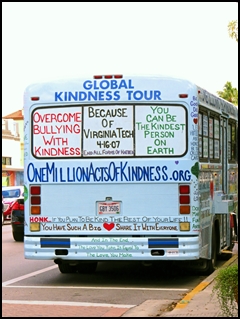 The mission of the World Kindness Movement (WKM) is to “inspire individuals and connect nations to create a kinder world.” Having no political or religious affiliations, the WKM is an international coalition of like-minded kindness NGOs (non-governmental organizations typically set up to address a social or political issue). Since its introduction in 1998, “World Kindness Day” has been observed every November 13. The purpose of this day is to “highlight good deeds in the community because kindness is the common thread that unites us all.”
 “He’s the ultimate solipsist – the guy who’d burn the world down to light his cigarette. He’s not cruel, particularly – although he’s capable of cruelty – he’s just so focused on his own goals and his own needs that nobody else exists for him.” That’s how Mike Carey, author of the graphic novel series Lucifer, describes his main character. I admit having to look up “solipsism” to learn that it’s the extreme preoccupation with self and the indulgence of one’s feelings and desires. A self-professed atheist, Carey went on to say, “I think total self-absorption is probably the root of most evil that we meet in the world.” While he may not believe in God, I think Carey has a good handle on the root of much of the world’s evil: self! Satan just loves to make us think of ourselves as more valuable and worthy than anyone else.
 Live wisely among those who are not believers, and make the most of every opportunity. Let your conversation be gracious and attractive so that you will have the right response for everyone. [Colossians 4:5-6 (NLT)]
 Greedy creatures that we are, when reading today’s verse, we tend to focus on the promise that God will give us our heart’s desires rather than the qualification: taking delight in the Lord. I usually think of a parent delighting in a child rather than a child of God delighting in his or her Heavenly Father. What does it mean to delight in God and how do we find our delight in Him?
 Devotions of the Heart