ENCOURAGING WORDS

Dear brothers and sisters, I close my letter with these last words: Be joyful. Grow to maturity. Encourage each other. Live in harmony and peace. Then the God of love and peace will be with you. [2 Corinthians 13:11 (NLT)]

Oh, give me a home where the Buffalo roam
Where the Deer and the Antelope play;
Where seldom is heard a discouraging word,
And the sky is not cloudy all day. [Brewster M. Higley]

pronghorn antelope - buffaloWouldn’t it be nice to live in a world where we’d never (at least rarely ever) hear a discouraging word? It shouldn’t be necessary to ride the range in Wyoming for that to happen.

When my eldest child entered adolescence, it frequently seemed like he’d decided his task in life was to annoy his mother as much as humanly possible. Regrettably, during those challenging years, there were lots of discouraging words. One evening, I realized that our communication consisted of me directing him (“Make your bed!”), correcting him (“Do it this way!”), disciplining him (“You’ve lost that privilege!”), criticizing him (“You can’t go out dressed that way!”), or denying him (“I said ‘No’ and that’s final!”). Admittedly, directions, corrections, and criticism are a necessary part of life as are discipline and denial. Nevertheless, realizing there was a room for improvement on my part as well as his, I made a concerted effort to keep my negative comments to a bare minimum.

Seldom speaking (or hearing) a discouraging word was not enough. Where, I wondered, were the words of love? Where were the words of encouragement so necessary for him to thrive and feel good about himself? One doesn’t need to take psychology 101 or even a dog obedience class to know about the importance of positive reinforcement (which is simply a fancy term for encouragement). I had to add positive and heartening comments to our interaction if he was going to flourish and bloom. With God’s guidance and a heavy dose of the Spirit’s patience, we managed to get through those trying years. In spite of my many parental failings, he blossomed into a delightful responsible young man. A wonderful father, he now has to deal with adolescents of his own (which is God’s payback)!

My mother used to say, “If you can’t say something nice, say nothing at all!” If we all followed that advice, the world would be a much quieter place and we’d never have to watch another campaign commercial! More, however, is needed. The Apostle Paul urged the early Christians to encourage one another and he truly practiced what he preached. Whenever he instructed and directed (even when he disciplined or corrected), Paul always seemed to add encouragement to his words.

Encouragement (or exhortation) is a gift of the Holy Spirit but that doesn’t mean those of us without this gift should fail to encourage! Those gifted with encouragement are the church’s cheerleaders, but the rest of us are the fans in the stands who join in supporting the team! In the Fruit of the Spirit, we find love and kindness (along with patience) which means all Christians are capable of encouraging the people we meet in our daily lives. It’s not enough to seldom speak a discouraging word; we need to speak encouraging ones!

Become the most positive and enthusiastic person you know. [H. Jackson Brown]

Preach the word of God. Be prepared, whether the time is favorable or not. Patiently correct, rebuke, and encourage your people with good teaching. [2 Timothy 4:2 (NLT)]

So encourage each other and build each other up, just as you are already doing. [1 Thessalonians 5:11 (NLT)]

Copyright ©2020 jsjdevotions. All rights reserved.

BLOWING KISSES

Since we are receiving a Kingdom that is unshakable, let us be thankful and please God by worshiping him with holy fear and awe. [Hebrews 12:28 (NLT)]

hibiscusIn the New Testament, the Greek word commonly translated as “worship” is proskyneō. While it came to mean kneeling down, prostrating oneself, showing reverence toward, and worshiping, its roots are thought-provoking. Coming from the Greek pro (to or toward) and kyneō (to kiss), its literal meaning is “to kiss towards!” Knowing his Greek, a pastor said of proskyneō: ”I like to think of our worship in church as being sons and daughters of God blowing kisses to our Father.” I thought of his words when I welcomed the kisses my children and grands blew to me on our recent Zoom call.
The way we worship has changed drastically since March. For some people, it involves sitting in their cars in the church parking lot, tuning their radios to a specific station, and drive-by communion. For others, worship requires reservations, temperature checks, face masks, assigned seats, roped off pews, and restrictions on singing. Many of us, however, find church on the screen of our computers, tablets, smart phones, or TV. Our worship is virtual.

The live streaming from most churches really isn’t “live.” Having found that wide shots of the sanctuary and recreating the traditional Sunday service doesn’t transfer well to a small screen, many churches now pre-record. Early in the week, the pastor videos his part at home or in the empty church. At a different time, the worship leader and musicians video their parts, often from different locations. The tech team then pieces together the separate recordings and adds words for the songs and relevant Bible verses before posting the now cohesive video to their chosen platform. There’s a good chance that, even though the pastor “led” the worship service, even he doesn’t know what the finished product looks like until it is streamed on Sunday. That’s the case for a pastor I know who watches worship service with the rest of his congregation when it goes live on Sunday mornings.

This pastor mentioned getting an email from one of his parishioners thanking him for the inspiring on-line services. After telling her pastor that she still rises early Sunday mornings so she can get dressed and do her make-up and hair, the woman said she sets up her home “pew” with a lit candle and a Bible (so she can follow along during the lessons). Adding that she always stands for the Creed, Gospel and hymns, the woman said it almost feels like she’s worshiping inside the church! Hers were words of conviction for the pastor who reluctantly admitted to being unshaven and still in his pj’s while sitting on the sofa, feet resting on the coffee table, drinking coffee and eating a Danish as he views the service on his television. After confessing that the only time he stands is to get another cup of coffee from the kitchen, he realized he was watching rather than worshiping.

It’s not easy to stay engaged while worshiping on-line. People who normally wouldn’t talk during music now chat on-line during worship songs. I wouldn’t think of checking my phone, texting, or getting up for coffee during the sermon, but I did it during last week’s virtual worship! We don’t have to put on make-up or wear our Sunday best to worship in this COVID world but we might want to examine our worship behavior. The Essential Bible Dictionary defines worship as, “The honor, reverence, and homage that we should pay to God for his perfection, greatness, and goodness.” Does our worship reflect our love, respect, gratitude, dedication, and deference to God? Whether we’re worshiping in a kitchen, car, park, or pew, may our worship be so reverent, single-minded, and heartfelt that God receives it with the same joy a grandma would when her children and grands blow her kisses!

And so, dear brothers and sisters, I plead with you to give your bodies to God because of all he has done for you. Let them be a living and holy sacrifice—the kind he will find acceptable. This is truly the way to worship him. [Romans 12:1 (NLT)]

For God is Spirit, so those who worship him must worship in spirit and in truth. [John 4:24 (NLT)]

Copyright ©2020 jsjdevotions. All rights reserved.

ASSERT ONLY LOVE

And further, submit to one another out of reverence for Christ. [Ephesians 5:21 (NLT)]


While being in lockdown for months may have given some couples a chance to reconnect, that connection wasn’t welcomed by all. Once their mandatory 10-week lockdown was lifted, Italian lawyers reported a 30% surge in couples starting divorce proceedings and both China and Saudi Arabia showed a similar rise when couples emerged from quarantine. For some couples, 24/7 togetherness for weeks on end exacerbated typical martial issues like money, housework, drinking, child care, screen and phone time, and dirty dishes in the sink. With the additional stressors of homeschooling, job loss or working at home, apprehension about the future, and trying to navigate safely in a COVID-19 world, even the best marriages have been tested.

We may have married our spouses for better and worse, in sickness and health, but none of us expected this much togetherness for such an extended time. Before we complain, let’s remember our friends who live alone. With the exception of the pizza delivery man or the cashier behind a plastic shield at Walgreen’s, their contact with the outside world has been from a 6-foot distance. FaceTime or Zoom replaced visits from friends and family and it’s been months since they’ve gotten hugs from anyone. Their isolation puts our petty spousal complaints in perspective!

There always will be disputes in any relationship but, in a good relationship, both parties understand the importance of negotiation and concession. Unfortunately, we live in an increasingly polarized society and the world’s divisiveness seems to have crept into our homes. Lines get drawn in indelible marker (or even cement) and people often think of compromise, trade-offs, finding the middle ground and deference as signs of weakness.

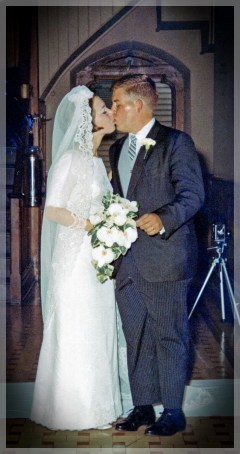
Today, my husband and I celebrate our anniversary. Rather than the traditional romantic dinner, weekend getaway, or family party, we’ll celebrate with a Chicago-style pizza our children sent us and a feel good movie on Netflix. The one tradition we’ll keep, however, is reading 1 Corinthians 13: the same words that were read at our wedding 53 years ago. Paul wasn’t writing about romantic or eros love. As delightful as romantic love is, that’s not what gets people through cancer, job loss, financial worry, Parkinson’s, a disabled spouse, an addicted child, or months of sheltering in place. Paul was writing of agape love—sacrificial unconditional love: the kind of love that carries people through pandemics (and decades of marriage)!

We’re often told to assert ourselves. What if, instead of asserting ourselves, we asserted our love? What if we remembered (and followed) Paul’s words: “love does not demand its own way.” Our love for one another is far more important than almost anything about which we disagree. When faced with disputes, let’s allow love and God to be our guides.

 What counts in making a happy marriage is not so much how compatible you are, but how you deal with incompatibility. [Leo Tolstoy]

Love is patient and kind. Love is not jealous or boastful or proud or rude. It does not demand its own way. It is not irritable, and it keeps no record of being wronged. It does not rejoice about injustice but rejoices whenever the truth wins out. Love never gives up, never loses faith, is always hopeful, and endures through every circumstance. [1 Corinthians 13:4-5 (NLT)]

Copyright ©2020 jsjdevotions. All rights reserved.

FINAL HOURS

Jesus replied, “I tell you the truth, unless you are born again, you cannot see the Kingdom of God.” [John 3:3 (NLT)]

Every man must do two things alone; he must do his own believing and his own dying. [Martin Luther]

ColumbineWhen Pat died, it was difficult to find words of comfort for her grieving husband. A non-believer, he has no faith in Jesus, no understanding of the soul, no hope of eternity, and no anticipation of Christ’s return. Distance and timing kept me from attending Pat’s Celebration of Life and, because we rarely saw one another, I’m not sure I felt her absence until today when I received a letter from her husband. With the letter was a bookmark made for her Celebration of Life. It had her picture and some sweet words about memories filling our hearts, time healing our souls, and the peace of knowing there’s one more angel in heaven. To a non-believer, those words may be comforting but, to me, they were empty (along with being theologically incorrect). I’ve never understood how non-believers find it so easy to believe in heaven and angels but so hard to believe in judgment, hell, God, or Jesus.

As difficult as I found it to find comforting words for Pat’s husband, I’m not finding words in Scripture that bring much comfort to me. Sadly, Pat seemed to share her husband’s lack of faith in Jesus. Although we grew up together, our lives went in different directions when I was fifteen and we lived more than 1,000 miles apart as adults. Except for an occasional wedding or funeral, our contact consisted mostly of emails, a shared interest in genealogy, a few phone calls, and Christmas cards.

Growing up, we attended the same church and I know Pat was baptized as an infant; that, however, doesn’t mean she was saved. Regardless of the age or the method, Baptism isn’t what saves us. We are saved by a proclamation of faith in Jesus. While she may have proclaimed her outrage at cold water sprinkled on her head, that wasn’t a statement of faith.

We both were confirmed in eighth grade but, like infant Baptism, Confirmation has no Biblical basis. At the time, Pat reaffirmed the vows her Baptismal sponsors made for her, but I suspect that was more about doing what was expected and getting a new white dress and gifts than declaring her undying faith in the work and words of Jesus. In spite of our Confirmation classes, I don’t think either of us truly understood the ritual’s meaning or knew what a commitment to follow Jesus as Lord and Savior really meant.

Undoubtedly, Pat was a good person but “Christian” is not an adjective nor is it a synonym for good. If good works were all it took for eternal life, Jesus’ death upon the cross wouldn’t have been necessary. Salvation is more than going to church, being raised in a Christian family, a sprinkle of water, a Bishop laying his hands on your head, a prayer, giving to charity, calling yourself a Christian, or even saying you’ve made a decision; it is becoming a new person in Christ. Being a Christian, a follower of Christ, involves putting our entire faith and trust in the person and work of Jesus, finding a new life in Him, and the presence of His Holy Spirit in our lives.

Pat knew of my faith but let me know that Jesus was off limits when it came to our communications. Nevertheless, I look at that bookmark with the picture of her smiling face and wish I’d tried harder. If Pat didn’t do so earlier, I hope that, in her final days, she took God up on his offer of salvation. Waiting until the eleventh hour, however, is dangerous; after all, we might die at 10:30!

When God our Savior revealed his kindness and love, he saved us, not because of the righteous things we had done, but because of his mercy. He washed away our sins, giving us a new birth and new life through the Holy Spirit. He generously poured out the Spirit upon us through Jesus Christ our Savior. Because of his grace he made us right in his sight and gave us confidence that we will inherit eternal life. [Titus 3:4-7 (NLT)]

Copyright ©2020 jsjdevotions. All rights reserved.

LEADING THE HERD

sheepDo not be deceived: “Bad company ruins good morals.” Come to your right mind, and sin no more. [1 Corinthians 15:33-34 (RSV)]

You’ve probably heard of herd mentality or herd behavior: when people’s natural desire to be part of the crowd affects their decisions. When herd behavior occurs, rather than relying on their own judgment, values, or natural instinct, people allow themselves to be influenced by the behavior of those around them. While copying what others are doing can be useful at times (it gets our garbage out the right nights), challenges arise when our personal beliefs contradict what the crowd is doing.

A few years ago, when we were in Chicago, my husband wanted to purchase his favorite cheddar/caramel popcorn mix at Garrett’s. While he waited in line inside the crowded store, I remained outside. The queue of customers eventually extended out the door and partway down the street. When a couple visiting from France asked me why people were waiting, my reply of popcorn surprised them. Telling me they could understand lining up for chocolate or ice cream but certainly not popcorn, I expected they’d continue walking. Instead, they decided to follow the herd and joined the long line.

Even though that couple weren’t fans of popcorn, they joined the herd, but do we only follow the herd when there are more of them than us? According to an experiment done in 2008 at Leeds University, the answer is no. 200 subjects were told to walk in a totally random path around a large hall without communicating with one another in any way. Unknown to them, however, a group of walkers had been given detailed instructions on where to walk. In a short time, the “random” walkers started following the ones who seemed to know where they were going and a long snake-like line formed. When the experiment was over, those “random” walkers admitted not realizing that they’d become followers. The researchers found that it took only 5% of the people to walk purposefully to get the other 95% to follow. Apparently humans, like sheep and birds, will subconsciously gather in flocks and follow a minority if that minority appears to know what they’re doing!

Scripture warns that bad company can corrupt good character but, if we consider herd behavior, could good company improve bad character? Believing their findings could be used when planning traffic flow in emergencies and crisis situations, the Leeds’ researchers called the people who were followed “informed individuals.” The world appears to be in crisis and, as Christ’s followers, we are the “informed individuals.” Could this be our call to lead the herd?

Jesus left His church in the hands of just a few followers and yet there were over 3,000 believers by the first Pentecost and the church continued to grow rapidly. In those early years, Christianity was illegal, believers were persecuted, and there were no church buildings, public ceremonies, famed evangelists, or mass media. Nevertheless, the church steadily expanded in the first 300 years. It spread because people saw the lives of Christ’s followers: that Christians walked with a sense of purpose in a different and better way. Knowing the route to take, the informed minority led the herd to Jesus. Do we walk as “informed individuals” or like someone with a bumper sticker reading, “Don’t follow me—I’m lost, too!”  Let our lights shine brightly that we might lead the way to the Lord!

We formerly rejoiced in uncleanness of life, but now love only chastity; before we used the magic arts, but now dedicate ourselves to the true and unbegotten God; before we loved money and possessions more than anything, but now we share what we have and to everyone who is in need; before we hated one another and killed one another and would not eat with those of another race, but now since the manifestation of Christ, we have come to a common life and pray for our enemies and try to win over those who hate us without just cause. [Justin Martyr describing Christians to Emperor Antoninus Pius in 153 AD]

You are the light of the world. A city set on a hill cannot be hid. Nor do men light a lamp and put it under a bushel, but on a stand, and it gives light to all in the house. Let your light so shine before men, that they may see your good works and give glory to your Father who is in heaven. [Matthew 5:14-16 (RSV)]

Do all things without grumbling or questioning, that you may be blameless and innocent, children of God without blemish in the midst of a crooked and perverse generation, among whom you shine as lights in the world. [Philippians 2:14-15 (RSV)]

Copyright ©2020 jsjdevotions. All rights reserved.

GIVE PEACE A CHANCE

A gentle answer deflects anger, but harsh words make tempers flare. [Proverbs 15:1 (NLT)]

mourning doveIn 2 Samuel 20, we find the story of the “wise woman from Able.” Even though David and his men had suppressed Absalom’s revolt, hostility remained between the people of Judah (David’s tribe) and the ten northern tribes of Israel. When a “troublemaker” named Sheba led the men of Israel in rebellion, Joab and an army of Judeans pursued him. After Sheba’s men found refuge in the town of Abel, Joab’s forces raised a siege ramp against the ramparts of the city and began to batter its walls. Knowing the city and all of its inhabitants would be destroyed once the walls were breached, a “wise woman” came to the wall and asked to speak with Joab. After reminding him that her city was famous for the wisdom of its inhabitants, she assured him of their loyalty and inquired what it was he wanted. Telling her that all he wanted was Sheba, the woman struck a bargain with him and traded the life of Sheba for the safety of the city. After she convinced the town to turn over the rebel leader, his dismembered head was thrown over the city wall, Joab and his army withdrew, and the city was safe.

Like many Old Testament accounts, this story is gruesome, but that shouldn’t keep us from its lesson. With famine, disease, destruction, and death threatening the besieged city, Able’s men wouldn’t stand idly by while their walls were under attack and some of Joab’s troops surely would fall before they conquered the city. When it comes to war, while one side eventually may lay claim to victory, no one ever wins. Instead of coming to the city wall armed with weapons as did Joab, the wise woman of Able came armed with reason. Simply by saying, “Let’s talk!” she discovered what he wanted, determined a solution, and saved lives on both sides of that wall.

It was this nameless woman who defused the situation but that’s what Joab should have done. When God gave the Israelites all those laws in Deuteronomy, He gave them some about warfare and, before attacking a city, they were to offer the inhabitants terms for peace. [20:10] Joab, however, immediately launched an attack (but we know from the rest of Joab’s story that he was a man of treachery and not of God). Wisdom, however, comes from the Lord and the wise woman of Able knew God and His word!

Unlike Joab, we’re not likely to be chasing a rebel army and, unlike this unnamed woman, we probably won’t need to save an entire city from death and destruction, but consider what might happen if we always sought peace before conflict? What if, the next time we’re in a disagreement or dispute, we were more interested in resolution than victory? Instead of trying to change someone else’s mind, what if we opened ours? What if we discussed rather than disparaged and negotiated rather than litigated? Instead of insisting we’re right, what if we tried to reconcile our differences? What would happen if we said, “Let’s talk!” and then really listened? What if we asked, “What can I do to make this right?” and then did it?

God blesses those who work for peace, for they will be called the children of God. [Matthew 5:9 (NLT)]

Do all that you can to live in peace with everyone. [Romans 12:18 (NLT)]

Copyright ©2020 jsjdevotions. All rights reserved.