
For the whole law can be summed up in this one command: “Love your neighbor as yourself.” [Galatians 5:14 (NLT)]
The only way to have a friend is to be one. [Ralph Waldo Emerson]
 When the religious scholar asked, “And who is my neighbor?” Jesus answered with the parable of the Good Samaritan in which he made it clear that one’s neighbors can be strangers—even enemies. Sometimes, however, our neighbor really is the guy next door or the couple sitting in the pew behind us at church.
Many of the houses in our Florida community have beautiful front porches and nearly every one of those porches has a lovely set of wicker chairs sitting on it. Yet, in all of our years here, I never have seen anyone sitting in those chairs. There was a time many years ago when people sat on their front porches and chatted with their neighbors after dinner. Now, I guess we’re all inside in front of our computers or televisions. Have we all become so busy with our own interests and activities that we have no interest in anyone else? Have we become so afraid of getting involved that we don’t even want to know our neighbors? How can we love them if we don’t even bother to meet them?
I thought of neighbors last night while driving through a nearby community famed for their over-the-top Christmas lights. With all the Santas, elves, snowmen, gaudy lights, and music, it was incredibly colorful, tacky, and fun, but it had little or nothing to do with Christ or Christmas. It did, however, have a lot to do with neighbors and friendship.
As we drove down the brightly lit streets, residents were outside chatting with one another, driving friends around in golf carts, or gathering around fire pits in front yards. Older children in Santa hats collected money for the Cancer Society and the little ones were toted around in wagons and strollers. With each street having a theme, neighbors had to talk to and work with one another to erect arches across their roads, place giant angels on the mailboxes, put candy canes in every yard on the block, or help one another assemble their elaborate displays. They probably discussed who on the block would play the holiday music and I’m sure several extension cords were shared. The residents had to communicate, cooperate, and assist one another. In fact, they seem to enjoy decorating so much that they also bedeck the neighborhood for Halloween. Their little community isn’t just a group of homes with the same zip code and garbage pick-up day; it is a group of neighbors who share and care—both for the community and for one another.
Taking the Good Samaritan parable seriously, my husband and I care for our neighbors—or at least the ones we don’t know: the nameless faceless ones who benefit from our donations to good causes. While that’s loving our neighbor, it’s the impersonal and easy way to do it. Rather than simply writing checks for the neighbor we’ll never know, we should think a little closer to home and find ways to know the neighbors down the street. Maybe it’s time to meet the woman next door, make an effort to go beyond a quick hello to the couple with the schnauzer, invite the recently widowed man down the street to dinner, or introduce ourselves to that stranger at church. Perhaps, that neighborhood with the extraordinary holiday decorations had more to do with love, Christ, and Christmas than I realized.
I have always wanted to have a neighbor just like you,
I’ve always wanted to live in a neighborhood with you.
So let’s make the most of this beautiful day,
Since we’re together we might as well say,
Would you be mine? Could you be mine?
Won’t you be my neighbor? [Fred Rogers]
 “A children’s story which is enjoyed only by children is a bad children’s story,” said C.S. Lewis. I agree and admit to enjoying the seven books comprising Lewis’ The Chronicles of Narnia both as a child and an adult. Even though the Narnia books take place in a make-believe world filled with talking animals, mythical creatures, and magic, there are Christian overtones to the entire series. For example, the first book calls up images from Genesis when Aslan, the Great Lion, sings Narnia into existence and evil is introduced to the land. In the second, Aslan willingly dies so that the sins of one boy are forgiven but comes alive again. In another book, Eustace, who had “greedy, dragonish thoughts” becomes a dragon. When Aslan strips away the boy’s scales and throws him into the water, the repentant boy is transformed and images of rebirth and baptism come to mind. Resembling the last book of the Bible, the final story in the series tells of a beast, a false prophet, Narnia’s fall, and a Narnian paradise (where sadness and weariness do not exist).
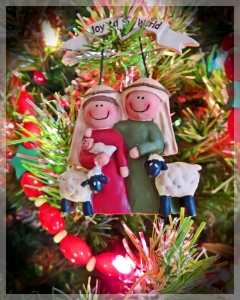 Even though “Black Friday” sales already have started and stores have been decorated for Christmas since Halloween, the holiday season doesn’t officially start until Thursday with Thanksgiving. Although the angel brought good news of joy to the shepherds and told them not to be afraid, the holiday season brings a sense of dread and anxiety for many of us. “Stress” and “family” are two words that shouldn’t go together but often do. The dynamics of several families and generations gathering together over the holidays can put a strain on everyone as different traditions, expectations, politics, and faiths collide with one another. Couples struggle to keep both in-laws and parents happy while grandparents overindulge their grands. Children get too much sugar and not enough sleep, too much money is spent, and too much alcohol often gets consumed. Add to that the challenges presented by long-distance travel with its almost inevitable lost luggage, delays, or cancellations and trying to maintain peace at a politically divided dinner table and we have the makings of a perfect storm! The joy of the season easily gets lost in the stress of the season.
 Since there are about 25 genealogy lists in the Bible, genealogy must be important to both God and His people. Genealogies were important to the Jews since priests and Levites could serve only if they were of pure ancestry. In Chronicles we saw how genealogies provide a connection between generations and the promises made to their ancestors. Matthew and Luke’s genealogies were important to Jewish believers because they showed that Jesus came from the Davidic line and important to Gentiles because Jesus’ Gentile ancestry shows that God sent His son for all people. What do they mean to Christians today?
 Even though they have their own unique song, northern mockingbirds usually incorporate the songs of other birds into theirs. With their ability to sound like jays, thrashers, hawks, orioles, and robins (along with car alarms and frogs), rather than sounding like themselves, these masters of mimicry can sound like what they’ve heard.
 When visiting our daughter’s family in New Mexico one October, stormy weather caused us to switch from the pumpkin patch/corn maze outing to an escape room attempt. With just an hour to solve a mystery and “escape,” we entered into a room filled with assorted puzzles, locks, props, and gadgets. Knowing we had to discover clues and complete a series of clever puzzles, we novices decided to divide and conquer. Each person worked on a different task speaking to their individual strengths. I worked on word puzzles while others worked on number challenges, dexterity puzzles, combination locks, or searched for hidden clues.
 Devotions of the Heart