
Afterward he appeared to the eleven themselves as they were reclining at table, and he rebuked them for their unbelief and hardness of heart, because they had not believed those who saw him after he had risen. [Mark 16:14 (ESV)]
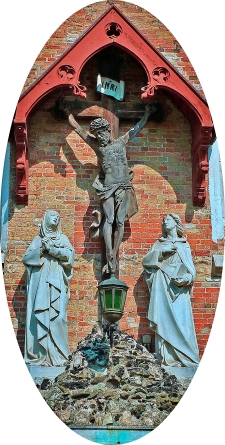
 Most of us probably spent Saturday preparing for Easter. We may have done last minute grocery shopping, prepped for Easter dinner, purchased an Easter lily, decorated eggs, assembled Easter baskets, snacked on jelly beans, or hidden plastic eggs around the yard. The previous day’s service on Good Friday had been a somber one but we knew the following day’s worship would be one of joy and celebration. While we may have sung “Were you There When They Crucified My Lord?” on Friday, we knew that we’d be singing “Christ the Lord is Risen Today” on Sunday.
Because we know how Good Friday’s story ends, we don’t mourn, feel abandoned, or fear being arrested on Saturday. The disciples, however, didn’t know that Sunday would reveal an empty tomb. Having been unable to finish preparing Jesus’ body and offer a proper hepsed (eulogy), there must have been a feeling of unfinished business and, when the Sabbath ended, the women purchased burial spices. Scripture, however, is strangely silent about that Saturday and the narrative does not resume until Sunday morning.
Did His followers tear their clothes in grief as did Jacob when he thought Joseph was dead? Did they wear sack cloth as did David upon Abner’s death? To show their grief and anguish, did they fast and cover themselves with ashes in sorrow and anguish as did the Jews when they learned that King Xerxes had ordered their death? Did they tear their robes, cover their heads with ashes, and silently sit shiva with Mary as Job’s friends had done for him?
Their sense of despair and defeat must have been unbearable. How could they make sense of all that happened? Thinking they’d never again see Jesus, was there regret or anger that they’d given up their homes and livelihoods for what now seemed a failed Messiah? Consider their heartache and the many “would’ves, could’ves, and should’ves” as they remembered Thursday night. Think of their remorse for having fallen asleep while Jesus prayed, the shame of abandoning Him in the garden, and Peter’s self-reproach for denying Him three times in the courtyard.
The disciples never fully understood when Jesus spoke of his impending death. Not expecting God’s plan to be the crucifixion, death, and burial of His only Son, they didn’t expect Jesus to return. When their rabbi said, “It is finished!” they didn’t know what Jesus finished. Seeing no future, the disciples lost hope and didn’t even believe the women when they reported the empty tomb.
Perhaps the gospel writers chose not to tell us about that gloomy Saturday because the disciples weren’t especially proud of it. Yet, they reported things like Peter’s denials, Thomas’ doubt, and James and John wanting places of honor. Perhaps there’s no mention of Saturday because we’re not meant to dwell in the Saturdays of our lives.
I’m not talking about the day we get the chores done, take the kids to soccer practice, or watch Saturday Night Live. I’m speaking of the times when disaster, despair, regrets, or anguish assault us and we can’t see tomorrow because of the darkness of today. The disciples’ Saturday lasted less than 48 hours but our Saturdays often last much longer.
The disciples didn’t know that Saturday was simply a day between despair and joy, but we do. Because Jesus rose from the dead on Sunday, we know that we have not been abandoned. Because Jesus gave us His Holy Spirit, we know that we’ll never be alone. No matter how long our Saturdays are, we have no reason for despair, fear, or anxiety. Whether in this world or the next, a glorious Sunday eventually will come.
 I read a devotion that suggested substituting our own personal anxieties and concerns for the troubles listed by Paul in Romans 8. Perhaps your version would read: “And I am convinced that nothing can ever separate me from God’s love. Neither old age nor loss of loved ones, neither cancer nor dementia, neither my anxiety about my wayward child nor my reservations about finances—not even the powers of terrorism and hate can separate me from God’s love. No hurricanes, earthquakes, pandemics, or wars—indeed, nothing in all creation will ever be able to separate me from the love of God that is revealed in Christ Jesus our Lord.”
 “He’d always looked at religion as a crutch for people who were too scared to do life by themselves,” is the way author Chris Fabry described a character in his book June Bug. That description made me think of Karl Marx’s frequently paraphrased statement: “Religion is the opium of the people.” Sigmund Freud had an equally low opinion of religion and described it as a form of wish fulfillment. Thinking of religion as little more than a man-made coping mechanism for dealing with the harsh realities of life, Fabray’s character, Marx, and Freud disparaged it along with things like crutches and pain relievers.
 I suspect we would prefer a eulogy that shines a light on our victories and accomplishments but the man known as “the father of modern missions” chose otherwise. When William Carey [1762-1834] was asked what text he wanted for his funeral sermon, he chose today’s verse. The humble man wanted to shine a light on God’s lovingkindness and great compassion rather than his personal accomplishments.
 The Israelites were camped on the east side of the Jordan River, in view of Canaan, when Moses addressed them. After spending the last forty years as nomads in the wilderness of the Sinai Peninsula, can you imagine their excitement at the thought of finally having a place to call their own and their eagerness for a new beginning in a new land? There must have been some apprehension, as well. They weren’t naïve; they knew there would be conflict, battles, and even loss before Canaan was conquered.
