THE JESSE TREE

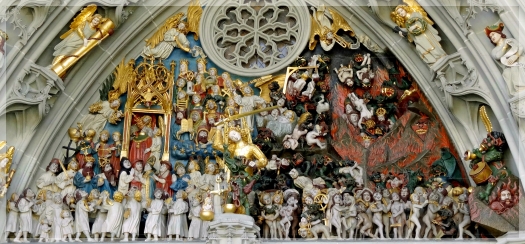
Last Judgment - Minster Cathedral - BernThere shall come forth a shoot from the stump of Jesse, and a branch shall grow out of his roots. And the Spirit of the Lord shall rest upon him, the spirit of wisdom and understanding, the spirit of counsel and might, the spirit of knowledge and the fear of the Lord. [Isaiah 11:1-2 (RSV)]

I remember standing in awe in front of an enormous sandstone sculpture of the Last Judgment at the entrance to Bern’s Minster Cathedral. With 294 figures, the naked wicked are on the right while the white-robed righteous are on the left. There are prophets, angels with trumpets, Jesus, Lady Justice, the wise and foolish virgins and both sinners and saints—the condemned and the blessed. In graphic detail, it illustrates God’s final judgment and the horrible fate of the damned!

It’s said that a picture is worth a thousand words and that’s true of the Last Judgment. In fact, much of the art in old European churches was there to illustrate Scripture for the largely illiterate population of the Middle Ages and early Renaissance. Seeing the portrayal of the last judgment, Michelangelo’s image of the outstretched hand of God giving life to Adam or Rembrandt’s picture of a distraught Moses smashing the stone tablets brought those stories to life for a people who couldn’t read them for themselves. Several churches had what was known as a Jesse Tree. Rather than a tree, these were large tapestries, carvings, or stained glass windows that illustrated the Bible’s salvation theme through the Old Testament to the birth of Jesus.

For example, the stained glass Jesse Tree in the Cathedral of Chartres (c.1150) portrays a sleeping Jesse at the bottom of the window. A shoot springing from his loins reaches up into four branches. Above Jesse are four kings (David, Solomon and two unnamed ones) and, above them, is Mary. At the top is Jesus surrounded by seven doves (representing the Holy Spirit and His gifts). Surrounding this center panel are fourteen figures holding scrolls. These are the people like Moses, Zechariah, Isaiah, and Samuel, who foretold the coming of a savior. In this single sixteen-by-five-foot window, the whole of the Old Testament prophecies and their fulfillment in Jesus is represented and God’s faithfulness in keeping His promises is illustrated.

The Jesse tree comes from Isaiah’s prophecy that the Messiah would come from Jesse’s line—the Davidic line of kings. Jesse was David’s father. The prophet referred to the lesser known Jesse rather than his famed son because, by the time of the Messiah, Judah would be a conquered nation and, with no more kings, David’s line would appear chopped off, like the stump of a hacked down tree. There was, however, life within that stump and a new branch, the Messiah, would sprout from it. The Jesse tree art in churches illustrated that Jesus’ story didn’t start in the New Testament. It began in the Old; Jesus was the fulfillment of God’s promises made thousands of years earlier.

Nowadays, some people celebrate Advent with a Jesse tree that serves as a sort of Advent calendar. Each day during December, a different Bible story is read and then a small ornament representing the story is placed on the “tree”—the family’s actual Christmas tree, a bare branch anchored in a stand, a small tabletop tree or even a felt hanging. An apple might accompany the story of the fall; an ark or rainbow, the story of Noah; and a scarlet cord, the story of Rahab.

Although I’m not decorating a Jesse tree, I am reading stories and prophecies from the Old Testament that tell of God’s faithfulness and plan for redemption. Starting in Genesis with God telling the serpent (Satan) that his final defeat will be brought about by one of Adam and Eve’s descendants, I’ll do a quick tour through the Old Testament and read about Abraham, Isaac, Jacob, Joseph, Moses, Joshua and David. As I prepare to celebrate Christ’s birth, I’ll put his arrival in historical context—in the world of Rahab, Gideon, Ruth, Samuel, Isaiah, Jeremiah, Habakkuk, and John the Baptist: a world in desperate need of salvation.

We often think of the Bible as two separate books—the Old and New, the Hebrew and the Christian, but it is one continuous story that leads across thousands of years to Christ’s birth, death and resurrection. Let us never forget that Jesus, as the Alpha, was there at the very beginning and, as the Omega, He will be there at the end.
And his delight shall be in the fear of the Lord. He shall not judge by what his eyes see, or decide by what his ears hear; but with righteousness he shall judge the poor, and decide with equity for the meek of the earth; and he shall smite the earth with the rod of his mouth, and with the breath of his lips he shall slay the wicked. Righteousness shall be the girdle of his waist, and faithfulness the girdle of his loins. … In that day the root of Jesse shall stand as an ensign to the peoples; him shall the nations seek, and his dwellings shall be glorious. [Isaiah 11:1-5,10 (RSV)]

Copyright ©2020 jsjdevotions. All rights reserved.

WAITING WITH HOPE

Then everyone will see the Son of Man coming on the clouds with great power and glory. And he will send out his angels to gather his chosen ones from all over the world—from the farthest ends of the earth and heaven. [Mark 13:26-27 (NLT)]

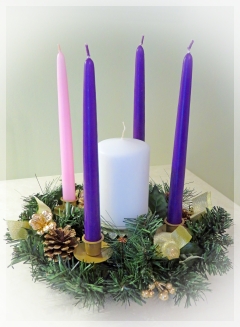
advent wreathIt’s less than a month until Christmas. This Christmas will be vastly different from past ones for us as I imagine it will be for you. Traditionally, our holiday season has been a busy and festive one of concerts, friends, church, fellowship activities, volunteering, entertaining, and family but being in the midst of a pandemic has changed all that. In an attempt to keep the spirit of Christmas alive in what has been a dreary and disappointing year, I’ve started decorating for the holiday and playing Christmas music. Christmas, however, is more than decorations, carols, presents, parties, and peppermint bark. Perhaps not having all of the fun-filled extras of this season will help us focus on its true meaning.

When I was young, I always had a special Advent calendar with a nativity scene and 24 little numbered “windows.” Starting December 1, I opened a window every day to find a special picture or Bible verse that helped tell the Christmas story. Advent, however, isn’t just a way to count down the days until Christmas. In the 4th and 5th centuries, the season of Advent wasn’t about Christmas at all. Lasting 40 days, it was a season of penance, prayer, and fasting in preparation for the baptism of new believers on the Feast of Epiphany (January 6). By the 6th century, Advent was tied to the coming of Jesus—but not His first arrival in Bethlehem. Coming from the Latin adventus, meaning “coming,” Advent was about Christ’s second coming—when the one who arrived as a lamb would return as a triumphant lion. It was not until the Middle Ages that four Sundays became Advent’s length and the season was linked to both Christ’s first and second comings along with His presence among us through the Holy Spirit.

Although the custom of an Advent wreath began with Lutheran and Roman Catholic families in 16th century Germany, it didn’t spread to churches until three centuries later. The wreath is a circle of evergreen branches; its circular shape, with no beginning or end, symbolizes the immortality of the soul and God’s promise of eternal life through Jesus Christ. Four candles, representing the four weeks of Advent, are arranged around the wreath; sometimes, a fifth candle is in its center. A new candle is lit on each of the four Sundays leading up to Christmas with the fifth candle lit on Christmas.

The season of Advent begins this Sunday and, while COVID-19 keeps us from our liturgical church and its Advent wreath ritual, it can’t prevent us from observing Advent at home. We will read the pleas for a savior found in Isaiah 60 and Psalm 80, Jesus’ words about His return in Mark 13, and Paul’s assurance that Jesus will return in 1 Corinthians 1. While it doesn’t seem Christmassy to read about Jesus’ return before He’s appeared in Bethlehem, these readings are reminders that ours is an in-between time—a time between Jesus’s first arrival and His final return. After the readings, we’ll light the first candle on our Advent wreath: the candle of hope, often called the “prophecy candle.” We’ll say a prayer of thanksgiving for the gift of hope that came with the Messiah. This first candle will remind us that we wait with hope for His return: for the time when Satan is defeated, God’s final judgment occurs, all things are made new, and all of God’s promises come true! May the candle of hope stay lit in our lives!

Let us be alert to the season in which we are living. It is the season of the Blessed Hope, calling for us to cut our ties with the world and build ourselves on this One who will soon appear. He is our hope—a Blessed Hope enabling us to rise above our times and fix our gaze upon Him. [A.W. Tozer]

However, no one knows the day or hour when these things will happen, not even the angels in heaven or the Son himself. Only the Father knows. And since you don’t know when that time will come, be on guard! Stay alert! … Don’t let him find you sleeping when he arrives without warning. I say to you what I say to everyone: “Watch for him!” [Mark 13:32-33,36-37 (NLT)]

Copyright ©2020 jsjdevotions. All rights reserved.

IN ALL CIRCUMSTANCES – THANKSGIVING 2020

Enter his gates with thanksgiving; go into his courts with praise. Give thanks to him and praise his name. For the Lord is good. His unfailing love continues forever, and his faithfulness continues to each generation. [Psalm 100: 4-5 (NLT)] 

turkeyWhen an irrevocable law was signed that prohibited praying to anyone but King Darius, Daniel prayed! Knowing he’d be thrown into a den of lions for doing so, the devout man went home, opened the windows, and prayed to God just as he always had done. Rather than starting with a fervent plea for God’s help, however, Daniel began with a prayer of thanks. His prayer of thanksgiving showed Daniel’s faith in a good God who was present in all circumstances!

Back in the 1630s, in the midst of the Thirty Years’ War when all of Europe was in turmoil, a Lutheran minister named Martin Rinckart also understood the importance of thanking God in all circumstances. Life seemed hopeless, especially in the walled city of Eilenburg where Rinckart lived. Refugees overcrowded the city, people were starving, and the city was surrounded by enemy soldiers. Poverty, famine and disease reigned. Mercenary soldiers committed atrocities, looted, and extorted tribute. Rinckart had to quarter soldiers in his house and endure their plundering of his possessions and stocks of grain. Diseases like typhus, dysentery, and scurvy already were widespread when the plague took control and devastated the population in 1637. And we think we have it tough in 2020!

Rinkart faithfully served the sick and dying. As the last living pastor in town, he performed as many as fifty funerals a day and buried over 4,400 townspeople, including his own wife. It was during this horrific time, one of the darkest in Europe’s history, that Rinckart counted his blessings and wrote a beautiful family prayer of thanksgiving. We know that joyful prayer as the popular Thanksgiving hymn Now Thank We All Our God. Martin Rinckart, like Daniel, offered thanks to God in the midst of challenging circumstances. Can we do anything less?

I saw a cartoon in which the heavy-set husband, after looking down at his skimpy plate of dieter’s salad, looked up at his wife and said, “You better say grace this time. If I do it, God will know I’m lying.” Unlike Daniel and Martin Rinckart, most of us are like him: blind to the blessings of life and deficient in our thanks to God for those blessings, however great or small. Today, as we celebrate our national day of thanks, let us remember that every day should be a day of giving thanks—even if, instead of sweet potatoes, stuffing, turkey, and pumpkin pie, our plates have only lettuce, carrots and celery!

Now thank we all our God, with heart and hands and voices,
who wondrous things has done, in whom this world rejoices;
who from our mothers’ arms has blessed us on our way
with countless gifts of love, and still is ours today.
O may this bounteous God through all our life be near us,
with ever joyful hearts and blessed peace to cheer us;
and keep us still in grace, and guide us when perplexed;
and free us from all ills, in this world and the next.
All praise and thanks to God the Father now be given;
the Son, and him who reigns with them in highest heaven;
the one eternal God, whom earth and heaven adore;
for thus it was, is now, and shall be evermore. [Martin Rinckart)]

Be thankful in all circumstances, for this is God’s will for you who belong to Christ Jesus. [1 Thessalonians 5:18 (NLT)]

Come, let us sing to the Lord! Let us shout joyfully to the Rock of our salvation. Let us come to him with thanksgiving. Let us sing psalms of praise to him. [Psalm 95:1-2 (NLT)]

Copyright ©2020 jsjdevotions. All rights reserved.

IMPEDIMENTS OR AMBASSADORS?

Celebrate your hope; be patient in suffering; give constant energy to prayer; contribute to the needs of God’s people; make sure you are hospitable to strangers. [Romans 12:12-13 (NTE)]

Don’t forget to be hospitable; by that means, some people have entertained angels without realizing it. [Hebrews 13: 2 (NTE)]

blanket flowerThe story was told of a devout Christian woman who, after moving to a new town, visited the local church: the Church of Holier than Thou. When the children’s choir sang the prelude, she was so happy to hear their angelic voices that she applauded at the end of their song. An usher came up and whispered in her ear, “Ma’am, we don’t applaud in this church.” She apologized for the disturbance and the service continued. When the pastor gave his sermon, she was so moved by his words that she shouted out an “Amen!” in response. The usher returned to her side and again sternly instructed her, “You’ll have to restrain yourself here in the Church of Holier than Thou.” Chagrined, the woman promised to behave and the service continued. The choir rose and sang a beautiful medley that included God of our Fathers and How Great Thou Art. Overcome by the words of praise, the woman shouted out “Hallelujah” and “Praise God!” at the song’s conclusion. The usher strode up to her and said, “Lady, you’re causing a disturbance. You’ll have to leave!” The poor woman responded, “I just couldn’t help myself; I was overcome by the joy of the Lord!” In a huff, the usher responded, ‘Well, you sure didn’t get it here!”

A good friend preached several times at our Colorado church and even served briefly as a pastor for a local parish when they were without an ordained minister. This man, filled with joy in the Lord, is a mature and knowledgeable Christian, but that wasn’t always the case. When he became a Christian many years ago, he was totally unfamiliar with the Bible and didn’t even know there were several different translations and publications of this one book. He couldn’t understand why chapter and verse had to be mentioned when just a page number should do. What would have happened to him if he’d attended the Church of Holier than Thou (or others like it)? I think God might have lost a child to disillusionment and doubt.

One friend told of an experience while searching for a church. She’d just settled into the pew when an irate couple told her she had to move because she was in their pew! When we first moved here and were “church shopping,” we attended a madrigal dinner at a local church in hope of meeting members of the congregation. In spite of getting there early and the large number of empty chairs, we had trouble finding a seat because everyone seemed to saving those chairs for the people they already knew. Sadly, I’ve seen the same thing at Tuesday Bible study when a newcomer has difficulty finding a place to sit among all the empty (but saved) chairs! Although the church is supposed to be a place of welcome, it frequently isn’t.

It has been said that there are two reasons people don’t become Christians. First, they haven’t met one. The second reason, of course, is that they have! What kind of Christians are we? Are we impediments or ambassadors? Are we filled with the joy of the Lord or are we holier than thou? Do we welcome others to worship and study with us? Are willing to enlarge our circle to receive someone new? If Jesus stopped by, would He have trouble finding a place to sit?

To all my nonbelieving, sort-of-believing, and used-to-be-believing friends: I feel like I should begin with a confession. I am sorry that so often the biggest obstacle to God has been Christians. [Shane Claiborne]

Welcome one another, therefore, as the Messiah has welcomed you, to God’s glory. [Romans 15:7 (NTE)]

So we are Christ’s ambassadors; God is making his appeal through us. We speak for Christ when we plead, “Come back to God!” [2 Corinthians 12:20 (NTE)]

Copyright ©2020 jsjdevotions. All rights reserved.

CLOSED DOORS

Let my prayer be counted as incense before you, and the lifting up of my hands as the evening sacrifice! [Psalm 141:2 (ESV)]

For I desire steadfast love and not sacrifice, the knowledge of God rather than burnt offerings. [Hosea 6:6 (ESV)]

chapel of the transfiguration - Grand TetonsOne of the countless questions we have about this pandemic is how God could allow church doors to close throughout the world. 2020 is not the first time the doors to His house have been shut. In 586 BC, the Temple doors closed for the Jews when Judah fell to Babylon; Jerusalem was laid to waste and the Temple destroyed. Its doors didn’t open again until the exiles returned and completed the second Temple in 515 BC. Destroyed by the Romans in 70 AD, all that remains of that Temple is a small portion of an external supporting wall on the Temple Mount.
Although the focal point of Jewish worship was the Temple, we know that synagogues existed in Jesus’ day. They may have evolved as a substitute for the first Temple during the Babylonian exile. Rather than houses of worship, however, they were places for study, communal meals, the local court, and from which to distribute charity. Until 70 AD, the Temple remained fundamental to Jewish worship and, every year, Jews from all over the world returned to Jerusalem to worship there for the festivals of Passover, Pentecost, and Tabernacles.

After the Romans destroyed it, the Jews wondered how they could continue to worship and offer the required sacrifices without a Temple. Looking to the Bible and tradition for answers, they found scripture that connected prayer with sacrifice. Prayer became a satisfactory substitute for ritual sacrifice and the synagogue became a place of worship and prayer (as well as study).

Nowadays, Rosh Hashanah and Yom Kippur draw Jews to the synagogue the way Christmas and Easter draw Christians to a church. COVID changed that this year and, when the High Holy Days were celebrated last month, even the doors to Jerusalem’s Great Synagogue were shut. When asked how they could observe the holiest days of the year without going to synagogue, Cantor Benny Rogosnitzky replied, “You’re going to make your home into a mini-synagogue.” He then made reference to a quote by Menachem Mendel of Kotzk, a 19th century Hasidic rabbi who, at the age of five, is said to have asked his father, “Where is God?” When his father answered, “God is everywhere!” the future rabbi responded, “No, I think God is only where you let Him in.”

God needs somewhere to live but that place isn’t a church or synagogue; that place is us! When we ask, “Where is God?” let us remember He doesn’t live in a building. God is wherever we allow Him in! He is in the simple everyday miracles of life and His Holy Spirit dwells within us. Since God has allowed our church doors to close, He must have His reasons. Perhaps it’s simply a reminder that being a Christian isn’t going to church; it is being the church! We can do that anywhere! Let our homes become mini-churches and may our lives reflect His presence.

Jesus answered him, “If anyone loves me, he will keep my word, and my Father will love him, and we will come to him and make our home with him.” [John 14:23 (ESV)]

Do you not know that you are God’s temple and that God’s Spirit dwells in you? [1 Corinthians 3:16 (ESV)]

Copyright ©2020 jsjdevotions. All rights reserved.

FOR THE CLERGY

Dear brothers, honor the officers of your church who work hard among you and warn you against all that is wrong. Think highly of them and give them your wholehearted love because they are straining to help you. And remember, no quarreling among yourselves. [1 Thessalonians 5:12-13 (TLB)]

October brings Columbus Day sales, pumpkins, corn mazes, Halloween candy, jack-o-lanterns, and the first Christmas items in the stores. On the second Sunday of the month, it also brings us Clergy Appreciation Day. Although we should let our pastors know how much we appreciate them all year long, we probably don’t. We’re more likely to complain about a sermon, the choice of songs, the temperature of the sanctuary, or the sound system than we are to compliment, encourage or thank our ministers. If we haven’t expressed gratitude to our clergy men and women, this coming Sunday is the time to do so.

This year has been especially difficult for our pastors. Their biggest challenge was maintaining unity while addressing their congregation’s concerns and complaints regarding opening. Since March, they’ve continually fielded questions as to when or how their church would open while knowing that half the congregation wouldn’t like the answer. Deciding to close the church was a whole lot easier than figuring out how and when to reopen! They’ve had to cope with the technology required for on-line services and think outside the box as they offered drive-by blessings, drive-in church, Zoom Bible study, or Skype counseling. Preaching to a camera from their living room or an empty church presented its own set of challenges as did offering virtual communion. The isolation of sheltering in place was heartbreaking for the people who regularly visited households, nursing homes, hospitals, and hospice rooms. They could no longer lay hands on the sick or embrace those who grieved. As they’ve ministered to people with financial, health, and family concerns, they’ve struggled with those same issues themselves.

Our pastors have a huge responsibility and we have huge (and often unrealistic) expectations of them. They work far more than a few hours on Sunday morning. Along with writing sermons and prayers, planning services, teaching Bible studies, counseling the troubled, visiting the sick, supervising a staff, marrying, burying, baptizing, and blessing, they manage to unite a disparate group of people into a church family and lead them on their faith journey. We may not always like what they say or do but their job is not to please us; it is to lead us. Consider Moses and the Israelites—if they’d had their way, the Israelites would have ended up back in Egypt as slaves. In spite of their grumbling and complaints, however, Moses led them where God wanted them to go—to the Promised Land. Without a doubt, shepherding a church today is no easier than leading a bunch of disgruntled Israelites through the desert.

Appreciating our pastors shouldn’t be limited to just to one day; we should show our appreciation all year long. While a thank you note is nice, perhaps a better way of communicating our gratitude is by providing support with our time, talents, and treasures; avoiding church politics; and offering encouragement rather than complaints. The best thing we can do for our pastors, however, is to pray for them every day.

Father, we thank you for our clergy—the people you have called to shepherd your church. Let your Holy Spirit fill them so that they shine your light, share your love, and shape your people.

If a church wants a better pastor, it only needs to pray for the one it has. [Anonymous]

Pastors need your grace, not your gripes. [Woodrow Kroll]

Obey your spiritual leaders and be willing to do what they say. For their work is to watch over your souls, and God will judge them on how well they do this. Give them reason to report joyfully about you to the Lord and not with sorrow, for then you will suffer for it too. [Hebrews 3:17 (TLB)]

Copyright ©2020 jsjdevotions. All rights reserved.