
Then I turned my face to the Lord God, seeking him by prayer and pleas for mercy with fasting and sackcloth and ashes. [Daniel 9:3 (CSB)]
Even now—this is the Lord’s declaration—turn to me with all your heart, with fasting, weeping, and mourning. Tear your hearts, not just your clothes, and return to the Lord your God. For he is gracious and compassionate, slow to anger, abounding in faithful love, and he relents from sending disaster. [Joel 2:12-13 (CSB)]
 We’re two weeks into the season of Lent. While we typically associate this time before Easter with giving up something, it is more than simply abstaining or fasting from some thing or things. Fasting without prayer is nothing more than a diet and abstaining from some pleasure without prayer is more like dry January than a Lenten discipline! Without prayer, fasting and abstinence are physical acts but not spiritual ones! When we give up something for Lent, we need to deliberately and intentionally seek the Lord in prayer at the same time!
Faith is a living thing, and like all living things, it needs to be nurtured and fed to grow. During Lent, as we abstain from worldly things, we feast on the spiritual so that this season of self-denial becomes one of growth. Lent is the time to feed our faith with extra servings of prayer and Scripture along with Christian fellowship, praise, thanksgiving, and worship.
If we choose to observe Lent, there are a few words of warning. We must be cautious of spiritual pride—thinking we’re better or “more spiritual” than others who may not observe this season or might practice it in a different way. How we keep this season is between us and God and not to be compared to anyone else’s Lenten practice. We shouldn’t be like the proud Pharisee in Jesus’ parable who compared himself to the tax collector while boasting that he fasted twice a week and gave away a tenth of all he received. Spiritual pride means we’re looking at ourselves instead of the Lord. Jesus reminded His listeners that “everyone who exalts himself will be humbled, but the one who humbles himself will be exalted.” [Luke 18:14]
Just as self-denial is not a way to boost our egos, let us never make the mistake of thinking that giving up something for Lent has any merit as far as our salvation is concerned. Self-denial and fasting are not done to curry favor and earn ”brownie points” with God. Neither fasting nor abstinence give us special standing before God and they won’t make God love us any more than He already does!
Moreover, we must never give up something as a way of manipulating God into doing something for us; there no quid pro quo in God’s Kingdom! Fasting and abstinence won’t sprinkle spiritual vitamins and minerals on our prayers to give them extra power. We don’t adopt a spiritual discipline so God will do what we want—we do it so we’ll do what He wants! Fasting and abstaining change us, not God! They’re like cleaning our glasses so we better see God and cleaning the wax from our ears so that we hear Him more clearly. Rather than getting a better response to our prayers, self-denial leads to better prayers!
Finally, Jesus specifically warned us about the danger of hypocrisy while fasting. Lent’s purpose is not to impress others with our devotion. It’s personal and private—between us and God—it’s a secret commitment rather than a public display. May we always remember that we fast to please the Lord—not to impress others!
Prayer is reaching out after the unseen; fasting is letting go of all that is seen and temporal. Fasting helps express, deepen, confirm the resolution that we are ready to sacrifice anything, even ourselves to attain what we seek for the kingdom of God. [Andrew Murray]
 Lent begins on Wednesday. Beginning with the solemn reminder that we are but dust and to dust we shall return and concluding with Christ’s victory over death on Easter Sunday, the season’s forty days represent the time the Lord spent alone in the wilderness, fasting in preparation for his ministry, and undergoing Satan’s temptations. A period of self-discipline and repentance, Lent often is observed by such things as contemplation, confession, prayer, fasting, moderation, service, and giving
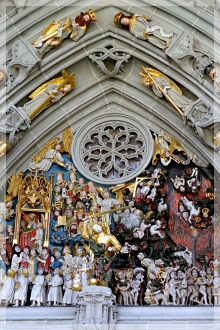 Before stepping inside of the Bern Münster Cathedral, you’ll probably stop and stare at the archway above the main entrance. There you’ll see 294 carved sandstone figures in a graphic illustration of God’s final judgment when the wicked are separated from the righteous. To your right are the naked damned souls in the midst of flames while, on your left, the righteous stand clothed in white and marked with the seal of God on their foreheads. Lady Justice with her scales and the Archangel Michael with his sword stand in the center. The entire scene is surrounded by larger statues of various saints and martyrs as well as the five wise virgins and the five foolish ones who weren’t ready for the bridegroom’s return!
 Remember the Sabbath day, to keep it holy. Six days you shall labor, and do all your work, but the seventh day is a Sabbath to the Lord your God. On it you shall not do any work, you, or your son, or your daughter, your male servant, or your female servant, or your livestock, or the sojourner who is within your gates. [Exodus 20:8-10 (ESV)]
 The Levites (descendants of Jacob’s son Levi) were set aside for religious service. While all priests were Levites, not all Levites were priests. The most sacred tasks, like offering the sacrifices and conducting ceremonies, were reserved for the priests (kohanim) who were descendants of Aaron; the rest of the Levites supported the priests in their duties.
