
What good is fasting when you keep on fighting and quarreling? This kind of fasting will never get you anywhere with me. You dress in burlap and cover yourselves with ashes. Is this what you call fasting? Do you really think this will please the Lord? [Isaiah 58:4-5 (NLT)]
 With nearly 20,000 tweets, the 2022 Twitter “Lent Tracker” revealed that the top Lenten fast for Twitter users was alcohol. Twitter and social networking took second and third places followed by Lent, sex, coffee, chocolate, swearing, men and meat. Using Twitter to give up Twitter seems somewhat counter-productive and giving up Lent for Lent makes no sense at all. Then again, since I don’t tweet, Twitter itself doesn’t make sense to me. In a survey by YouGov, people were asked what would be the hardest thing to abstain from for Lent and watching TV or using streaming services was the number one answer in all age groups except for ages 18 to 24. It’s no surprise that the hardest thing to relinquish for that group was social networking!
I tried something new for my Lenten observance this year by letting Alicia Britt Chole’s 40 Days of Decrease lead me through the season. Along with a daily devotion about Jesus’ life, an inspiring quote upon which to meditate, a tidbit about Lent’s history, Scripture reading and journaling, a specific fast was suggested for each day. Over the past several weeks, I’ve fasted from things like regret, avoidance, apathy, denial, leavening, and comparison.
Fasting from a meal one day was far easier than fasting from isolation the next. Since the pandemic, I’ve grown comfortable in isolation and gotten lax about making an effort to socialize. As God would have it, my fast from isolation was on a Tuesday, the day our pastor has an informal gathering at a local coffee shop. The day’s assignment was to, “Purpose to link and be linked…and intentionally nurture your God-given web of relationships.” Even though I was behind in my writing, the fast required me to join the others. It was a needed reminder that we are to “think of ways to motivate one another to acts of love and good works,” and not to “neglect our meeting together… but encourage one another.” [Hebrews 10:24-25]
Another day, after reading about the woman who lavishly anointed Jesus with essence of nard, the fast was stinginess. I pondered which charity would get the benefit of the day’s fast but writing a check didn’t seem much of a sacrifice since we’ve never been stingy with our money to charity. When my husband asked me to walk the beach with him, my first thought was that I didn’t have the time. The day’s stinginess fast, however, reminded me that we can be miserly with time as well as money. Having been directed not to allow reason to “ration out your love in stingy portions,” I accepted the offer to spend quality time with him. The woman who anointed Jesus is remembered “as one who loved lavishly;” I’d like to be remembered the same way! Time is as precious as money or a flask of expensive perfume and we never should be stingy with it.
Thinking about these two fasts, I realized they both had to do with time. They made me question my willingness to share my time with others, to sacrifice my agenda for a better purpose, and to put relationships ahead of tasks. Like money, time is a precious commodity with a limited supply and, like money, time can be wasted or foolishly spent. Unlike money, however, we can’t gain more than our allotted amount nor can we save what we have for another day. Whether we use it or not, time is gone as fast as it came. May we always remember we have a limited time here and no real way of knowing when our days will end. Let us live each precious day as if it is the only one we have.
Never, in peace or war, commit your virtue or your happiness to the future. Happy work is best done by the man who takes his long-term plans somewhat lightly and works from moment to moment “as to the Lord.” It is only our daily bread that we are encouraged to ask for. The present is the only time in which any duty can be done or any grace received. [C.S. Lewis]
 We always knelt for prayer in the church I attended as a girl so I used to think the only way to pray was on my knees with head bowed and hands tightly clasped. While I now pray in a variety of postures, I wondered if Scripture tells us exactly how we should pray.
 We don’t know how far Philip and the Ethiopian traveled together before the eunuch spotted water. The book of Isaiah is 66 chapters long and there was a lot to cover as Philip told him about the man called Jesus, so it may have been as far as Gaza. It is there that the road split—north to Caesarea and south to Egypt and Ethiopia. While we don’t know the location, we just know that the Ethiopian was baptized when they came to water.
 Go therefore and make disciples of all nations, baptizing them in the name of the Father and of the Son and of the Holy Spirit, teaching them to observe all that I have commanded you. And behold, I am with you always, to the end of the age. [Matthew 28:19-20 (ESV)]
 The Israelites were surrounded by various pagan peoples who worshipped foreign deities. Baal ruled over Canaan and Phoenicia, Chemosh over Moab, and Marduk/Bel and Nebo over Babylonia. The Philistines’ had Dagon and the Ammonites worshipped Molech. These gods usually had a domain over which they ruled. For example, Baal’s domain was rain, storms, and the harvest. Moab’s Chemosh presided over war and mountains. As patron deity of Babylon, Marduk/Bel was supposed to protect the city and rule over storms while Nebo’s purview was wisdom and science. The Philistines’ chief god Dagon presided over death, the afterlife, war, and agriculture while Ammon’s Molech reigned over the underworld, which may explain his association with child sacrifice in the Old Testament.
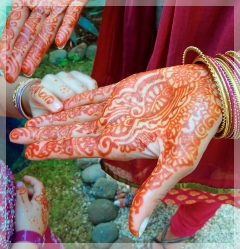 To the delight of the girls who attended the party, my daughter-in-law hired a Mehndi artist for my grand-daughter’s birthday celebration. Using a red-orange paste made from the dried leaves of the henna plant, the artist adorned the girls’ hands or arms with assorted intricate floral motifs. Since all of the family on her mother’s side is from India, this ancient form of body art is familiar to my grand. Although she’s attended several Mehndi parties, most of her guests have not. A Mehndi party for close friends and family is an important pre-wedding tradition in any Indian wedding. Along with plenty of food and music, there are henna artists. While they take only a few minutes painting designs on the guests, they spend several hours painting intricate geometric shapes and floral and paisley motifs on the bride’s hands, arms and feet. Hidden somewhere among the elaborate patterns on her body is the groom’s name.
