YES!

You see, my dear family, we don’t want to keep you in the dark about the suffering we went through in Asia. The load we had to carry was far too heavy for us; it got to the point where we gave up on life itself. Yes: deep inside ourselves we received the death sentence. This was to stop us relying on ourselves, and to make us rely on the God who raises the dead. He rescued us from such a great and deadly peril, and he’ll do it again; we have placed our hope in him, that he’ll do it again! [2 Corinthians 1:8-11 (NTE)]

blue flag irisI know I’m not invulnerable but I never thought of myself as particularly vulnerable until now. Since I am well over 65, I am officially vulnerable to COVID-19, as is my husband; that knowledge, along with the terrible toll being taken by this pandemic, has put me on edge. Knowing that it is just a matter of time before someone I love is taken down by this virus has unnerved me. That my prayer list is lengthening by the day doesn’t make it any easier. Before this, I rarely had been apprehensive about my health or that of my family, uneasy about our finances, or concerned about the family business. I’ve endured my share of trials, sorrow, illness, and uncertainty but this combination of circumstances is the “perfect storm” that has shaken me to my core.

As I prayed reassuring Bible verses this morning, I realized how much easier it is to talk the talk than actually walk the walk. I wondered if the Apostle Paul ever was shaken by circumstances. Throughout his ministry, he suffered trials and persecution. He was stoned, imprisoned, shipwrecked, beaten, betrayed, and abandoned and yet it seems as if God’s abundant grace sustained him throughout his life. In 2 Corinthians, Paul tells of a time he felt unbearably crushed by circumstances, so much so that he thought he’d die. As he came to realize his powerlessness, however, he stopped relying on himself and came to trust and depend on God. Delivered by God from whatever the trial was, Paul boldly stated that God would deliver him again.

Jumping ahead another ten years, however, we find Paul in a Roman prison. A few years earlier, he’d been released from his first Roman imprisonment (a house arrest) but now he was sitting in Rome’s Mamertine dungeon. Although he’d escaped a death sentence at his preliminary hearing, he fully expected to be found guilty at his final trial. Knowing his execution was imminent, there was no bold statement that God would deliver him. Nevertheless, in 2 Timothy, we don’t read the words of a man who is afraid or anxious; they are the words of a man who trusts God and lives by faith rather than sight. They are the words of a man who is calmly facing his future, whatever that may be, with confidence that God will bring him safely into His kingdom.

Rather than saying, “No!” to God, we see Paul saying an enthusiastic “Yes!” to all that will happen, whatever that may be. Like Paul, we must learn to rely solely on God and release our fears and anxiety to Him. To really do that, however, we also have to release our future – our hopes and dreams – to Him, as well. Let us trust in God: that He will give us the strength to endure whatever the future holds and that, in the end, He will bring us safely into His kingdom!

How to get through this? My prayer will be the words of former U.N. Secretary General Dag Hammarskjöld: “For all that has been, Thanks. To all that shall be, Yes.”

For I am already being poured out as a drink-offering; my departure time has arrived. I have fought the good fight; I have completed the course; I have kept the faith. What do I still have to look for? The crown of righteousness! The Lord, the righteous judge, will give it to me as my reward on that day – and not only to me, but also to all who have loved his appearing. … The Lord will snatch me clear from every wicked deed and will save me for his heavenly kingdom. Glory to him for the ages of ages, Amen! [2 Timothy 4:6-8,18 (NTE)]

Copyright ©2020 jsjdevotions. All rights reserved.

GROUNDHOG DAY…AGAIN

Dear brothers and sisters, when troubles of any kind come your way, consider it an opportunity for great joy. For you know that when your faith is tested, your endurance has a chance to grow.  So let it grow, for when your endurance is fully developed, you will be perfect and complete, needing nothing. [James 1:2-4 [(NLT)]

ground squirrel - chipmunkWith each new day feeling like yesterday, we decided to watch the 1993 movie Groundhog Day. In it, the discontented TV weatherman Phil Connors, played by Bill Murray, is trapped in a time loop and keeps reliving February 2. At first, he takes advantage of never having to reap the consequences of his selfish actions but grows tired of his hedonistic life. When the predictability of the day causes boredom, depression, and cynicism to set in, he commits suicide several times—only to wake again and again on the same February 2. Eventually, Phil comes to grips with his situation and decides to make the most of it. Among other things, he learns to to play jazz piano, speak French, memorize the life story of everyone in town, sculpt ice, and master the art of flipping cards into an upturned hat. As he betters himself, he begins to better the lives of the people around him. The time loop eventually ends when the changed man finally gets the day right by caring more about others than himself.

Although many people have tried to estimate how many Groundhog Days Phil experienced, even co-author Danny Rubin wasn’t sure. He said the point of the movie “was that you had to feel you were enduring something that was going on for a long time… I don’t know. A hundred years. A lifetime.”  Psychologists actually have named the feeling that we’re caught in a rut the “Groundhog Day Syndrome” and, with this self-quarantining, we may feel as trapped as was Phil Connors.

Even though they can’t agree on what it means, people from various religious backgrounds view Groundhog Day as a spiritually meaningful movie. Buddhists see samsara or continuing rebirth and Hindus see reincarnation. With good deeds begetting more good deeds, Jews see the fulfilling of the Torah’s 613 mitzvoth while Roman Catholics see Phil’s situation as purgatory. Psychiatrists see it as a metaphor for psychoanalysis, soldiers as a film about boredom, motivational speakers as an illustration of transformational self-improvement, and one film critic saw the groundhog as symbolic of the risen Christ! Sometimes, however, a movie is just a movie.

Perhaps the meaning of Groundhog Day comes down to the words in Reinhold Niebuhr’s Serenity Prayer: “Grant me the serenity to accept the things I cannot change; courage to change the things I can; and wisdom to know the difference.” After all, even though Phil changes, his circumstances and the people of Punxsutawney don’t. But, once Phil starts changing the only thing over which he does have control, which is himself, the weatherman finds that his circumstances eventually do improve.

Whether it was Max Lucado or Mark Batterson who originally said, “The circumstances we ask God to change are often the circumstances God is using to change us,” they’re right. Phil’s circumstances changed him for the better and God can use our circumstances to change us—if we let Him. Let us remember that, until our last day, we are works in progress; even though we can’t change what is happening around us, our hearts and minds can change. As they do, we may just find the world around us changing, as well. COVID-19 will still be here, just as Punxsutawney and the groundhog were still there for Phil. Nevertheless, Phil’s life changed and, just as he found joy in his circumstances, we can, too!

We have little control over the circumstances of life. We can’t control the weather or the economy, and we can’t control what other people say about or do to us. There is only one area where we have control—we can rule the kingdom inside. The heart of every problem is the problem in the heart. [Warren Wiersbe]

So be truly glad. There is wonderful joy ahead, even though you must endure many trials for a little while. These trials will show that your faith is genuine. It is being tested as fire tests and purifies gold—though your faith is far more precious than mere gold. So when your faith remains strong through many trials, it will bring you much praise and glory and honor on the day when Jesus Christ is revealed to the whole world. [1 Peter 1:6-7 (NLT)]

Always be joyful. Never stop praying. Be thankful in all circumstances, for this is God’s will for you who belong to Christ Jesus. [1 Thessalonians 5:16-18 (NLT)]

Copyright ©2020 jsjdevotions. All rights reserved.

THE REAL QUESTION

So, my dear family, this is my appeal to you by the mercies of God: offer your bodies as a living sacrifice, holy and pleasing to God. Worship like this brings your mind into line with God’s. What’s more, don’t let yourselves be squeezed into the shape dictated by the present age. Instead, be transformed by the renewing of your minds, so that you can work out what God’s will is, what is good, acceptable and complete. [Romans 12:1-2 (NTE)]

agoseris (orange) - mountain dandelionLike Job, we want to know “Why?” Wanting to understand the inexplicable, there are some who claim this pandemic is a sign of the end times; indeed, it is a terrifying time. When Jesus spoke of the end times, however, He warned His disciples to be wary about the signs and not to be misled. When we start looking for signs, we begin reading meanings into things that aren’t necessarily there. While we know that chaotic and difficult times will pave the way for Jesus’ return, we also know that chaos, difficulty, and even pandemics have been characteristics of life since the exile from Eden. I don’t know if this is a sign of the end times but I am cautious of doomsday prophets who claim to know what God is doing. Let us remember Jesus’ own words: ”No one knows the day or hour when these things will happen not even the angels in heaven or the Son himself. Only the Father knows.” [Matthew 24:36] If neither Jesus nor angels knew, I doubt a mere mortal does! Whether or not the Australian wildfires, African locusts, and COVID-19 are precursors of things to come doesn’t change what’s happening or our reaction to them.

“Do you suppose,” said a friend, “that God got so sick and tired of our bickering, conflicts, and complaint that He’s sent us all to our rooms as punishment?” Indeed, there are some who say this pandemic is God’s judgment upon his sinful children. He’s used plagues before and it wasn’t just the Egyptians who suffered them at His hands. After the Israelites worshiped the golden calf, God sent a plague upon them; when they complained of no meat, He struck them with another plague; and, when they complained about Moses and Aaron, a plague that killed 14,700 quickly followed. When David sinned against God by taking a census, 70,000 innocent people died in a plague. Since God used plagues to discipline His children in the past, we might wonder if COVID-19 is His punishment for our sins. We simply don’t know and I would be cautious of anyone who claims to know the answer; Job’s friends got in trouble for that very thing! God made it clear to Job that the “why” is really not ours to know.

Perhaps, rather than sending us to our rooms as punishment, our loving Father has given us a “time out” for an attitude adjustment. Could this be God’s version of a “market correction” when, following a drop of 10%, the value of over-priced stocks are adjusted to more accurate levels? Instead of stocks, however, could this be a time to correct our priorities: a time to reevaluate their value and adjust them to more godly levels? When viewed in the light of this pandemic, many of the things we once thought important have become meaningless and some things we took for granted have become precious. Just as a stock market correction is a reminder for investors to reassess their holdings, this pandemic may be a time for us to reassess our priorities and values. What is worth keeping and what should we let go?

Jesus told us that wherever our treasure is, there will be our heart. Perhaps we’ve been sent to our rooms to examine our hearts: to see ourselves in a spiritual mirror to determine how much like Christ we look, how attached we’ve become to the things of the world, and determine who and what comes first in our lives.

None of us can divine God’s purpose; He didn’t tell Jesus or Job so I don’t think we can expect to know. Rather than asking “why?” theologian and author Timothy Keller says the question we should be asking is this: “Is God to whom I look to and trust in when bad things happen?”

You must keep all earthy treasures out of your heart, and let Christ be your treasure, and let Him have your heart. [Charles Spurgeon]

“Don’t let your hearts be troubled,” Jesus continued. “Trust God – and trust me, too! … I’m leaving you peace. I’m giving you my own peace. I don’t give gifts in the way the world does. Don’t let your hearts be troubled; don’t be fearful. … I’ve said these things to you so that you can have peace in me. You’ll have trouble in the world. But cheer up! I have defeated the world! [John 14:1,27,16:33 (NTE)]

Copyright ©2020 jsjdevotions. All rights reserved.

THE SONG OF HOPE

Rejoice in our confident hope. Be patient in trouble, and keep on praying. [Romans 12:12 (NLT)]

Let all that I am wait quietly before God, for my hope is in him. He alone is my rock and my salvation, my fortress where I will not be shaken. [Psalm 62:5-6 (NLT)]

northern mockingbirdA family of mockingbirds has moved into a nearby bush and they frequently serenade us from their vast repertoire of songs. Hearing their exuberant and joyful warbles is a perfect antidote to the sameness of life during this pandemic. While being charmed by their avian concerts, I thought of Emily Dickenson’s poem “‘Hope’ is a thing with feathers.”
What exactly is hope? In the world’s view, hope is like wishful thinking: an “I don’t know what will happen tomorrow, but I hope it will be something good!” attitude. We hope for a cure, a job, a raise, or a phone call without knowing if we’ll receive them. Worldly hope can fail us—the cure isn’t found, the job falls through, the raise doesn’t materialize, or the phone doesn’t ring. We live in a fallen world where we will be disappointed and our hopes often are dashed.

Biblical hope, however, never disappoints because it is based on God’s promises; it is confident that something will come to pass because God has promised it! We may hope our circumstances will improve while knowing they might not but that uncertainty about our circumstances or how God will answer our prayers doesn’t mean we don’t have hope. Ours is a living hope; while it looks to the future, it is grounded in the present. We put our trust in God because His promises became a reality in Jesus. We don’t have to dream of a better life tomorrow because Jesus had given us a better life today. Our Christian hope is a confident expectation that God will work “for the good of those who love God and are called according to his purpose for them.” [Romans 8:28] It tells us that eventually God will deliver us and that our salvation is secure.

Although raised in a Christian family, Emily Dickenson never made a public profession of faith in Jesus, explaining, “I feel that the world holds a predominant place in my affections. I do not feel that I could give up all for Christ, were I called to die.” She was, perhaps, more honest than many of us. Nevertheless, several of her poems reveal her Christian roots. I think she understood a Christian’s hope in her metaphor of hope as a bird. Just as a bird perches on a branch, hope rests in our soul. Like a bird, Christian hope sings its pleasing song endlessly and, undeterred by hardship, hope’s song sounds sweetest in a storm. The bird’s song can be heard from the coldest land to the strangest sea and Christian hope can be found from the bleakest of conditions to the most inexplicable of situations. Even in the harshest circumstances, the bird never asked anything of Dickenson and our hope, the hope offered by Christ, asks nothing of us. We can’t earn it or buy it; it is there for the asking if only we believe!

For many right now, this is a time of darkness and fear and it seems like hope has taken flight. It hasn’t! God doesn’t change—He’s still there—the promises He made yesterday hold true today. God promises to be with us—both on the hilltop and in the valleys. Promising provision, His grace is sufficient for us. Promising to empower us, He tells us that, when we are weak, He is strong. As I listen to the mockingbirds’ songs, it seems as if they know God’s eyes are upon them and that He will take care of them. [Matthew 6:26,10:29] They remind me to live with hope perched in my soul.

“Hope” is the thing with feathers –
That perches in the soul –
And sings the tune without the words –
And never stops – at all –
And sweetest – in the Gale – is heard –
And sore must be the storm –
That could abash the little Bird
That kept so many warm –
I’ve heard it in the chillest land –
And on the strangest Sea –
Yet – never – in Extremity,
It asked a crumb – of me.
[Emily Dickenson]

We can rejoice, too, when we run into problems and trials, for we know that they help us develop endurance. And endurance develops strength of character, and character strengthens our confident hope of salvation. And this hope will not lead to disappointment. For we know how dearly God loves us, because he has given us the Holy Spirit to fill our hearts with his love. [Romans 5:3-5 (NLT)]

Copyright ©2020 jsjdevotions. All rights reserved.

CATALOG OF JOY

Make a joyful noise to the Lord, all the earth! Serve the Lord with gladness! Come into his presence with singing! Know that the Lord, he is God! It is he who made us, and we are his; we are his people, and the sheep of his pasture. [Psalm 100:1-2 (ESV)]

The surest mark of a Christian is not faith, or even love, but joy.[ Samuel M. Shoemaker]

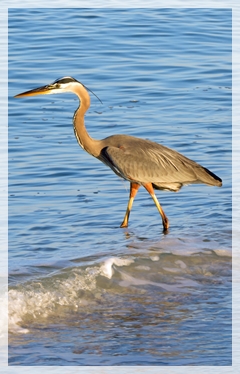
great blue heronWhen we retired, we joked that our pill boxes were the only way we knew the day of the week. Now that we’re sheltering in place, that is more true than funny. For young and old alike, the days are blending one into the other with the only difference between yesterday and today being the news (which just seems to gets worse).

While COVID-19 is an enemy lurking at our door, chances are another enemy has already entered our lives: common garden variety depression—what I call the glums and gloomies. As the days wear on, it’s harder to see the bright side of life. Built for community, we now live in a world where kisses are weapons and we show our love by staying away from one another! Instead of hoarding toilet paper and bleach wipes, we wish we’d stockpiled hugs. We’d happily trade a bottle of hand sanitizer just to cuddle with a grand for a minute or shake a friend’s hand.

This prolonged isolation reminds me of a winter spent at our mountain home back in 1997. Having broken my knee the first day on the slopes, my mobility was severely limited. In spite of having hung up my skis for the season, I maintained good spirits until my husband and son departed for two weeks on business. Although they left me well stocked with food and a stack of library books, it was just me, my crutches, and the four walls for the duration and the glums and gloomies descended in full force. In one of those beautiful God-incidences, I happened upon an Oprah show about keeping a gratitude journal. Since my days were all the same, writing down five things for which I was grateful every day was a challenge at first. But, once I started, it got easier as I found joy in little everyday things: seeing a cardinal on the back deck, getting a phone call, reading a good book, or sipping cocoa by the fire on a snowy night! That gratitude journal was my life-line to sanity (and continues to be one today) because it moved my focus from me and my misery to God and His goodness.

When the glums and gloomies visited one of my friends fourteen years ago, she made a list of the things that gave her joy and ended up with about fifty things—none of which cost money. As with my gratitude journal, her entries weren’t deep spiritual thoughts: just simple things like hearing her little grand’s giggle, balancing her checkbook on the first try, or seeing her golf ball miss the water hazard. Although she’s made a few revisions and additions to the list through the years, she still pulls out her catalog of joy whenever she feels depression knocking at her door! I imagine she’s been looking at it a lot nowadays.

It’s easy to be grateful when life is good but, when life takes a downhill slide into discouragement or despair, gratitude doesn’t come naturally—certainly not easily. Nevertheless, it’s worth the effort. Even though the world has gone topsy turvy, we can be thankful because our sovereign God, a God who loves and cherishes us, is firmly in control. We can be thankful that, even though we are apart from one another, we are not alone; we are united in Christ with other believers. We can be thankful because we have the hope given to us by Jesus. We may not feel grateful for all that has occurred but we can be grateful by choosing to look beyond our circumstances. We don’t have to be thankful for this pandemic but we can practice being thankful in the midst of it.

Between the horror of this pandemic and the sameness of our days, we must be intentional about gratitude and joy and open our eyes to God’s many blessings. An attitude of gratitude, even in our trials, is what distinguishes us as Christians. What would you write in a gratitude journal today? What would be in your catalog of joy?

The Christian who walks with the Lord and keeps constant communion with Him will see many reason for rejoicing and thanksgiving all day long.[Warren Wiersbe]

Enter his gates with thanksgiving, and his courts with praise! Give thanks to him; bless his name! For the Lord is good; his steadfast love endures forever, and his faithfulness to all generations.  [Psalm 100:4-5 (NLT)]

 Copyright ©2020 jsjdevotions. All rights reserved.

A PROTECTIVE HEDGE

“Does Job fear God for nothing?” Satan replied. “Have you not put a hedge around him and his household and everything he has? You have blessed the work of his hands, so that his flocks and herds are spread throughout the land. But now stretch out your hand and strike everything he has, and he will surely curse you to your face.” [Job 1:9-11 (NIV)]

armor - castle chillon - lake genevaYou’ve probably heard people pray for a hedge of protection around friends or family members. Is it an impenetrable bubble that keeps tragedy and trouble at bay or a substance that acts like kryptonite against Satan and protects us from his temptations and deceit?

In Biblical days, hedges of loosely packed stones or thorny bushes were built around livestock and crops to protect them from wild animals and thieves. A hedge in Scripture often represented God’s protective care and we find mention of such a hedge in the book of Job. A wealthy and godly man, Job’s righteousness was challenged by Satan. Questioning the motivation for Job’s blameless behavior, Satan complained that God put a hedge of protection around the man and all his possessions. Wanting to prove that Job only worshiped God because of the blessings he’d received, Satan suggested that once God removed the hedge and Job’s blessings disappeared, rather than worshiping God, the man would curse God to His face! When Job loses his ten children and their families, his workers, his livestock and wealth, and then his health, it becomes clear that no hedge protected him from tragedy.

Satan, however, was wrong about Job cursing God! His righteousness and integrity weren’t because of God’s gifts. Job worshiped God out of love and not as payment for the blessings of health, wealth, and family. Although the afflicted man questioned God’s reasons while trying to sort out his dilemma, he never cursed Him. A hedge didn’t make Job invincible to Satan’s ploy; it was his faith!

Today, COVID-19 is putting us all to the test and, like Job, we find life incomprehensible. Job didn’t know the why of his troubles and we’ll never the why of this pandemic but, like Job, we know who is in charge! Satan thought people believe in God only when they’re prospering under a hedge of protection, not when they suffer loss, pain, or defeat. Are we fair weather believers and only willing to follow God if the road is filled with blessings? Or, like Job, will we stay faithful while experiencing the devastation this disease will leave in its wake? Much will be lost before the crisis passes and it probably won’t be returned two-fold as it was for Job—at least not in this world! Let us rest assured: full restoration will occur in the life to come.

Rather than building a hedge of protection out of rocks or thorny shrubs, let us erect one out of our unshakable faith in a loving God and our confidence that His ultimate purpose will come to pass. While social distancing, sheltering in place, and washing our hands may serve to protect us from this virus, only the armor of God will protect us from Satan!

Anyone can rejoice when things are going reasonably well. But when we’re facing adversity or sickness or hardship or death and then we rejoice, we are obeying God. God is on his throne. He loves you and is watching out for you. So rejoice in the Lord. [Greg Laurie]

Finally, be strong in the Lord and in his mighty power. Put on the full armor of God, so that you can take your stand against the devil’s schemes. … so that when the day of evil comes, you may be able to stand your ground, and after you have done everything, to stand. Stand firm then, with the belt of truth buckled around your waist, with the breastplate of righteousness in place, and with your feet fitted with the readiness that comes from the gospel of peace. In addition to all this, take up the shield of faith, with which you can extinguish all the flaming arrows of the evil one. Take the helmet of salvation and the sword of the Spirit, which is the word of God. [Ephesians 6:10-11,13-17 (NIV)]

Copyright ©2020 jsjdevotions. All rights reserved.