
You have heard the law that says the punishment must match the injury: “An eye for an eye, and a tooth for a tooth.” But I say, do not resist an evil person! If someone slaps you on the right cheek, offer the other cheek also. [Matthew 5:38-39 (NLT)]
 When Jesus said to turn the other cheek, was he teaching total nonresistance in every circumstance? Are Christians to be doormats to be walked all over? Was he telling the battered wife to remain a punching bag to her abusive husband, the father not to defend his family in a home invasion, the teacher not to protect his students from a crazed shooter, or the girl being molested not to fight back? Having nothing to do with pacifism, Jesus’ words don’t mean we ever should place ourselves or others in danger nor did He say we shouldn’t resist the forces of evil. Using an easily understood example (at least for a 1st century person in Judah), Jesus made it clear that He was speaking about our reaction to personal insults. Rather than not resisting evil, we are not to resist an evil person by seeking retaliation.
To Jesus’ listeners, a slap on the right cheek wasn’t the start of a physical altercation like a punch in the stomach. Not intended to cause physical harm, a slap on the right cheek was meant to disgrace and humiliate. A challenge to one’s honor, it was the most disrespectful and belittling thing one person could do to another. Most people are right-handed and, normally, would slap someone else’s left cheek. When Jesus specified the “right cheek,” He was describing a back-handed slap which, according to rabbinic law, was twice as offensive as being smacked with a flat hand. It was so insulting that the striker could be taken to court and fined. In actuality, it might have been easier for Jesus’ listeners to ignore a gut punch than this slap of contempt and disrespect! When Jesus tells us to turn the other cheek, He’s telling us that it’s better to be insulted twice than to retaliate with a return slap or by taking the matter to court!
Since we don’t go around slapping people’s cheeks to insult them, what does this mean to us? Perhaps it’s as simple as refusing to play the petty game of “tit for tat.” Regretfully, as mean-spirited as it is, we’ve all played it. It’s things like deciding I’m not going to return his call because he didn’t return mine, I’m going to be late today since she kept me waiting last week, I’m unfriending them because they didn’t include me in their plans, my dogs can poop in his yard since his dog pooped on my lawn, I’m turning up my music since the neighbor’s music is too loud, I’m ignoring her birthday to pay her back for forgetting mine, or I’m not going to let the car merge because the driver cut me off!
Whether it’s rudeness, spite, malice, slight, or contempt, when we return like for like, this old nursery rhyme best says what happens next: “Tit for tat, Butter for fat; If you kill my dog, I’ll kill your cat.” We foolishly think we’re evening the score and punishing the other person, but we’re not. Returning tit for tat simply raises the stakes and escalates the battle. Let us remember that, by refusing to react, the nasty game is over!
In this day and age, people have endless opportunities to degrade, insult, offend, mock, and slight one another. While we have no way to control what other people do or say, the Holy Spirit provides us with the power to control our reaction—to turn the other cheek. As Jesus’ peaceful soldiers, we can claim victory by not fighting at all!
In taking revenge, a man is but even with his enemy; but in passing it over, he is superior. [Francis Bacon]
Don’t repay evil for evil. Don’t retaliate with insults when people insult you. Instead, pay them back with a blessing. That is what God has called you to do, and he will grant you his blessing. [1 Peter 3:9 (NLT)]
Copyright ©2021 jsjdevotions. All rights reserved.
 “There is nothing personal going on here,” were the words that helped author Jane Smiley get through her acrimonious divorce. Although no divorce is pretty, the circumstances surrounding hers were especially ugly. Realizing that her husband was acting out his own drama helped her to better understand and deal with his dreadful behavior and hurtful actions. Smiley explained, “This is a wiser way of understanding the people around you … how they have their own passions, motivations, and histories, that sometimes (always) grip them in ways, that even they do not grasp—ways you don’t have to respond to automatically.” Her words impressed me so much that I wrote them down after reading them several years ago. The author wrote that remembering the phrase, “There’s nothing personal going on here,” has helped her deal with other difficult people and situations in her life. I find them useful, as well.
 Under siege for nearly a year, Jerusalem was surrounded by the Babylonians, and Judah’s future looked grim. Whether it was poverty or the desire to get rid of property that soon would be worthless once Babylon invaded, Hanamel decided to sell his land in Anathoth, about three miles from Jerusalem. Under Israelite law, property was supposed to stay within a family and so Hanamel offered it to his cousin, the prophet Jeremiah.
 The guest pastor shared an experience when he was an intern at a large church. Posted on the door leading into the senior pastor’s office was this quote by Stephen Covey: “The main thing is to keep the main thing the main thing.” At eye level and in large letters, anyone entering the pastor’s office was sure to see it. He’d given the sign little thought until one day, hot under the collar and ready to voice a complaint, he started to knock on his boss’s door. Seeing the sign, he paused, quietly returned to his desk, gave his complaint more thought, and asked himself if he was keeping the main thing main with his grievance.
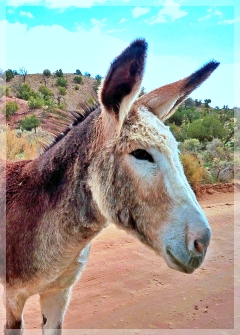 The story is told of a donkey who fell into a deep pit. Unable to get out, the animal brayed loudly until the farmer came to investigate. Seeing no way to get his donkey out of the pit, the farmer decided the only thing he could do was to put the poor animal out of its misery. Since the pit needed to be filled anyway, he got a spade and started to shovel dirt into it. When the donkey felt those first clods of dirt on his back, he lost all hope of rescue and brayed even louder. As he shook the dirt off his back, however, he discovered a growing mound of dirt beneath his feet. Seeing a possible solution, the donkey grew silent as he continued to shake dirt off his back and started tamping it down with his hooves. As the dirt piled up beneath his feet, the donkey got higher and higher in the pit. Paying no attention to the now silent animal, the farmer kept shoveling until he finally stopped for a rest. When he turned around, the man was shocked to see the donkey step out of the pit and trot away. The animal could have chosen to wallow in his misery—simply hung his head and let that dirt cover him up—but he didn’t. Instead, he took steps to change his situation.
 Days bled into weeks, weeks into months, and every day seemed the same for much of the last eighteen months. Life became a series of postponements, rebookings, cancelations, setbacks, inconveniences, letdowns, and disappointments. Visiting Grandma meant waving at her through a window, final farewells were FaceTime calls on a nurse’s cell phone, and we mourned from a distance while attending celebrations of life virtually. Weddings were postponed, family reunions put on hold, shut-downs and travel restrictions kept loved ones apart, theaters and concert halls went dark, vacations were delayed, businesses closed, jobs were lost, and junior year abroad became junior year on Zoom.
 Devotions of the Heart