PICTURING HIM

My soul thirsts for God, for the living God. When may I come to see God’s face? [Psalm 42:2 (GW)]

But you can’t see my face, because no one may see me and live. [Exodus 33:20 (GW)]
“He’s not at all what I expected!” I said after seeing a well-known radio personality in person. Nowhere near as attractive, suave and elegant as he’d sounded on the air, he was much better in my mind’s eye. Older, heavier, less stylish and bald, I was disappointed. The imagined was so much better than the reality.

Do you ever try to visualize God? Would he look like George Burns, the kindly white-haired old man in the movie Oh, God? whose first words to John Denver’s character were, “Eh, not what you expected?” He certainly wasn’t! Maybe God would sound and look more like Morgan Freeman in Bruce Almighty and appear in an elegant white suit. Perhaps He’d be more like David Strathairn in Interview with God, who, in true rabbinic fashion, answered questions with questions of his own during three interviews. In The Shack, God was portrayed by Octavia Spencer, a heavy-set soft-spoken African-American woman who went by the name of “Papa.” Of course, none of these characterizations come anywhere close to personifying God.

Nevertheless, even though we know God is spirit and without a physical body, we continue trying to visualize Him. Even the most creative mind is incapable of clearly picturing a God, unrestrained by time or space, who can be everywhere at all times: a God who sees, hears and knows all, not just in the present, but in the past and future as well. Our limited imaginations can’t come close to comprehending such an unlimited being who always has been, is now, and forevermore will be. The enormity and power of God is incomprehensible. I’m overwhelmed even thinking about it. That, however, is what I think God wants: for us to be awed and overcome by His amazing presence.

Even though God walked on earth for thirty-three years, we have no physical description of Him and Scripture used few adjectives. While John, Peter and James saw Jesus’ face shine like the sun and His clothes become white during the Transfiguration, they had but a glimpse of His great God glory! Since Judas had to point out Jesus to the soldiers in the garden, when living as a man, Jesus must have looked quite similar to every other Jewish Galilean.

Fortunately, while we may not know exactly what God looks like, we can know Him. Scripture tells us what He was like and, even though we can’t see Him, we know He is there. Moreover, when we eventually do come face to face with our Heavenly Father, we won’t be disappointed (as I was with that radio personality). It’s a guarantee; the reality will be far better than anything we possibly could imagine.

The throne of God and the lamb will be in the city. His servants will worship him and see his face. His name will be on their foreheads. There will be no more night, and they will not need any light from lamps or the sun because the Lord God will shine on them. They will rule as kings forever and ever. [Revelation 22:3b-5 (GW)]

Copyright ©2020 jsjdevotions. All rights reserved.

WITH AUTHORITY

When Jesus finished these words, the crowds were astonished at his teaching, for he taught them as one having authority, and not as their scribes. [Matthew 7:28-29 (NABRE)]

water liliesWhen Jesus finished the Sermon on the Mount, the crowds were astounded at his teaching because, unlike the scribes and Pharisees, He taught with “authority.” When the people wondered at Jesus’ authority, they weren’t referring to His ability to speak confidently and persuasively. The Greek word translated as “authority” was exousia which meant power or right; the people wondered at Jesus’ authorization to say the things He said. Rather than teach on their own authority, most rabbis taught on the authority of earlier sages. The Moody Bible Commentary depicts them as virtual “walking footnotes” who merely cited famous teachers and repeated what had been said before by others.

While it’s usually translated as “Verily” or “Truly, I say to you,” Jesus often began His teaching with the words, “Amen, I say to you.” Meaning “truly” or “certainly,” the word “amen” was used at the end of a prayer to confirm its words. It also was said when affirming a pledge; saying “amen” at the end of an oath made the vow valid and binding. By saying, “amen” before He spoke, Jesus was guaranteeing the truth of His words: His distinctive power and right. In effect, Jesus was announcing, “I say this to you indisputably, unequivocally, and with the fullest authority.”

A perfect example of Jesus’ claim of authority is found in His lesson about building on a solid foundation (written about yesterday). His simile echoed one used by many Jewish rabbis but with one very important difference. In the rabbis’ version, the solid foundation was to be the Torah; in Jesus’ version, the unshakable foundation was His word! His audience must have been shocked by those words; it’s no wonder they marveled at the authority He claimed.

When we look at the authority with which Jesus taught and acted, we can see why the priests, teachers and elders felt their position threatened. When they demanded to know by whose authority Jesus acted and spoke, they weren’t interested in an answer; they just wanted to trick Him into saying something that would label Him as an eccentric fanatic or a blasphemer. Like a true rabbi, Jesus answered their question with one of His own and asked where John the Baptist got his authority. Instead of backing Jesus into a corner, He’d backed them into one. If they said John had no authority, the people would be angry and, if they said John’s authority was from God, they’d have to answer for not believing and supporting the Baptizer. When they refused to answer, so did Jesus.

It had been a long dry spell for the people of Palestine; before John, the last time God spoke was through the prophet Malachi more than 400 years earlier. When Jesus spoke, the people were again hearing the Word of God! The difference was that John and the other prophets knew they were mere messengers; the words they spoke were not their own. When Jesus spoke, he wasn’t God’s messenger; He was God’s Son. Jesus didn’t just have authority; He was the incarnate Authority of God!

Amen, amen, I say to you, whoever hears my word and believes in the one who sent me has eternal life and will not come to condemnation, but has passed from death to life. [John 5:24 (NABRE)]

Copyright ©2020 jsjdevotions. All rights reserved.

SINKING

Everyone who hears my teaching and applies it to his life can be compared to a wise man who built his house on an unshakable foundation. When the rains fell and the flood came, with fierce winds beating upon his house, it stood firm because of its strong foundation. [Matthew 7:24-25 (TPT)]

Mt. Hayden - Grand CanyonWhile summer is hurricane season here in Florida, early spring is “sinkhole season.” For most property owners, a sinkhole is little more than a headache but, for some, it means the loss of their homes and possibly their lives. Seven weeks ago, two families north of here lost their homes and belongings as the earth collapsed beneath them, leaving a chasm at least 40-feet wide and 60-feet long. Back in 2013, a man went to sleep and literally disappeared as he, his bed and then his entire bedroom vanished into the earth; his body was never recovered.

Here in the “Sunshine State,” our homes are built on limestone that dissolves easily in rainwater; as a result, the underground becomes honeycombed with cavities. Sometimes, a cavity becomes too big to support its ceiling and collapses, leaving a gaping hole at the surface. Too much or too little water can trigger these sinkholes. Although cavities filled with rainwater can support their ceiling, when drought causes them to empty out, they can’t. On the other hand, in a heavy rain, the sudden flood of groundwater rushing into a cavity combined with the weight of pooled water on the surface also can lead to the ground’s collapse.

When purchasing our house of poured concrete, I knew it was hurricane resistant but I never gave any thought to the strength of the ground beneath it. Many of us build our lives in much the same way. Attention is given to looking good on the surface but our lives are not built on God’s bedrock. Instead of a drought or torrential rains jeopardizing our stability, it’s things like job loss, illness, miscarriage, divorce, addiction, mental illness, teenage rebellion, betrayal, depression, boredom, and loss that threaten our weak foundation.

As a carpenter, Jesus knew all about the building of houses when He spoke about foundations at the end of His Sermon on the Mount. Two houses experience the same challenges but only the house built on rock can endure life’s storms. In case his listeners didn’t understand His point, Jesus clearly explained it: a life built upon His teaching was built on a foundation of bedrock and wouldn’t fail.

Since most sinkholes occur in the central part of our state and only a few small ones have occurred near us, I’m not worried about them. Nevertheless, we do look for signs of trouble such as leaks or structural cracks in our floors or walls. Sinkholes can be prevented if geotechnical experts are called in time and the necessary repairs or remediation are done. Those houses I mentioned didn’t have to disappear into an abyss and neither do our lives. Lives built on shaky foundations can be saved. The salvage expert to be consulted is Jesus who will shore up our lives with His living word. Moreover, unlike that man who disappeared into the ground, nobody can fall so far into the abyss that Jesus can’t lift them out. Let us all build our lives on the bedrock of Jesus Christ!

But everyone who hears my teaching and does not apply it to his life can be compared to a foolish man who built his house on sand. When it rained and rained and the flood came, with wind and waves beating upon his house, it collapsed and was swept away. [Matthew 7:26-27 (TPT)]

Could there be any other god like you? You are the only God to be worshiped, for there is not a more secure foundation to build my life upon than you. [Psalm 18:31 (TPT)]

Copyright ©2020 jsjdevotions. All rights reserved.

NEVER THE EASY WAY

No one who is tempted should ever be confused and say that God is testing him. The One who created us is free from evil and can’t be tempted, so He doesn’t tempt anyone. [James 1:13 (VOICE)]

When the Apostle James tells us that God can’t be tempted by evil, we wonder how Jesus could be tempted to sin while in the wilderness. Christians agree that Jesus never sinned but some question whether He actually could. They hold the “impeccability” position: because Jesus was God, sin was impossible and He couldn’t have been tempted. Others hold the “peccability” position: because Jesus was a man, he could sin and was tempted. Still others, recognizing His dual nature, say that, as a man, Jesus could be tempted to sin but, as a divinity, He couldn’t.
Jesus was both God and man in one person. Rather than ceasing to be God while on earth, He added humanity to His being. At the same time, He was both divine and mortal, impeccable and peccable, immortal and mortal, infinite and finite. He didn’t have a multiple personality disorder with dueling personas; His fully divine nature was united in perfect harmony with his fully human one. While Jesus’ human nature was tempted by evil, His divine nature was not. Nevertheless, the temptation was real!

When in the wilderness, Satan tempted the hungry Jesus to make bread from stones. As the One who later fed a multitude with a boy’s lunch, we know Jesus could easily have done it; but He didn’t. Satan then tempted Jesus to prove himself by jumping off the highest point of the Temple. We know that the One who walked on water and passed unseen through an angry mob didn’t need angels to bring Him to safety. Jesus could have transported Himself safely to the ground effortlessly; but He didn’t. Finally, Satan tempted Jesus by offering Him kingdoms and glory if only He’d worship the enemy. We know the One who returned the dead to life, healed the sick, and turned water into wine didn’t need Satan to give Him kingdoms and glory. With a snap of His fingers, the One who was there at creation was capable of performing such an extraordinary spectacle that all of Jerusalem would have knelt immediately in worship; but He didn’t. When I look at those temptations, I see Satan tempting the Jesus to use His divine power to take the easy way out of the struggle and suffering that lay in His future as a man.

Satan left Jesus after that but his departure was temporary. He lay in wait for the next opportunity and I suspect he frequently tempted Jesus to take the easy way. As God, Jesus could be anywhere He wanted but, as a man, He had to walk to get there. God never gets tired, hungry, or thirsty but Jesus the man did When we look at the miracles done by Jesus, there was a unique purpose to each one and, while they helped to establish His identity, none were done to make His life easier. He deliberately chose to meet the challenges of life as a vulnerable human not an invincible God. Jesus never took a shortcut as God!

Satan is merely a fallen angel and was no match for the divine nature of Jesus. Satan, however, can overpower man and it was as a man that Jesus had to defeat him! Satan wanted to prove that no man could be obedient to God’s will but, by living as a man and resisting temptation, Jesus did just that. Out of love for us, Jesus defeated Satan by living sinlessly as a man and by dying as a man at Calvary.

Though He was in the form of God, He chose not to cling to equality with God; But He poured Himself out to fill a vessel brand new; a servant in form and a man indeed. The very likeness of humanity, He humbled Himself, obedient to death—a merciless death on the cross! [Philippians 2:6-8 (VOICE)]

For Jesus is not some high priest who has no sympathy for our weaknesses and flaws. He has already been tested in every way that we are tested; but He emerged victorious, without failing God. [Hebrews 4:15 (VOICE)]

Copyright ©2020 jsjdevotions. All rights reserved.

FORTY DAYS

Then Jesus was led by the Spirit into the wilderness to be tempted there by the devil. For forty days and forty nights he fasted and became very hungry. [Matthew 4:1-2 (NLT)]

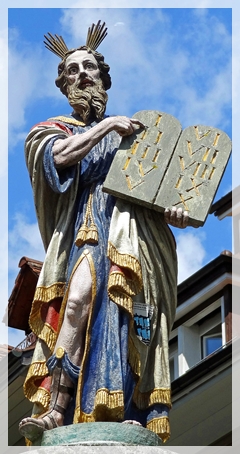
Moses Fountain - Bern SwitzerlandIn Scripture, the number forty often appeared in the context of preparation, judgment, or testing. The rain poured down upon Noah for forty days and nights. After spending forty years in Egypt and another forty as a shepherd, Moses twice spent forty days with the Lord on Mt. Sinai. The Israelite scouts spent forty days exploring the land of Canaan and, because the people lost heart and rebelled at their report, they spent an extra forty years wandering the wilderness (one year for each day the men explored). Jonah warned Nineveh their destruction would take place in forty days, Ezekiel lay on his right side for forty days because of Judah’s sins and, before being slain by David, Goliath taunted Saul’s army for forty days.
The number forty has significance in the life of Jesus, as well. After His baptism by John, the Spirit led Jesus into the wilderness for forty days of testing and, after His resurrection, Jesus remained on earth for forty days. Just because the number forty frequently appears in the context of trials, however, does not mean that forty is merely symbolic. Remembering that God is the One who chose the time, forty days probably means forty days.

Although people like David, John the Baptist, and Moses spent a time of testing in the wilderness, we wonder why Jesus, the son of God, would have to undergo a period of testing before beginning His ministry. Moreover, we wonder how Jesus, being God in flesh, could be tempted. Although both wholly God and wholly man, it was Jesus the man who grew, walked, talked, and was crucified for our sins, and it was Jesus the man who demonstrated His humanity by undergoing temptation. Obedience really isn’t obedience if disobedience is impossible and it’s impossible for our good God to sin. As God, Jesus couldn’t be tempted to sin but, as a man, He could. The sinless Lamb of God had to remain sinless, not as God, but as man and out of obedience to God the Father.

It’s how Jesus resisted temptation that is most telling. As God, he easily could have rebuked Satan and sent him scampering with a wave of His hand. As a man, however, Jesus relied on Scripture to defeat the evil one. God has provided us with His word as a way to withstand temptation. Of course, we have to know His word before we can use it against the enemy! I suppose we could spend the next forty days doing just that!

Yes, Adam’s one sin brings condemnation for everyone, but Christ’s one act of righteousness brings a right relationship with God and new life for everyone. Because one person disobeyed God, many became sinners. But because one other person obeyed God, many will be made righteous. [Romans 5:18-19 (NLT)]

If you think you are standing strong, be careful not to fall. The temptations in your life are no different from what others experience. And God is faithful. He will not allow the temptation to be more than you can stand. When you are tempted, he will show you a way out so that you can endure. [1 Corinthians 10:12-13 (NLT)]

Copyright ©2020 jsjdevotions. All rights reserved.

DUST TO DUST – ASH WEDNESDAY

I take back everything I said, and I sit in dust and ashes to show my repentance. [Job 42:6 (NLT)]

Matterhorn Memorial - ZermattToday is Ash Wednesday and the beginning of the Lenten season. Marking the forty days Jesus spent fasting in the wilderness before beginning His ministry, Lent is a time many believers intentionally reflect on the life of Jesus: his ministry, sacrifice, death, and resurrection. For some Christians, today also starts a season of repentance, fasting, and self-examination.

Although many evangelical Christians do not observe Lent, it is one of the oldest traditions of the Church. A letter written by Irenaus of Lyons (c. 130-200) describes a pre-Easter fast that originated “in the time of our forefathers.” Originally lasting only a few days, in 325 AD the Council of Nicaea wrote about the occurrence of a 40-day season of fasting, penitence and self-examination. While it originally may have been a time for new Christians to prepare for Baptism, the whole Church soon joined in observing the Lenten season.

Although Lent is 40-days long, a look at the calendar tells us there are 46 days until Easter. Since those other six days are Sundays, they aren’t considered Lent. The disciples and most of the first followers of Jesus were Jews who had observed the seventh day (Saturday) as the Sabbath. Because Jesus rose from the dead on Sunday, however, the early apostles changed their Sabbath day of rest and worship to the first day of the week as a continued celebration of His resurrection. When the early church began to observe the season of Lent, Sundays (being mini-celebrations of the risen Christ) were exempt from fasting and other forms of self-denial.

Most Roman Catholics and some Protestants will observe this day with the imposition of ashes on their foreheads. Made by burning palms from the previous year’s Palm Sunday and mixing the residue with anointing oil, the ashes are a visible reminder of mankind’s mortality—God made us by breathing life into dust and it is to dust that our bodies shall return. [Genesis 3:19] The ashes also represent penance. Putting dust or ashes on the head was an ancient gesture of mourning and penitence; when people repented of their sins, they would dress in uncomfortable sackcloth and cover themselves with ashes. Today, some worshipers may leave church with the ash cross still on their foreheads as a way of carrying the cross into the world while, in other churches, worshipers will wash off the smudge as a sign that they’ve been cleansed of their sins.

Neither Ash Wednesday nor Lent is Biblically ordained and whether we observe either is a matter between us and God. We must keep in mind that observing any religious ritual or rite is not a way to earn salvation; we are saved by God’s grace through faith alone. Moreover, if we choose to observe Lent, Jesus made it clear that fasting and abstinence should be done humbly, sincerely, and discreetly. [Matthew 6:16-18] While it is okay to be seen fasting, it is not okay to fast so to be seen. Finally, let us remember that there is no specific season for repentance; we should repent of our sins all year long!

I have come to call not those who think they are righteous, but those who know they are sinners and need to repent. [Luke 5:32 (NLT)]

Now repent of your sins and turn to God, so that your sins may be wiped away. [Acts 3:19 (NLT)]

Copyright ©2020 jsjdevotions. All rights reserved.