
Then Jesus explained his meaning: “I tell you the truth, corrupt tax collectors and prostitutes will get into the Kingdom of God before you do. For John the Baptist came and showed you the right way to live, but you didn’t believe him, while tax collectors and prostitutes did. And even when you saw this happening, you refused to believe him and repent of your sins.” [Matthew 21:31b-32 (NLT)]
 “It’s all about getting a second chance!” said the back of the man’s T-shirt. I then saw the dog paws printed on both sides of the message and realized his shirt was advertising a dog rescue organization. Nevertheless, the shirt’s words made me think of the parable Jesus told the Pharisees about two sons. The vineyard owner told his sons to go work in the vineyard. The first son rudely refused but the second son respectfully promised he’d do the work. As it turned out, the defiant son had a change of heart and went to work in the vineyard while the second seemingly dutiful son never did. Jesus then asked the Pharisees which of the two sons had done his father’s will. Of course, they had to say that the first son, in spite of his initial rebellion, was the obedient one.
The purpose of the parable was to convict the religious leaders of their phoniness. Claiming obedience and righteousness, they’d refused God’s invitation to repent delivered by John the Baptist. While saying they wanted to do God’s will, the Pharisees hadn’t. The scum of society, however, had believed and repented. When Jesus claimed that repentant sinners like tax collectors and prostitutes would get into the Kingdom of Heaven long before the Pharisees, they were shocked. You see, in God’s world, performance takes precedence over promise!
While immediate obedience is preferable, delayed obedience always beats phony obedience. Like the first son, some people prove to be far better than initially expected. Before we accepted Jesus, most of us didn’t show much potential. Truth be told, we probably were willful, selfish, mean, hypocritical and possibly immoral. Like the first son, however, we repented, mended our ways, and now work for our Father in Heaven. Unfortunately, like the second son, others prove false to their initial promise. There is, however, good news for those people whose intentions and promises haven’t materialized. Like the first brother, they too can repent, change their ways, and start working for their Father. Jesus’ words to the Pharisees tell them that the door to His Kingdom is closed to religious pretenders but open to even the vilest of repentant sinners.
The parables of the Two Sons and the Prodigal Son tell us that our God is a God of Second Chances! If there had been a cross on that man’s T-shirt instead of dog paws, the same words would have promoted Christianity! Indeed, “It’s all about getting a second chance!” in Jesus’ rescue organization! Best of all, He doesn’t stop at second chances. Our God is the God of Endless Second Chances, which is good news since it’s pretty much a guarantee that most of us will mess up our second chance and need several more!
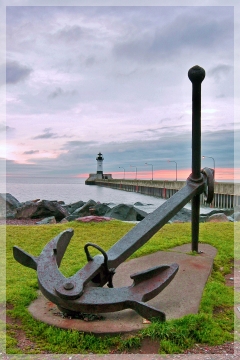 The sign in front of a nearby church read, “Our hope is anchored in the Lord,” which got me thinking about anchors. I’d never given them much thought until we took a Windjammer cruise off the coast of Maine many years ago. Accompanied by four friends and a crew of two, we sailed for a week. At dusk, we’d lower the sails and anchor in a harbor for the night. After breakfast, we’d pull up anchor for another relaxing day of sailing by lighthouses, granite cliffs, fishing villages, and even a few seals. One day, however, gale force winds replaced the gentle breeze and the calm sea turned violent. The sky darkened as rain and hail poured down on us. We immediately pulled into the nearest inlet, lowered the sails, and dropped two anchors to keep from being blown into the rocks! If we’d had two more anchors (as did the sailors in Acts 27), I suspect we would have dropped them, as well. After donning my life jacket and slicker, all I could do was pray and hope those anchors held. You really don’t appreciate the worth of an anchor until you’ve needed one in a storm!
 In all three accounts of Jesus healing the paralytic whose friends carried him to the Lord, Jesus forgave the man before healing him. While the combination of both forgiveness and healing demonstrated Jesus’ power over both sin and disease, His offer of forgiveness before healing might lead us to think there is a causal relationship between sin and sickness or forgiveness and physical healing.
 When Jesus forgave the unnamed woman’s sins, he caused quite a stir among the Pharisees and religious leaders who were His fellow dinner guests. People can forgive an offense against them, but they can’t forgive an offense against someone else or God! While I can forgive your $10 debt to me, I have neither the right nor the power to say you don’t have to pay the $150,000 you also owe the Bank of America, Sallie Mae, Capital One and Chase for your mortgage, college loan, car financing, and credit card purchases. A person can’t do that but God can! Because only God has the authority to forgive people’s sins, implied in Jesus’ forgiveness of the woman’s sins, is a claim that He is God.
 When entering someone’s home, while we might be offered some hand sanitizer or asked to remove our shoes, none of us expect the host to provide us with water to wash our feet. Back in Biblical times, however, hospitality was quite different. No one wore socks and the shoes and sandals bore little resemblance to the Nikes, Tevas, and Keens of today. Between the dusty roads and the oxen, horse, donkey and camel droppings on them, people’s feet were filthy. Foot washing was an expected sign of hospitality and a good host always offered water so a guest could wash his own feet. If the host were rich enough, his servant did the washing and, if the guests were honored enough, the host might do the washing. For example, both Abraham and Lot offered foot washing to their heavenly visitors and, before feeding them, Laban provided Abraham’s servant and men water for foot washing. On the last night of His life, Jesus took on the role of a servant and washed the feet of His disciples.
 Yesterday, I wrote about Job’s lamentation. 19th century bible scholar George Granville Bradley said this about Job 3: “Where in the world will you find a sadder strain of more hopeless, uncontrolled, and unbroken lamentation and mourning? … Filled to the brim, they run over with pain.” I have to agree.
 Devotions of the Heart