
So you see, just as death came into the world through a man, now the resurrection from the dead has begun through another man. Just as everyone dies because we all belong to Adam, everyone who belongs to Christ will be given new life. [1 Corinthians 15:21-22 (NLT)]
For this is how God loved the world: He gave his one and only Son, so that everyone who believes in him will not perish but have eternal life. God sent his Son into the world not to judge the world, but to save the world through him. [John 3:16 (NLT)]
 In less than five minutes the house was ready for Easter. I’d hung out the spring wreath with its silk tulips, placed the resin Easter rabbit with his cart and eggs on the hall table, and put the three ceramic bunnies around the flowers on the table. With no grands visiting this year, I didn’t even have eggs to boil or baskets to fill! Since it took me days to ready the house for Christmas, I wondered why Easter doesn’t get the same amount of decoration and celebration. Granted, most of the holiday traditions for both holy days have pagan beginnings. Nevertheless, those customs have become part of our culture and Christmas seems to overshadow Easter by a mile.
Christmas has its own color scheme, its own genre of music, and its own beloved fictional characters, including a Grinch, a snowman, an elf on a shelf, and a red-nosed reindeer. We spend weeks decorating our homes, purchasing gifts, and preparing food. We have special Christmas attire ranging from Santa hats to candy cane jewelry and ugly holiday sweaters. People decorate trees, hang garlands and lights, dress up their dogs, and adorn their cars with reindeer horns. Every year sees at least one Christmas-themed movie release and we get a plethora of holiday-themed television shows throughout December. Christmas music is played from the first of November to New Year’s and our calendars are filled with dates for holiday parties and concerts. Easter traditions pale in comparison to Christmas. Even with Easter baskets and egg hunts, the Easter Bunny can’t hold a candle to Santa. The few Easter hymns are sung only a couple of Sundays and hard-boiled eggs and Peeps are second-rate when compared to the plethora of holiday treats, Christmas cookies, and peppermint bark! As far as celebrations go, Easter is sort of like the neglected step-child of holy days. Of course, it’s difficult to generate a festive spirit when Easter is preceded by a season of penitence and fasting and follows the darkest day in Christendom.
As much as I enjoy the traditions of Christmas (in spite of their pagan origins), Christmas really has nothing to do with decorating houses, baking cookies, hanging stockings, gift exchanges, sending cards, singing carols, or holiday parties. Although our sacred Christmas traditions emphasize Jesus’ birth with nativity scenes and pageants, that night in Bethlehem was just the beginning of a far greater story—the story of who Jesus was and what He did for us.
Granted, we usually consider a person’s arrival more reason to celebrate that his departure and we celebrate birthdays rather than dates of death but, in Christ’s case, it is just the opposite. The meaning of Christmas is actually found in the Easter story. Without Jesus’ death, resurrection, and ascension there would be no forgiveness, redemption, and salvation. Without Easter, the Christmas story would be no more than just a story. For me, the purpose of Christmas can be summed up in one word: Easter!
So, Merry Christmas and Happy Easter on this upcoming Resurrection Sunday!
Somehow we just don’t make the same boisterous fun of Holy Week that we do of Christmas. No one plans to have a holly, jolly Easter. … Easter may seem boring to children, and it is blessedly unencumbered by the silly fun that plagues Christmas. Yet it contains the one thing needful for every human life: the good news of Resurrection. [Frederica Mathewes-Green]
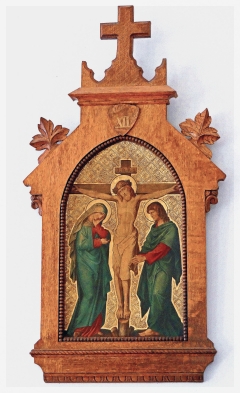 Jesus knew that one would betray Him, another deny Him, and all desert Him. He knew the people He’d fed, healed, taught, and loved—the people who just a few days earlier had greeted him like a king with palm branches and shouts of “Hosanna”—soon would prefer a thief over Him. Because of His anguished prayers later that evening in Gethsemane, we know that He knew the suffering and torment that lay ahead for him. Nevertheless, he sang with the disciples during their Passover meal that last night and it wasn’t a sorrow-filled psalm of lament.
 Apparently, coffee was not served after dinner in the upper room that Thursday night. Granted, a nap is welcome after a big meal but that evening’s Passover meal was like no other and Jesus had predicted that the disciples would desert Him. After such a warning, you’d think the men would have been extra cautious. Scripture tells us Jesus was troubled and grief-stricken when He asked Peter, James, and John to keep watch with Him. Surely, that should have motivated His closest friends to keep awake, but it didn’t. Three times Jesus went to pray and three times he returned to find the men asleep. It was Jewish custom on Passover night to stay up late and talk of God’s acts of redemption so staying awake this night was something they’d all done on other Passover nights. Nevertheless, even after Peter specifically was cautioned to stay awake while praying to stand strong against temptation, the men slumbered. Shouldn’t the warning that he’d deny Jesus three times before morning been enough at least to keep Peter alert and deep in prayer? While the Lord was in anguish and prayed so intently that He sweat drops of blood, His most trusted friends took an after-dinner snooze. They were asleep on the job.
 Throughout His ministry, it seems that Jesus knew that the cross awaited Him but we don’t know if the human part of Him knew the exact details. Even so, it’s one thing to know what lays in the future but quite another to know it is about to begin within a matter of minutes. That night in Gethsemane, God showed Jesus the cup from which He would drink and He showed it in gruesome detail. Jesus viewed the betrayal, abandonment, sham trials, mocking, beating, flogging, and suffering torture on the cross along with the jeers of the crowd and the heartbreak and tears of His mother and the other women at the foot of the cross. Had Jesus not known exactly what the next 24-hours held, He would have been no different than the lambs brought to the Temple for sacrifice. They weren’t there of their own volition and had no knowledge of what would happen to them when presented to the priest. Rather than willing sacrifices, they were victims! The Lamb of God, however, needed to know the extraordinary cup—the horrible ordeal—that lay before him because, rather than a victim, He was a willing volunteer! His anguished prayers that night, however, tell us He didn’t look forward to it.
 We always knelt for prayer in the church I attended as a girl so I used to think the only way to pray was on my knees with head bowed and hands tightly clasped. While I now pray in a variety of postures, I wondered if Scripture tells us exactly how we should pray.
 While asking one’s teacher how to pray was a typical request in Jesus’ day, Jesus was anything but a typical teacher. He’d walked on water, stilled storms, healed the sick, raised the dead, and turned water into wine, but His disciples didn’t ask how to do those impressive miracles. Instead, they asked Him how to pray.
 Devotions of the Heart