
Then he said to the crowd, “If any of you wants to be my follower, you must give up your own way, take up your cross daily, and follow me.” … As they led Jesus away, a man named Simon, who was from Cyrene, happened to be coming in from the countryside. The soldiers seized him and put the cross on him and made him carry it behind Jesus. [Luke 9:23, 23:26 (NLT)]
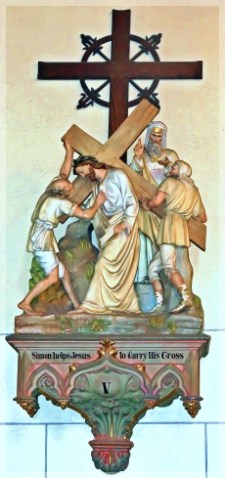
Although Jesus spoke of carrying your own cross, it was Simon of Cyrene who carried His. Cyrene was in Cyrenaica, a land just east of Egypt in what now is Libya. We don’t know if Simon had resettled in Judea or if he was there just for the Passover. We only know that Simon had just come into the city from the fields (or countryside) when the soldiers pressed him into service. Carrying a 75-to-125-pound cross-beam (patibulum) of a Roman cross certainly hadn’t been in Simon’s plans that day but one didn’t refuse a Roman soldier.
If we’re supposed to carry our own cross, why didn’t Jesus carry His? Perhaps because that cross was as much Simon’s as it was Peter’s and John’s and yours and mine. That cross weighed more than 125 pounds because it carried the weight of mankind’s sins. It was at Golgotha that Simon surrendered the weight of his (and everyone else’s) sins to Jesus. Not only did Simon carry his own cross but Luke tells us specifically that Simon followed Jesus as he did it!
When they impressed Simon into service, it seems as if the Roman soldiers finally showed some compassion on the man they’d so mercilessly beaten earlier that day. Kindness, however, may not have been their motivation. Not everyone condemned to the cross survived the soldiers’ scourging but they’d been told to crucify Jesus. If He died before getting to Golgotha, they’d have failed at their task. The soldiers may have enlisted Simon simply to keep Jesus alive long enough so they could inflict more torture on Him!
Whatever the soldier’s motive was for conscripting Simon, theologian John Piper posits that God put Simon there for Jesus. Let us remember that the man who healed the sick, turned water into wine, fed a multitude with a boy’s lunch, gave life back to Jairus’ daughter, and called Lazarus out of the tomb had the power to stop his suffering at any time that day. If we thought Jesus’ anguish was great the previous night while praying to do God’s will, His agony that day was far worse. If we thought Jesus’ temptation to yield to Satan was great in the wilderness, it was even greater as He stumbled toward Golgotha. Angels, however, ministered to our Lord in the wilderness and an angel strengthened Jesus in the Garden of Gethsemane. In the same way, did God have Simon carry the cross as a way of helping and sustaining His Son so that Jesus’ obedience would not falter?
God works in amazing ways and maybe Simon of Cyrene was placed on that roadside at just that time for just such a purpose! Could God have placed us somewhere today so that we can serve as one of His ministering angels?


 It’s easy to assume the Pharisees were irate just because Jesus had worked on the Sabbath but, for these sticklers for the law, it was as much about how He healed the man! Spitting on the ground on the Sabbath was forbidden because plowing was one of the 39 types of work prohibited on the Sabbath! Using their convoluted logic, that meant that digging any hole was prohibited and, when spittle landed on soil, it might cause a small dent in the ground (which would be digging a hole) and dislocate a small amount of dirt (which would be plowing)! Compounding Jesus’ violation of the law by both healing and plowing, He made mud. Kneading, defined as joining small particles into a mass using any liquid, was another of the 39 kinds work prohibited on the Sabbath. Jesus broke this law the moment his spittle wet the dust; the mixing of his spittle and the dirt together to make mud was an additional offense! To them, the restoration of sight meant nothing when compared to His many transgressions of the law!
 We know that four of the disciples were fisherman and one was a despised tax collector but have no idea what careers the others left behind to follow Jesus. If Jesus wasn’t carpentering, the fishermen weren’t fishing, the tax collector wasn’t collecting, and others weren’t doing whatever it was they did, how did these men support themselves? For the most part, they probably depended on the hospitality of strangers or friends like Martha, Mary, and Lazarus but we also know that the disciples were in Sychar purchasing food when Jesus had a conversation with the Samaritan woman at the well. Like any ministry, the group needed money for everyday expenses and Scripture tells us that people like Joanna, Susanna, and Mary Magdalene provided for them out of their resources.
 When Jesus brought Matthew into the inner circles of disciples, it was as shocking as if someone like Billy Graham brought a loan shark, heroin trafficker, money launderer, or embezzler onto his worship team. But, along with his questionable reputation and his devotion to Jesus, Matthew brought a unique set of skills to the Lord and to countless generations of Christ’s followers.
 Devotions of the Heart