TATTOOS – Part 1

Do not cut your bodies for the dead, and do not mark your skin with tattoos. I am the Lord. [Leviticus 19:28 (NLT)]
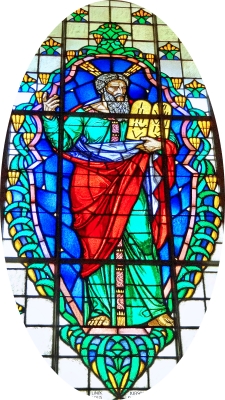
Moses - Meiringen - Michaelskirch
Since Leviticus 19:28 seems to prohibit tattoos, some people mistakenly believe that that it’s a sin for a Christian to be tattooed. My attention was drawn to this specific verse because a friend’s parents had cautioned him throughout his youth that a tattoo would keep him out of God’s kingdom.

Even though the word “tattoo” appears in most Bible translations of this verse, Scripture makes no specific reference to tattoos as we understand them today—a permanent mark or design on one’s body made by depositing pigment beneath the surface of the skin. The original Hebrew word was kethobeth; appearing just this one time, it appears to mean incised writing. Whether this was a scar from cutting (previously mentioned in this verse), a brand, or a mark using dye is unclear. The English word “tattoo” comes from tatau, tatatau, and similar words found in the tribal cultures of Polynesia and didn’t even enter the English language until 1771 when Captain James Cook (and his freshly tattooed sailors) returned from their first South Pacific voyage. Published in 1611, the King James Bible more correctly translates kethobeth as “mark.”  We really don’t know if Leviticus 19:28 was a blanket prohibition of all body markings or just certain types nor do we know if it applied to all circumstances or just specific ones like mourning, idolatry, or blasphemy.

Nevertheless, we’re curious about the various prohibitions in the Mosaic law and often wonder about God’s reasoning behind them. Many laws that seem quite arbitrary, like that in Leviticus 19:28, may well have been to distinguish the Israelites from the pagan customs they left in Egypt and would encounter in Canaan. Archeology indicates that ritualistic cutting was common in the Canaanite, Hittite, and Mesopotamian cultures when mourning the dead or honoring their gods. In their false belief that drawing blood called the attention of the gods, 1 Kings 18 tells us the prophets of Baal, “following their normal custom,” cut themselves with knives and swords “until the blood gushed out!” after they failed to call down fire from heaven.

Since we can’t understand God any better than an ant can understand us, trying to determine His reasoning behind many of the Torah’s laws is an exercise in futility. Moreover, obedience to God’s word isn’t dependent upon our understanding; His laws are to be obeyed simply because He is God and we are not. If the Israelites were presumptuous enough to ask God’s justification for the 613 mitzvot (commandments) in the Torah, His answer would have been the same one our parents gave us when we whined about curfews, TV time, proper attire, and being nice to our annoying little brother: “Because I said so!” God doesn’t need to justify His reasoning to His children any more than did our parents to us!

Heeding his parents’ caution about tattoos, my friend never got one but his grandchildren have! I assured him that their body ink has no bearing on their final destination. While many of the Old Testament laws are guidelines for knowing how to love God and our neighbor, they are not the standard by which Christians measure their conduct. We wear garments made of two or more kinds of fabric, trim our beards and side burns, consume dairy and meat in the same meal, and eat things like bacon, shrimp, and shellfish—all of which defy the Torah’s laws, yet no one claims any of those things will keep us out of the Kingdom and neither will tattoos!

When Jesus died on the cross, He put an end to the Old Testament law (even the one about body markings). As Christians the only law we are under is that of Christ: to love God with our heart, soul, and mind and to love our neighbors as ourselves!

Before the way of faith in Christ was available to us, we were placed under guard by the law. We were kept in protective custody, so to speak, until the way of faith was revealed. … The law was our guardian until Christ came; it protected us until we could be made right with God through faith. And now that the way of faith has come, we no longer need the law as our guardian. [Ephesians 3:23, 24-25 (NLT)]

Copyright ©2023 jsjdevotions. All rights reserved.

WHAT CAN PEOPLE DO TO ME?

For God has said, “I will never fail you. I will never abandon you.” So we can say with confidence, “The Lord is my helper, so I will have no fear. What can mere people do to me?” [Hebrews 13:5-6 (NLT)]

peony

While 21st century Christians might not recognize the source of the two verses quoted in Hebrews 13:5-6, the recipients of that epistle certainly did. As Jews who converted to Christianity, they were familiar with the Hebrew Scriptures. The first verse (found in Deuteronomy 1:6 and 8), were relayed by Moses to all of Israel and then specifically to Joshua. After Moses’ death, God personally made the same promise to Joshua in Joshua 1:9.

The second verse cited can be found in Psalms 118:6 and 56:4 and 11. While we don’t know who authored Psalm 118, we know that Psalm 56 was penned by David and was about running from Saul and being seized by Philistines in Gath. Any Hebrew in Paul’s time would know these quotes and the full context in which they were used.

Rather than facing battle with the Canaanites, fleeing from Saul’s army, or being in the hands of the enemy, the original readers of this epistle were new believers who faced persecution from both Rome and their fellow Jews. Having already endured public ridicule, beatings, imprisonment, excommunication from their synagogues, confiscation of their property, and flight from their homes, yet another wave of persecution loomed on the horizon at the time this epistle was written. Discouraged and disheartened, these new Christians were losing heart. Fearful, many contemplated abandoning their belief in Jesus and returning to Judaism.

Wanting to prevent them from apostasy, the epistle’s author encouraged these Jewish converts to remain steadfast in their new faith. Rather than disparaging Judaism, he fortified their faith by showing how Hebrew Scripture pointed the way to the Messiah and how Jesus fulfilled its Messianic promises. He explained that Jesus was superior to the Levitical priesthood, that His sacrifice was better than any required by the Law, and that the new covenant was better than the old. It is when encouraging his readers to stay strong in the faith that the letter’s author refers to these two Old Testament verses.

The last part of the second quote asks, “What can mere people do to me?” Clearly, people had done a great deal of harm to those Hebrew Christians in the past and worse soon would follow. Moreover, just as Christians were persecuted in the 1st century, they continue to be persecuted in parts of the world today. The epistle’s author, however, wasn’t delusional; he knew the people to whom he wrote were not safe from harm at the hands of their fellow man! A closer look at the full verse never says Christ’s followers won’t suffer. Hebrews’ author was telling those new Christians not to be afraid because God was beside them; his words are as relevant today as they were 2,000 years ago. His confidence came from knowing that our lives and future are in the hands of a God who loves us and has pledged Himself to us.

No matter how dire the circumstances, we aren’t alone. While our adversaries are mere mortals, standing beside us is God and His love for us outweighs the hatred of men. In the end, all of the adversities and suffering of this world pale in comparison to the resurrection blessings that await us. The worst thing people can do is kill our bodies. No person, however, can touch our souls!

Don’t be afraid of those who want to kill your body; they cannot touch your soul. Fear only God? But not a single sparrow can fall to the ground without your Father knowing it. And the very hairs on your head are all numbered. So don’t be afraid; you are more valuable to God than a whole flock of sparrows. [Matthew 10:28-31 (NLT)]

Copyright ©2023 jsjdevotions. All rights reserved.

TRUTH OR FICTION?

All scripture is breathed by God, and it is useful for teaching, for rebuke, for improvement, for training in righteousness, so that people who belong to God may be complete, fitted out and ready for every good work. [2 Timothy 3:16-17 (NTE)]

Bible
I didn’t mean to spoil anyone’s holiday last month when writing about some common Christmas misconceptions in “The Real Story.” Like many others, I display historically inaccurate nativity scenes, sing “We Three Kings,” attend live nativities and Christmas pageants, and never will tire of the little ones, in their crooked tinsel halos, singing “Happy Birthday, Jesus!” Even when not historically accurate, Christmas practices like these have become a beautiful part of our traditional celebration of the Lord’s birth. That devotion’s purpose was to point out that, since  God’s story needs no embellishment, we need to know the difference between legend, tradition, and truth if our witness is to be effective.

It’s crucial to know what Scripture says because it’s not just Christmas traditions that can blur the line between truth and fiction. For example, even though Dan Brown’s bestseller The Da Vinci Code  is entirely fiction, there are many people who believe it to be reality-based. While adding sex, intrigue, and conspiracy to the story of God’s redemption of mankind made for a best seller and popular movie, it’s a poor substitute for the truth found in God’s word! We can’t rewrite Jesus to make Him more human nor can we rewrite His message to make it fit our purposes. As Christians, we must be wary of hoaxes and untruths in any sort of media, whether they purport to be fiction or not.

Several years ago, a woman in our study group asked to lead the day’s prayer from a popular devotional. Because the book’s author originally claimed the book’s words came directly from Jesus, this woman believed she was directly quoting the Lord in the prayer and gave its words the same authority as Scripture. The problem wasn’t in the prayer’s insipid words, it was in the author’s claim of divine revelation—that they were Jesus’ words. None of us can speak for God and that prayer’s words were the author’s, not the Lord’s. If our witness is to be effective, we must know the difference between Spirit-led ideas and God’s word. No matter how inspiring, we must never put our words (or those of anyone else) in Jesus’ mouth. If we want to know what He has to say, the Bible (rather than a devotional) is where we should look!

In another small group, we were discussing the crucifixion when Joseph of Arimathea was mentioned. Scripture only tells us that he was a wealthy member of the Sanhedrin who obtained Jesus’ body from Pilate and, with Nicodemus, prepared it for burial before laying the Lord in his own tomb. One group member, however, related how Joseph later brought the gospel to Britain along with the Holy Grail and, when he stuck his staff into the ground, it miraculously turned into a thorn tree overnight. While Joseph was mentioned by early church historians and in apocryphal and non-canonical accounts, no additional details were ever found credible. He wasn’t even associated with the Holy Grail until his name appeared in a 12th century verse romance and the first mention of his evangelizing Britain wasn’t made until the mid-13th century! As for the Holy Grail—Scripture makes absolutely no mention of a Holy Grail because there was none; like this story of Joseph of Arimathea, it is nothing more than a mythical legend. Nevertheless, many Christians continue to confuse legend with gospel truth.

Because it is authoritative, true, and complete, Scripture alone is the basis for our faith, doctrine, and witness. Proverbs 30:5-6 and Deuteronomy 4:2 and 12:32 all speak to Scripture’s sufficiency with their warnings to neither add to nor take away from God’s word. Moreover, in spite of skeptics’ claims, every book that God intended to be in the Bible is there. Rather than being lost or hidden, any “missing” books were rejected because they were fallible religious/historical books rather than the inspired inerrant Word of God.

As Jesus’ witnesses, we are expected to “tell the truth, the whole truth, and nothing but the truth!” Of course, to do that we must know the truth and we can only do that by doing what the Bereans did—test what we hear and read by searching for the truth in Scripture!

And the people of Berea were more open-minded than those in Thessalonica, and they listened eagerly to Paul’s message. They searched the Scriptures day after day to see if Paul and Silas were teaching the truth. [Acts 17:11 (NLT)]

Copyright ©2023 jsjdevotions. All rights reserved.

HANUKKAH (2) – FEAST OF DEDICATION

Look at my servant, whom I strengthen. He is my chosen one, who pleases me. I have put my Spirit upon him. He will bring justice to the nations. [Isaiah 42:1 (NLT)]

In the same way, let your light shine before others, that they may see your good deeds and glorify your Father in heaven. [Matthew 5:16 (NLT)]
menorah

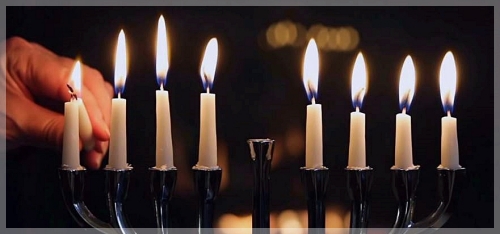
Most of us associate Hanukkah with Judaism’s menorah. Although the books of the Maccabees mention the relighting of the Temple’s lampstand/menorah, they make no mention of a miracle of oil. However, the Talmud (a collection of discussion and commentary on Jewish history, customs, law and culture) does. It claims that, while only one small flask of consecrated oil was found to light the menorah that first day, the lamp remained lit the entire eight days of celebration until new oil could be consecrated.

Although the Temple’s menorah had seven branches with wicks that burned fresh olive oil, Hanukkah’s menorah usually has nine branches with nine candles. Eight of those candles represent each day of the feast. The ninth candle, often placed in the center and slightly higher than the rest, is called the shamash, meaning servant. Rather than lighting each candle with a match, only the shamash is lit. It is this “servant” candle’s flame that is used to ignite the rest. Upon learning this, I couldn’t help but think of the Messianic prophecies of a suffering servant found in Isaiah 53. That servant was Jesus—He was the shamash who brought God’s light into the world and, like the shamash candle, He gave His light to our lives. By trusting in Him, Jesus said we become  “children of the light,” and, as His children, we are His servants. The Great Commission tells us that we are to be the shamash candles who continue to bring His light into our troubled world.

Thinking of Hanukkah merely as a festival of lights, however, misses the heart of this story—the rededication of the Temple. When a ragtag group of Jewish rebels retook the Temple from the powerful Seleucid army, the Temple had been desecrated and profaned. Before resuming worship there, the Temple had to be cleaned, the idols removed, the pagan altar dismantled, and a new altar consecrated. Only after they made it a fitting place for Jehovah to live did they re-dedicate the Temple to God.

For the people of Judah, the Temple was where God resided. For the people of Jesus, however, it is our bodies—our hearts, minds, and souls—that serve as a temple for God’s Holy Spirit. As believers, we are God’s temple individually and, as the body or church of Christ, we are His temple collectively. As His temple, we should be as holy and pure as were the Temple’s menorah and altar. Nevertheless, it’s difficult to walk through this sinful world and not have some of its filth contaminate us. Things like hate, anger, prejudice, envy, pride, deception, and greed defile us as much as that pig’s blood and idol of Zeus defiled Jerusalem’s Temple. Worse, as the collective temple of God, we’ve seen His church desecrated with things like corruption, exploitation, abuse, hypocrisy, bigotry, and shoddy, distorted and false doctrine. Like the Maccabees, do we need to do some cleaning of His holy temple?

The season of Hanukkah reminds us that Jesus is the servant whose light overcame the darkness of the world. My prayer for this Christmas season is that we allow Hanukkah’s story and traditions to inspire us so that we rid our lives of all that defiles His temple. Let us rededicate ourselves to the Lord and, as His servants, may we glorify Him in all we do.

He that chooses God, devotes himself to God as the vessels of the sanctuary were consecrated and set apart from common to holy uses, so he that has chosen God to be his God, has dedicated himself to God, and will no more be devoted to profane uses. [Thomas Watson]

Don’t you realize that your body is the temple of the Holy Spirit, who lives in you and was given to you by God? You do not belong to yourself, for God bought you with a high price. So you must honor God with your body. [1 Corinthians 6:19-20 (NLT)]

Copyright ©2022 jsjdevotions. All rights reserved.

HANUKKAH (1) – FESTIVAL OF LIGHTS

It was now winter, and Jesus was in Jerusalem at the time of Hanukkah, the Festival of Dedication. He was in the Temple, walking through the section known as Solomon’s Colonnade. The people surrounded him and asked, “How long are you going to keep us in suspense? If you are the Messiah, tell us plainly.” [John 10:22-24 (NLT)]

Today is the 25th of Kislev on the Hebrew calendar: the first of the eight days of Hanukkah. Last night, our Jewish brothers and sisters lit the first of the Hanukkah candles. Hanukkah isn’t a Jewish version of Christmas and it’s no more about dreidels (spinning tops), gelt (foil wrapped chocolate coins), potato latkes, or gifts than Christmas is about presents, decorated trees, holiday lights, or Santa. Just as Scripture doesn’t require celebrating Christ’s birthday, it doesn’t require Hanukkah’s observance. Nevertheless, because they both recognize events of great significance to Christians or Jews, these holidays continue to be celebrated throughout the world.
The Hanukkah story is recorded in the books of 1st and 2nd Maccabees and celebrates events that took place in 164 BC. Having been mercilessly persecuted by their Seleucid rulers, the people of Judah rebelled when the Syrian king Antiochus Epiphanes vandalized the Temple and defiled it by erecting an idol on its altar and sacrificing swine. Three years after its desecration, Jewish guerilla forces (led by Judah Maccabee) managed to defeat an army of 40,000 to reclaim the Temple. After thoroughly purifying the Temple, they relit the golden lampstand (the menorah), rededicated the Temple, and celebrated for eight days. Known as the Feast of Dedication (hanukkah means dedication), this celebration also became known as the Festival of Lights in commemoration of the relighting of the seven lamps of the Temple’s menorah.

The books of the Maccabees, however, have never been part of the accepted canon of the Hebrew scriptures and, like other books of the Apocrypha, they won’t be found in Jewish Bibles or in most Christian ones. Nevertheless, the Feast of Dedication was celebrated by Jews in the 1st century and John tells us that Jesus was at the Temple in Jerusalem during its observance. It was at that time that He was asked point blank if He were the Messiah.

Having seen His miracles, the people knew Jesus’ power exceeded that of an ordinary man and, having heard His words, they knew His authority surpassed that of their religious leaders. Nevertheless, they were expecting a military leader like Judah Maccabee—someone who would free them from Roman oppression and Jesus hadn’t spoken of politics or rebellion. Saying that the proof of His identity lay in His works, Jesus accused his questioners of being unwilling to believe. Indeed, rather than being interested in the truth, many simply wanted to catch Jesus saying something that might lead to His arrest. After Jesus made a claim of divinity by saying, “The Father and I are one,” they accused Him of blasphemy. Indeed, if Jesus were a mere man claiming to be God, His words would have been blasphemous. Jesus, however, wasn’t a man claiming to be God; He was the second member of the Godhead who was claiming to be a man!  Wanting to stone Jesus for His supposed sacrilege, the people tried to arrest Him, but He escaped. In the end, however, He died for His truthful words.

How ironic that, at the very time people were remembering God’s deliverance of Israel from the pagan Seleucids, they wanted to kill the One who came to deliver them from Satan! Having been conquered again by Rome in 63 BC, the deliverance they were celebrating had been temporary; the deliverance offered by Jesus would last forever! While celebrating the Festival of Lights, they wanted to kill the One who actually was the Light of the World! The way, the truth, and the life stood right before them and yet some refused to believe!

When we see the brightly colored lights associated with Christmas, let us celebrate the One who truly brought God’s light into the world. Those who follow Jesus will never walk in darkness because He is the Light of Life!

Jesus spoke to the people once more and said, “I am the light of the world. If you follow me, you won’t have to walk in darkness, because you will have the light that leads to life.” [John 8:10 (NLT)]

Copyright ©2022 jsjdevotions. All rights reserved.

THE REAL STORY

And she brought forth her firstborn son, and wrapped him in swaddling clothes, and laid him in a manger; because there was no room for them in the inn. [Luke 2:7 (KJV)]

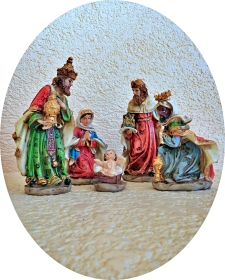
Magi
Between countless Christmas pageants, Christmas card illustrations, nativity sets, and the words of our favorite carols, the Christmas story we know actually may not be the one told by Luke. Although most translations say Mary laid Jesus in a manger because there was “no room for them in the inn,” it probably wasn’t an inn and no mention is made of an innkeeper (or his wife). The word usually translated as “inn” in this verse was kataluma and it appears one more time in Luke 22:11 and Mark 14:14 when Jesus sent Peter and John to Jerusalem to determine the location of the kataluma where they would celebrate their Passover meal. Here kataluma  is translated as guest room or guestchamber and Luke described it as a large upstairs room in a person’s house. Rather than kataluma , the word Luke used for inn when telling the Parable of the Good Samaritan was pandocheion which clearly meant inn or public house.

Rather than staying in the 1st century equivalent of a Motel 6, the couple would have stayed with relatives, as was the custom of the time. But, since everyone else in the family also was in Bethlehem for the census, the house would have been overflowing with people. Even though Mary was pregnant, the older family members had priority on rooms. Rather than no room at the inn, there was no room for them in the normal living quarters.

We wrongly assume Jesus was born in a barn or a stable because of the manger (an animal’s feeding trough) but animals usually weren’t housed in an exterior building. To keep them safe from theft and the elements, they were kept on the ground floor of the house, often under the living quarters. Because of the manger’s mention, it probably was here that Mary gave birth. Had I been Mary and about to give birth, I would have preferred the relative quiet and privacy afforded in the animals’ quarters to the commotion of a house filled with people! While it makes for great drama to think of a cruel innkeeper refusing them a room, it’s rather nice to picture the savior of mankind being welcomed into the wonderful chaos of an extended family oohing and aahing over Him!

Even though animals are included in every pageant and nativity, Scripture doesn’t mention Mary riding a donkey into Bethlehem, the shepherds bringing any sheep, or even camels. Because of the manger, we assume the presence of a cow but that’s mere speculation.

As for the angels—the only mention of angels in Luke’s account is when they announce Messiah’s birth to the shepherds. While it’s logical to think angels watched over the Holy Family that night, Scripture doesn’t say so and there’s no reason to think they were visible. Moreover, as much as I love singing the long “Gloria in excelsis Deo,” in the carol, Scripture only says the angels praised God and spoke their message.

In Matthew’s gospel we read of the wise men (magi) from the east who visited Jesus. While “magi” came to mean astrologers, sorcerers, or magicians, these men probably were Magians, a priestly caste from Media, Persia, Assyria, or Babylonia. Learned in the prophecies of Hebrew Scripture, they were worshipful seekers of the truth. Their number (three) and names come from song rather than Scripture and their kingship and camels may come from their mention in Isaiah 60. Careful reading, however, tells us Isaiah’s prophecy refers to Christ’s return rather than His birth. Nevertheless, an unknown number of Magi brought this young king gifts of gold, frankincense, and myrrh. Whether such costly offerings were theirs or on behalf of a foreign king is unknown.

Even the Magi’s appearance in our pageants and nativities is incorrect. Because the Holy Family fled to Egypt immediately after their departure, the Magi must have arrived after Mary’s purification and Jesus’ presentation in the Temple 40 days after His birth. When the Magi arrive, Matthew refers to Jesus as a child rather than an infant and, based on the age of the boys Herod ordered slaughtered, their visit probably occurred when Jesus was a toddler.

Christmas is a time of great pageantry and kings kneeling in front of an infant in a manger, surrounded by animals, shepherds, and angels, makes for great theater. The facts surrounding Jesus’ birth, however, are more marvelous that any we could imagine! The message that the Son of God came in human form to sacrifice Himself for our sins and provide eternal life to all who believe in Him needs no embellishment.

It is here, in the thing that happened at the first Christmas, that the most profound unfathomable depths of the Christian revelation lie. God became man; Nothing in fiction is so fantastic as this truth of the incarnation.  [J.I. Packer]

And the angel said unto them, Fear not: for, behold, I bring you good tidings of great joy, which shall be to all people. For unto you is born this day in the city of David a Saviour, which is Christ the Lord. And this shall be a sign unto you; Ye shall find the babe wrapped in swaddling clothes, lying in a manger. And suddenly there was with the angel a multitude of the heavenly host praising God, and saying, Glory to God in the highest, and on earth peace, good will toward men. [Luke 2:10-14 (KJV)]

Copyright ©2022 jsjdevotions. All rights reserved.