
Give us this day our daily bread… Look at the birds of the air: they neither sow nor reap nor gather into barns, and yet your heavenly Father feeds them. Are you not of more value than they? [Matthew 6:11,26 (RSV)]
 A pastor friend told me about returning from a service project with some of his SK8 church youth including Brian, a young man new to the faith. When they stopped for lunch at a taco stand, a street person asked Brian for money. Trying to do what Jesus would want done, the new Christian offered to buy the hard-up man a burrito. It was when Brian ordered two bean burritos that his dining guest loudly complained, “I ain’t eatin’ no $%2#!* bean burrito—I want a steak one!” Brian had little money to spare but, since the man was getting vociferous, he ordered the steak burrito for his guest and a bean one for himself. Apparently, the vagrant wasn’t familiar with the proverbs about beggars not being choosers, half a loaf being better than none, and not looking a gift horse in the mouth!
When I came across a cartoon done by Mark Lynch about Jesus feeding the multitude, I remembered my pastor friend’s story. In Lynch’s cartoon, Jesus is standing in front of a large group. Behind Him are piles of loaves and fish. With the caption “IF IT HAD BEEN TODAY,” the various speech balloons show members of the crowd asking if the fish contains mercury and if there’s a vegan option. Others want to know if the bread is gluten-free, baked locally, or has nuts. Another one complains, “I’m lactose intolerant.” While it is just a comic, I think Lynch isn’t far off. Human nature being what it is, the day Jesus fed a multitude of hungry people, I suspect there were some who grumbled about the lack of things like honey, olives, grapes or figs. Perhaps others asked, “Is this the best He can do?”
Shortly after teaching us to pray, “Give us this day our daily bread,” Jesus reassured us that, since God cares for the birds, He surely will care for us. His miracle of feeding the multitude shows us that God cares for His people. God, however, isn’t like Burger King and never promised us, “Have it your way!” He certainly never told us (as the hamburger chain now does), “You Rule.”
God is concerned about meeting our necessities but, like the homeless man and the comic’s multitude, our vision of a necessity often differs from His. Our daily bread probably isn’t brioche, a gluten-free all-natural blueberry muffin, a $10 loaf of artisanal sourdough from the farmer’s market, or even that $3.79 orange scone from Panera. It definitely isn’t the Gold Leaf Bread from Algatocin, Spain, that’s made with 250 mg of gold dust! It may not even be a whole loaf and it probably won’t include extras like Nutella, honey, fruit preserves, pate or avocado spread. Daily bread is what’s necessary and nothing more—anything else is like frosting on a cake or peanut butter on toast!
“We are beggars; this is true,” was written on a scrap of paper found in Martin Luther’s pocket when he died. How easily we forget that. In truth, we are not that different from the panhandler at the taco stand or Lynch’s multitude gathered on a hillside—more often than not we are unappreciative of the gifts we’re given. Perhaps, after asking God for our daily bread, we might want to add another prayer: “Help me recognize my needs and appreciate your provision.” With thanksgiving, let us reach out and gladly accept God’s love, forgiveness, mercy, Holy Spirit, and daily provision on His terms, not ours. Let us remember that beggars can’t be choosers.
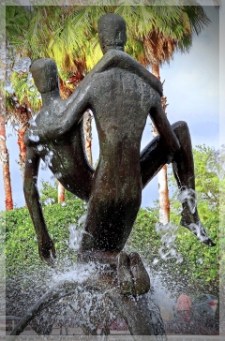 Back when I did weight training, I’d often find myself struggling with my last few reps. When I thought I couldn’t get the dumbbell up another inch and was about to give up, my trainer often gave me a little help so I could finish the rep. Disappointed that I couldn’t do it on my own, he’d remind me, “There’s nothing wrong with a little assisted lifting!”
 The Amalekites were a warlike nomadic tribe who frequently raided settlements to carry off plundered goods. About six weeks into the Israelites’ exodus from Egypt, these marauders made an unprovoked attack on the weary refugees while they camped at Rephidim. Moses commissioned Joshua to lead an army against their enemies the following morning. Joshua’s army, however, wasn’t made up of soldiers! Facing the veteran warriors of Amalek were men who less than two months earlier had been enslaved brick makers and field laborers! Worse, this unseasoned army was led by a general as inexperienced as were they. Nevertheless, Israel’s men set out to battle while Moses, his brother Aaron, and a man named Hur (who Jewish tradition believes was married to Miriam and brother-in-law to Moses) climbed to the top of a nearby hill to watch. As Israel fought their powerful foes, Moses extended his arms and held out his staff for all to see.
 Last week, after singing we’d come in the opening hymn, we promised to go in the closing one: I the Lord of Sea and Sky. Originally written for a Roman Catholic ordination mass in 1981, it has found its way into many Protestant hymnals. As I sang the refrain, “Here I am, Lord. Is it I, Lord?” I thought of Samuel and Isaiah, both of whom were called by God and both of whom responded by saying, “Here I am.” I wonder if I would have responded as positively as did they. Like Moses, would I have protested or, like Jeremiah, say my age disqualified me? Would I simply have run away as did Jonah? Although Moses, Jeremiah, and even Jonah eventually answered God’s call, I’m not so sure I would have (although three days in the belly of a fish might have convinced me)!
 As we came together in worship, each of us bringing the Lord our own private sins, sorrows, doubts, and fears, the hymn’s words, “Just as I am… I come, I come,” seemed a fitting way to start the service. Because its heartfelt words are so relatable, Just as I Am is one of my favorite hymns. Curious about its origin, I learned that its words were written by a Victorian hymn writer named Charlotte Elliott. The daughter of an evangelist, she suffered a serious illness at the age of 32 that left her an invalid for the rest of her life. Angry about what she perceived as uselessness because of her disability, Elliott became severely depressed and spiritually lost. After a visiting minister counseled her to come to Jesus, she asked how she could come to Him when all she had was her anger, sadness, questions, and broken body. The clergyman’s response was simple: “Come to Him just as you are.” Although she gave her life to Christ at that time, she continued to be plagued by depression.
 When writing about pride earlier this week, I remembered the Bible’s stories of proud men who got their comeuppance. 2 Chronicles 26 tells of Uzziah who, as long as he “sought guidance from the Lord, God gave him success.” His mighty army defeated the Philistines, Arabians, and Meunites (who then paid him an annual tribute) and, under his rule, Jerusalem’s walls were fortified, wilderness forts were established, water cisterns were dug, and something like catapults were erected on the walls to defend the city. With Uzziah as king, Judah prospered and the powerful king’s fame spread “far and wide.” Sadly, along with prosperity, power, and fame came pride. Believing he was above the law, the proud king entered the sanctuary and usurped the high priest’s role by offering incense. When priests warned him about his sacrilege, the proud king raged at them and immediately was stricken with leprosy—a disease that meant the “unclean” man lived the rest of his life in isolation and never again could enter the Temple. All the blessings, accomplishments, and prosperity of his reign were overshadowed by Uzziah’s one act of pride, insolence, and arrogance.
 Devotions of the Heart