
It was by faith that Noah built a large boat to save his family from the flood. He obeyed God, who warned him about things that had never happened before. By his faith Noah condemned the rest of the world, and he received the righteousness that comes by faith. [Hebrews 11:7 (NLT)]
 Thousands of years ago, God told Noah to build a boat the height of a four-story house, the length of one-and-a-half football fields, and with the storage capacity of about 450 semi-trailers. Without benefit of Home Depot or power tools, he managed to do it. What would happen if God gave Noah those same instructions today?
As the rain started to fall, I suspect 21st century Noah would be sitting on his front porch with no ark or animals in sight. He would however, have a litany of excuses for God. First, his neighbors objected to boat building in their neighborhood, so he had to go before the planning commission, zoning board, and city council for rezoning. The ark’s building permit wasn’t issued until its blueprints conformed to code with sprinkler system, emergency lighting, additional bathrooms, fire escape routes, exit signs, handicap accessibility, and commercial kitchen. The Forest Service refused to allow him to log the 3-million board feet of gopherwood he needed and the EPA objected to using tar to waterproof the ark.
FEMA said Noah couldn’t start work until an environmental impact study was done on the proposed flood. Even though the man explained he wasn’t proposing a flood but was preparing for one, Noah still had to wait until the study was finished. His attorney insisted he get easements from his neighbors to cross their property while hauling the ark to the shore, the power company demanded payment to raise several power lines so the ark could pass under them, and the Army Corps of Engineers required a permit to dredge a channel once the ark got to the water. Noah’s explanation that none of those things were necessary since the water would be coming to him fell on deaf ears.
After getting into a dispute with the CDC and USDA about importing and exporting animals, PETA and the ASPCA claimed Noah was collecting wildlife against their will and that placing them in pens on a boat was cruel. Even though Noah was trying to save rather than harm them, an injunction prevented him from gathering or possessing any animals. Following a confrontation with the Coast Guard about the number of life-jackets and life-boats needed for the people and animals coming aboard, Noah was told he needed to obtain a Master Captain’s license to pilot the ark. After sitting through 56 hours of classes, acing four exams, and spending the required 720 days aboard a ship, Noah failed the required physical because of his advanced age! “Lord, I tried,” he explained, “but what you asked was impossible!”
Fortunately, the deluge happened long before man’s invention of red tape and bureaucracy. If the real Noah had allowed circumstances to deter him from God’s task, mankind’s story would have ended in the sixth chapter of Genesis. Then again, it probably wasn’t a whole lot easier for the real Noah than my modern one. Obtaining the wood, building a ship that size, explaining the project to his family, dealing with skeptical neighbors, supplying the ark, assembling and loading the animals—all posed tremendous challenges. Noah, however, was a “righteous” man and, as “the only blameless person living on earth at the time…he walked in close fellowship with God.” Even in the 21st century, a man like that wouldn’t let any amount of red tape keep him from doing God’s will!
What my modern Noah didn’t understand is that we are to fear God above all others—even indignant neighbors, government bureaucracy, and angry protesters. There is an urgency in our obedience to God that has been lost in today’s world of red tape, paper work, and excuses. Even though the concept of a cataclysmic global flood and building a boat on dry land probably made little sense to him, Noah obediently did everything that God commanded him to do when God told him to do it. God expects us to do the same—even when the task seems impossible and the challenges insurmountable.
When God assigns a task, He doesn’t abandon us. He equips, enables, provides, and qualifies us. He can be trusted to give us the resources, skills, and direction necessary to do His work. Let us remember that the Jordan River didn’t stop flowing for the Israelites until the priests’ feet had touched the water and the widow’s flour and oil didn’t multiply until she used the last of hers to feed Elijah! If we are doing God’s will, He will hold back the water when we bravely walk into it, provide the ingredients we need when the cupboard is bare, and give us a giant pair of scissors to cut through red tape when we get tangled in it. Before that happens, however, we must trust Him enough to take the first step.
Each of us may be sure that if God sends us on stony paths, He will provide us with strong shoes, and He will not send us out on any journey for which He does not equip us well. [Alexander MacLaren]
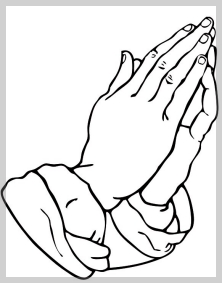 While there are no hard and fast rules about prayer except to believe in it and do it, some people use acronyms to help organize their prayers. The PRAY method stands for Praise, Repent, Ask, and Yield while the ACTS method formats prayer into Admiration (praise), Confession, Thanksgiving, and Supplication (asking God for what is needed). A TACOS prayer structure is Thanks, Adoration (or Applause), Confession, Others, and Self. Rather than an acronym, I was taught “The Hand of Prayer” as a girl. Beginning with the thumb, the order was Praise, Thanksgiving, Confession, Intercession (prayer for others), and Petition (prayer for oneself).
 By forgiving people’s sins, Jesus was placing Himself in the role of God because only God can forgive sins. Had Jesus not been God, it would have been blasphemy. When He raised the dead, multiplied food, stilled storms, and healed incurable diseases, Jesus was doing other things that only God could do. His incredible claim that He could bring Himself back from the dead, something only God could do, was another way Jesus claimed His divinity. The undeniable proof of His claim came Easter morning when Jesus demonstrated power over both life and death. The tomb was empty and people saw the risen Christ—they heard Him speak, watched Him eat, saw His wounds, and touched Him. The forty days the resurrected Jesus remained on earth, however, is about more than proof of his claim to be God; it’s about proof of our relationship to God.
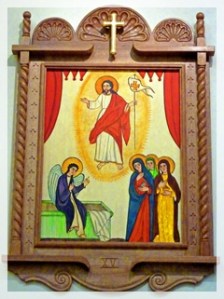 Found in almost every Roman Catholic church (and some Protestant and Orthodox ones), are the Stations of the Cross—a series of fourteen icons or carvings on the walls—each of which depict a moment in the Passion of Christ. Created to help people contemplate the events leading up to Christ’s crucifixion, they start with His death sentence from Pilate and end with His dead and battered body being laid in the tomb. Because Good Friday and Jesus’ death aren’t the end of the story, some churches have begun adding the resurrected Christ as a 15th station.
 In my last post, I pondered why Jesus chose the men he did as his apostles. As we enter Holy Week and the events leading to the Lord’s arrest and crucifixion, I wonder specifically about Judas Iscariot. We don’t know what Jesus saw in Judas when he was chosen as one of the twelve or even what was in Judas’ heart in the beginning of Jesus’ ministry. We only know that discontent, ambition, and greed had entered his treacherous heart by the end.
 We know Jesus prayed all night before choosing His Apostles. What made Him select those twelve men for His inner circle? Perhaps Andrew and John, having previously been disciples of John the Baptizer, were primed for the arrival of the Messiah but why did Jesus choose Andrew’s brother Simon/Peter and John’s brother James? Jesus called John and James the “Sons of Thunder,” implying they were bold, rash, and quick to anger. Why would Jesus choose them rather than men more even-tempered and less impetuous? For that matter, why four fishermen instead of students of the Torah? You don’t have to know how to cast a net to go fishing for people!
 Devotions of the Heart