
Don’t copy the behavior and customs of this world, but let God transform you into a new person by changing the way you think. Then you will learn to know God’s will for you, which is good and pleasing and perfect. [Romans 12:2 (NLT)]
The man who does not know where he is is lost; the man who does not know why he was born is worse lost; the man who cannot find an object worthy of his true devotion is lost utterly. [A.W. Tozer]
 A firm with whom we do business sends us a newsletter every month. After asking their associates what accomplishment in the last year made them most proud, January’s newsletter shared some of the answers. One man was proud that, after reading up on motors, he managed to repair the family boat by changing the starter motor, another was proud that he expanded his horizons by hiking and rock climbing in various national parks during the year, and a third man was proud that a case he pled had been cited in several law review articles.
The response that touched me, however, was from a man who had just been inducted into the Accounting Hall of Fame and named as one of the ten most influential people in his industry. While pleased by those honors, they were not his point of pride. This man was most proud of the fact that he’d made a positive impact on other people’s lives through his work—that people came to him with issues to clarify, problems to solve, or obstacles to surmount and he helped them. He shared that bettering the lives of others is the force that drives him to do what he does. After reading his response, I wondered how I would answer that same question. How would you? Of what are you most proud?
That question brought to mind A.W. Tozer’s words about a wealthy English aristocrat whose obituary read that he had “devoted his life to trying to breed the perfect spotted mouse.” While Tozer didn’t argue with the man’s right to breed spotted mice, he was troubled that a man of means and position would have devoted his entire life to such a task. Of this nameless man, Tozer wrote, “Made in the image of God, equipped with awesome powers of mind and soul, called to dream immortal dreams and to think the long thoughts of eternity, he chooses the breeding of a spotted mouse as his reason for existing.…Surely this is a tragedy.”
Apparently, breeding rodents is not as far-fetched as it sounds. There’s a National Mouse Club in England, the Rat & Mouse Club of America, and a Rat & Mouse Gazette. Every November 12 is Fancy Rat & Mouse Day and every April 4th is World Rat Day. While some people keep mice and rats as pets, I hope they aren’t devoting their lives to their rodent companions. Although mice are often bred and genetically modified to study genetics and human diseases, I hope that even the most zealous geneticists and researchers are not devoting their entire lives to that project.
We’re probably not trying to breed the perfect spotted mouse, but are we devoting our lives to its equivalent? People dedicate their lives to making money, becoming famous, getting frequent flyer miles, climbing mountains, having fun, setting or breaking records, shopping, going to casinos or playing the ponies, having a pristine house, decorating and redecorating, or building collections of art, cars, and Star Wars figures. While nothing is inherently wrong with those activities, none are worthy of our devotion! As Christians, Tozer points out that we have no right to dedicate ourselves to anything that can “burn or rust or rot or die.” We are not to give ourselves “completely to anyone but Christ nor to anything but prayer!”
Rather than having our obituaries tell of our commitment to breeding spotted mice, collecting Labubus, or attending every Grateful Dead concert, wouldn’t we rather have them speak of our devotion to God and of our love for His children? Rather than being remembered for the perfect spotted mouse or an immaculate house, I’d rather be remembered for making a positive impact on the lives of others.
One of the glories of the Christian gospel is its ability not only to deliver a man from sin but to orient him. … The spirit-illuminated Christian cannot be cheated. He knows the values of things; he will not bid on a rainbow nor make a down payment on a mirage; he will not, in short, devote his life to spotted mice. [A.W. Tozer]
 When my grandchildren were little, our guest bedroom was their playroom. Whenever they played house or school, the dolls and stuffed animals were the “children” in their imaginary world. For the most part, the dolls were well-behaved and helped in the play kitchen, sat attentively in their chairs, and were nice to the other children. But, sometimes, those pretend children misbehaved and needed to be put in “time-out.” In their world of make-believe, why did my grands choose to have children who sometimes disobeyed? I suspect they enjoyed the opportunity to do the disciplining instead of always being the one getting disciplined! Then again, without benefit of theological discussion, perhaps they simply understood the concept of free will and gave their dolls the ability to choose.
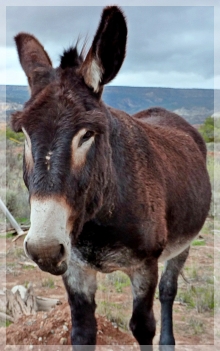 As the Israelites journeyed toward Canaan, they turned south to the plains of Moab. Fearful of so many Israelites in Moab and Midian, King Balak of Moab sent the elders of Moab and Midian to hire Balaam, a sorcerer and prophet, to curse the Israelites. Although Balaam tried to do just that, the Lord intervened by speaking through the mouth of a donkey, opening the prophet’s eyes to see an angel of the Lord, and being told he could speak only the message the Lord put in his mouth. Rather than cursing the Israelites, Balaam ended up blessing them and cursing Moab! Needless to say, the prophet did not receive the rich reward promised him. Although God prevented Balaam from cursing Israel, the unscrupulous prophet found another way to get his reward from Balak—he got Israel to bring a curse upon themselves!
 While I expected bear sightings when we lived in the mountains of Colorado, I never expected a bear to find its way into our Florida community and scavenge in a neighbor’s trash bin on her driveway! While bears generally prefer natural foods like berries and nuts, as civilization encroaches on their habitat, those foods are becoming less abundant. Driven by their need to eat, bears will go where they can find any food. With a sense of smell that is seven times greater than a bloodhound’s, it’s estimated they can smell a food source from as far away as 20 miles. Opportunistic creatures, they take advantage of whatever is easily available, whether bird seed, pet food, barbecue grills, or garbage.
 Once upon a time, a little boy was busy digging in the sand at the beach. Like other youngsters through the years, he thought he even might be able to dig all the way to China. His steadfast excavations got so deep that he encountered a large rock. With great determination, he dug and dug with his plastic shovel in an attempt to free it from the ground. Unfortunately, the little boy and his small shovel were no match for the rock. When the shovel broke in two, the boy let out a howl and burst into tears. Hearing the child’s cries, his father immediately went to comfort him. Through his sobs, the boy told how he’d tried and tried to free the rock but was too weak, his arm was too short, and he’d broken his only shovel. His father gently asked why he hadn’t used all of his strength. “But I did, Daddy, I really did!” exclaimed the boy. “No, son, you didn’t,” explained the man as he reached into the hole, grabbed the rock with his large hands, and pulled it from the ground. “You should have called me!”
 Remember the Sabbath day, to keep it holy. Six days you shall labor, and do all your work, but the seventh day is a Sabbath to the Lord your God. On it you shall not do any work, you, or your son, or your daughter, your male servant, or your female servant, or your livestock, or the sojourner who is within your gates. [Exodus 20:8-10 (ESV)]
