
But the fruit of the Spirit is love, joy, peace, patience, kindness, goodness, faithfulness, gentleness, and self-control. The law is not against such things. [Galatians 5:22-23 (CSB)]
 In contrast to works, which are produced by us, the Fruit of the Spirit is produced by the Holy Spirit. Rather than a basket with a variety of fruit, this is one indivisible fruit characterized by nine virtues: love, joy, peace, patience, kindness, goodness, faithfulness, gentleness and self-control. We could call this the “Christlikeness fruit” because these characteristics describe Jesus and should describe us.
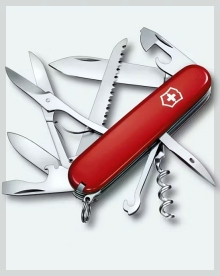
Planted by the Spirit in our hearts when we accept Jesus, the Fruit of the Spirit is a little like a Swiss Army knife with its numerous functions. Just as the multi-faceted pocketknife can provide us with two blades, along with a corkscrew, screwdriver, bottle opener, scissors, toothpick, tweezers, can opener, and key ring, the Fruit of the Spirit is an all-purpose spiritual tool providing us with love, joy, peace, patience, kindness, goodness, faithfulness, gentleness, and self-control.
Victorinox, however, doesn’t equip every Swiss Army knife with the same tools. With its 13 functions, their rescue knife comes with a saw for cutting shatterproof glass, a seatbelt cutter, and a window breaker but it doesn’t have the huntsman knife’s corkscrew and multi-purpose hook or the mini champ’s cuticle pusher and orange peeler! Unlike the knife maker, however, God equips every one of His children with the same nine all-purpose attributes in the Fruit of the Spirit!
It’s not Victorinox’s “cross on shield” logo that identifies it; the knife is known by its tools! In the same way, it’s not labeling ourselves Christians that identifies us as such—we’re known as Christ’s followers when the Fruit of the Spirit is evident in our behavior. The tools on any Swiss Army knife are meant to be used but, once it’s sold, Victorinox doesn’t care if you never open the knife. The virtues of the Fruit of the Spirit, however, are meant to be evident and God notices when they aren’t.
When describing the Fruit of the Spirit in “newspaper English,” famed preacher Samuel Chadwick (1860-1932) may have said it best: “The Fruit of the Spirit is an affectionate, lovable disposition, a radiant spirit and a cheerful temper, a tranquil mind and a quiet manner, a forbearing patience in provoking circumstances and with trying people, a sympathetic insight and tactful helpfulness, generous judgment and a big-souled charity, loyalty and reliableness under all circumstances, humility that forgets self in the joy of others, in all things self-mastered and self-controlled, which is the final mark of perfecting.” It is the presence of the Fruit of the Spirit that enables us to grow more like Jesus every day—to have His purpose, thoughts, words and actions be ours.
We recognize a Swiss Army knife by its tools; do people recognize us by our fruit?
 Fowlers are professional bird catchers. In ancient Israel, they supplied the market with wild pigeons and doves destined for sacrifice, small birds (like quail) for food, and doves and other birds for caged pets. Since most of us get our poultry at the grocery, we’re probably unfamiliar with the fowler and his methods. To capture birds, fowlers spread nets or set traps and snares on the ground, camouflage them with natural materials, and cover them with grain. Tempted by the food, the birds leave the safety of the sky and come down to the ground where they are caught.
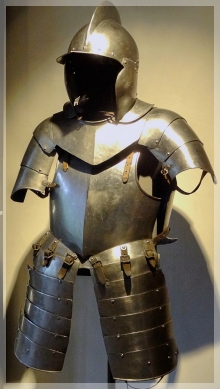 A Latin word, lorica originally meant armor or breastplate. Because of an ancient practice of inscribing a prayer on the armor or shields of knights who then recited the prayer before combat, lorica came to mean a prayer of protection.
 When we celebrate St. Patrick’s Day tomorrow, I suspect the revered bishop who brought Christianity to Ireland in the 5th century wouldn’t recognize this day in his honor. Originally a religious feast, it’s now a day for parades, sales, “Kiss Me I’m Irish” t-shirts, corned beef and cabbage, music, dancing, and lots of green (including hair, cookies, the Chicago River, milk shakes, and kegs of beer). St. Patrick, however, would recognize the common symbol of the day: the shamrock. Of course, to Patrick, the shamrock, with its three leaflets bound by a common stem, was a metaphor for the Holy Trinity. The shamrock’s three leaflets also came to symbolize faith, hope, and love.
 Flawed people that we are, we want to play down our culpability before God by minimizing sin and thinking of some sins as less significant than others. We’d like to think if we avoid the “big ten” Moses brought down from Mt. Sinai that we’re good and righteous people. God didn’t stop telling us how to behave with those two tablets! What about the hundreds of commands we find in the New Testament? Can we truthfully say we do nothing “out of selfish ambition or conceit” while we do everything “without grumbling and arguing?” [Phil 2:3,14] Are we ever conceited, boastful, or envious? [Gal 5:26] Do we show favoritism or partiality? [James 2:3-4] How are we doing in the loving our enemies and praying for them, forgiveness, and self-denial departments? [Matt 5:22,44;16:24] Are we truly free of “malice, all deceit, hypocrisy, envy, and all slander”? [1 Pet 2:1] Those sins are no less an affront to God than worshipping an idol or murdering a spouse. Every sin we commit damages our relationship with God.
 Having spared Israel’s first-born males during the final plague on Egypt, God called for every first-born Israelite male, whether man or beast, to be consecrated to Him. The entire male population of the tribe of Levi was 22,000 (about the same number of first-born Israelite men) and God substituted the Levites for the other first-born males. Substituting the Levites for the first-born male in every tribe centralized the sacred duties to one tribe without disrupting the other tribes’ families.
