
Give us this day our daily bread. [Matthew 6:11 (RSV)]
Therefore do not be anxious, saying, “What shall we eat?” or “What shall we drink?” or “What shall we wear?” For the Gentiles seek all these things; and your heavenly Father knows that you need them all. But seek first his kingdom and his righteousness, and all these things shall be yours as well. [Matthew 6:31-32 (RSV]
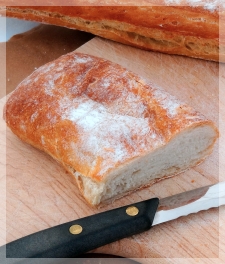 If “daily bread” refers to our necessities and nothing more, then what are the necessities of life? The most obvious answer is food enough to maintain us, water enough to sustain us, along with clothing and shelter enough to protect us. Chances are you are among the fortunate who have all that’s needed to support life (plus a great deal more.) I know I am. Should we then cease asking the Lord for our daily bread? Martin Luther would say, “No.”
When Luther explained the fourth petition of the Lord’s Prayer in his Small Catechism, he said “daily bread” comprised “Everything included in the necessities and nourishment for our bodies, such as food, drink, clothing, shoes, house, farm, fields, livestock, money, property, and upright spouse, upright children, upright members of the household, upright and faithful rulers, good government, good weather, peace, health, decency, honor, good friends, faithful neighbors, and the like.”
For Luther, the words “daily bread” encompassed far more than whatever was necessary to sustain life. He expanded it to mean whatever is necessary for a good life. In the mostly agrarian society of his time, it’s easy to see why farm, fields, livestock, and good weather were a necessity to Luther’s congregations. Nevertheless, they’re still necessary in our increasingly urban society—without those, our grocery stores would be empty. When we continue to think in broader terms, Luther’s list makes as much sense today as it did in 1529. While we probably don’t have servants as members of our household, we may have employees or co-workers in business and we all depend upon other people’s employees when we dine out, bank, shop, visit the doctor, or take medicine. We may not have (or want) a spouse and children, but today’s children are tomorrow’s employers, judges, mechanics, police, and office holders and we need strong and upright family units to raise them to be good ones. Indeed, our daily bread includes far more than food, water, clothing, and shelter enough for survival. We all need families, friends, and neighbors along with good government, peace, health, decency, and honor and yet I’d never thought of these necessities as daily bread until I read Luther’s words.
Let us never forget that along with both our physical requirements and the less observable needs of life like friendship, there is yet another kind of bread for which we ask. When we ask for our daily bread, we also ask for the true bread of life—Jesus Christ—the bread that satisfies our spiritual hunger. He is, indeed, a necessity for life both in this world and the next.
Rather than asking God for my daily bread, Jesus’ beautiful model prayer asks God to give us our daily bread. Regardless of how much we may have, as long as long as there are people in our world who lack the true necessities of life, we must pray for their provision—their daily bread and the bread of life.
Our Father in heaven, give us this day our daily bread!
 A pastor friend told me about returning from a service project with some of his SK8 church youth including Brian, a young man new to the faith. When they stopped for lunch at a taco stand, a street person asked Brian for money. Trying to do what Jesus would want done, the new Christian offered to buy the hard-up man a burrito. It was when Brian ordered two bean burritos that his dining guest loudly complained, “I ain’t eatin’ no $%2#!* bean burrito—I want a steak one!” Brian had little money to spare but, since the man was getting vociferous, he ordered the steak burrito for his guest and a bean one for himself. Apparently, the vagrant wasn’t familiar with the proverbs about beggars not being choosers, half a loaf being better than none, and not looking a gift horse in the mouth!
 As we continued our brief study on prayer, one person shared that his prayer frequently is for patience. Agreeing, I admitted often praying, “Lord, please give me patience…and give it to me now!” While patience is a fruit of the Spirit, I have a problem getting it to grow in the garden of my life.
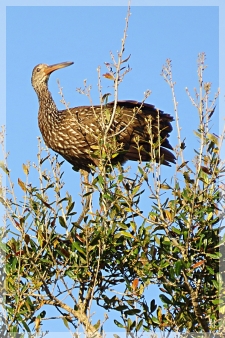 Looking like a cross between a heron and an ibis, the limpkin (Aramus guarauna) is common along Florida’s fresh water canals, wetlands, and swamps. While they’re lovely to look at, they’re not lovely to hear. Often referred to as the wailing or crying bird, limpkins have a loud piercing “banshee” scream that usually is heard at night, dawn, and dusk. During courtship, a male limpkin makes repetitive long, loud, rattling calls while a female replies with slightly lower (but still disturbing) screams.
 Back when I did weight training, I’d often find myself struggling with my last few reps. When I thought I couldn’t get the dumbbell up another inch and was about to give up, my trainer often gave me a little help so I could finish the rep. Disappointed that I couldn’t do it on my own, he’d remind me, “There’s nothing wrong with a little assisted lifting!”
 Last week, after singing we’d come in the opening hymn, we promised to go in the closing one: I the Lord of Sea and Sky. Originally written for a Roman Catholic ordination mass in 1981, it has found its way into many Protestant hymnals. As I sang the refrain, “Here I am, Lord. Is it I, Lord?” I thought of Samuel and Isaiah, both of whom were called by God and both of whom responded by saying, “Here I am.” I wonder if I would have responded as positively as did they. Like Moses, would I have protested or, like Jeremiah, say my age disqualified me? Would I simply have run away as did Jonah? Although Moses, Jeremiah, and even Jonah eventually answered God’s call, I’m not so sure I would have (although three days in the belly of a fish might have convinced me)!
 Devotions of the Heart