MORE WAG, LESS BARK!

Finally, brethren, whatever is true, whatever is honorable, whatever is just, whatever is pure, whatever is lovely, whatever is gracious, if there is any excellence, if there is anything worthy of praise, think about these things. [Philippians 4:8 (RSV)]

 My son, sweeten thy tongue and make savory the opening of thy mouth; for the tail of a dog gives him bread, and his mouth gets him blows. [Story of Ahikar]
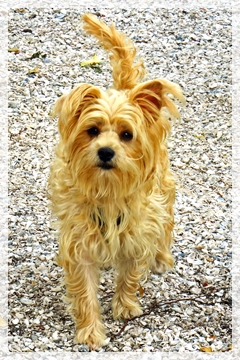
dogLast month, my husband and I attended a “Sweetheart” dinner at church. The men were in charge of the entire event and there were a few rough spots in the night. Then again, at the risk of being accused of political incorrectness or gender bias, most of the men probably were novices at that kind of event planning. Unlike the men, we women have had decades of organizing (and attending) school parties, PTA fund raisers, charity galas, birthday parties, showers, weddings, anniversary bashes, and other assorted celebrations. In spite of the glitches, there was much that went right and the evening was enjoyable and entertaining. Unfortunately, the woman sitting beside me kept criticizing how things were done—from name tags and table assignments to flowers and dessert. Her nit-picking comments became as annoying as the yapping of a bad-tempered dog and I thought of a bumper sticker I’d recently seen: “Wag More, Bark Less!”

Bad tempered dogs (and people) are nothing new; a similar proverb dates back to 500 B.C. in an Aramaic papyrus found in Egypt called the Story of Ahikar. “Wag More, Bark Less!” may be bumper sticker philosophy, but I wish more people (including me) did just that. After reading the qualifications and concerns of the candidates for our property association board, I was struck by how many were unpleasantly barking and nipping at each other rather than wagging their tails and showing me how well they’d work with one another and our management company. An on-line community newsletter was so filled with bark (and bite) that we stopped subscribing. Rarely are the letters to the editor in the newspaper anything but bark in the way of anger and criticism. While waiting at the bakery counter yesterday, an impatient woman yelled at the harried clerk and stormed away in a huff. Sometimes, it feels like we’re in a kennel full of angry upset dogs—yapping, baying, growling and snarling! Worse, once one dog (or person) starts barking, other dogs (and people) tend to join in the unpleasant clamor.

Like the woman beside me at that dinner, there are times I bark or snarl in disparagement, annoyance or anger rather than wag in happiness, appreciation, or compassion. In his letter to the Philippians, the Apostle Paul reminds us that we are responsible for what we put in our minds. Even in the bleakest of circumstances or worst of conditions, there is some small thing worthy of praise. Our job, as Christians, is to find it and think about it! Fortunately, we have the Holy Spirit to help us in that task. Moreover, as my mother used to say, “If you can’t say something nice, say nothing at all!” Thankfully, the Spirit gives us the self-control to do just that! If we can’t wag, at least we can muzzle ourselves so we don’t bark!
But the fruit of the Spirit is love, joy, peace, patience, kindness, goodness, faithfulness, gentleness, self-control; against such there is no law. … If we live by the Spirit, let us also walk by the Spirit. Let us have no self-conceit, no provoking of one another, no envy of one another. [Galatians 5:22-23, 25-26 (RSV)]

Copyright ©2018 jsjdevotions. All rights reserved.

GONE BANANAS

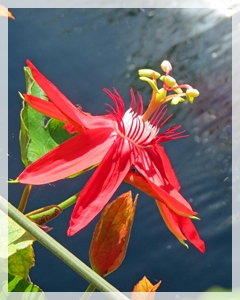
Passion flowerI have told all your people about your justice. I have not been afraid to speak out, as you, O Lord, well know. I have not kept the good news of your justice hidden in my heart; I have talked about your faithfulness and saving power. I have told everyone in the great assembly of your unfailing love and faithfulness. [Psalm 40:9-10 (NLT)]

We recently attended a program at our local zoo about giant armadillos. The speaker has spent the last seventeen years in the Brazilian Pantanal wetlands conducting research on several species ranging from peccaries to iguanas. Seven years ago, he became enamored by the elusive giant armadillo and it has been his focus ever since he realized this prehistoric creature (about five feet long and weighing up to 130 pounds) is a keystone species. With its many burrows (a new one every two days), it plays a crucial engineering role in the ecosystem; many other animals depend upon those burrows for their survival. The biologist’s enthusiasm for his topic was compelling and contagious. With his incredible passion for these amazing and endangered animals, he admitted to speaking about them whenever and wherever the opportunity arises.

Like many other scientists, prior to meeting the giant armadillo, this biologist did research, wrote a paper, published it, and went on to another project. The more he learned about the giant armadillo, however, the more concerned he became about its survival. Realizing that academic research alone would not save them, he began sharing his passion. He educated people about these secretive and endangered animals and lobbied for changes in land management, conservation, hunting practices, superstitions and even bee keeping. Scientific treatises alone won’t save this animal but sharing its story just might!

Listening to this biologist speak with such fervor, I couldn’t help but wonder why we Christians rarely demonstrate such passion for Jesus. Much of the time, we seem rather lukewarm about God and rarely show that same zeal about our Savior. Moreover, like research scientists, we are often content to limit our activities to the theoretical rather than the practical. But, just as field work and scientific papers alone will not save the giant armadillo, our neighbor will not get saved by our church attendance and Bible study. Our passion, like that biologist’s, must be evident. He’s trying to save animals, but we’re trying to save souls!

The late Christian musician Keith Green is reported to have said the definition of a Christian is someone who’s bananas for Jesus! I imagine that within an hour of meeting this biologist, anyone would know that he’s bananas for giant armadillos. I wonder, within an hour of meeting me, would anyone know I’m bananas for Jesus? How about you?

Jesus replied, “‘You must love the Lord your God with all your heart, all your soul, and all your mind.’ This is the first and greatest commandment.” [Matthew 22:37-38 (NLT)]

Copyright ©2018 jsjdevotions. All rights reserved.

STUDENTS FOR LIFE

He also told them a parable: “Can a blind man lead a blind man? Will they not both fall into a pit? A disciple is not above his teacher, but everyone when he is fully trained will be like his teacher.” [Luke 6:39-40 (ESV)]

roseate spoonbill - corkscrew swampIn Pieces of Eight, columnist Sydney Harris tells the story of a dinner party at which an elderly Albert Einstein was seated next to an eighteen-year-old girl. Unaware of his identity, she asked the famed professor what he did for a living. “I devote myself to the study of physics,” he responded. Shocked that he still studied physics at his age, she told him she’d finished her physics studies the previous year! Without a doubt, Albert Einstein knew more about physics than anyone else of his time and yet he continued to study physics until his death. Harris’s explanation is that the physicist recognized that what he didn’t know far outweighed all that he did.
In Jesus’s day, the word disciple referred to a student or apprentice and was usually associated with people who devotedly followed a religious leader or philosopher. Christian writer Dallas Willard suggests replacing the word disciple in our Bibles with apprentice or student to get the true meaning of the word. Just as Einstein continued to be a student of physics, if we are true disciples of Christ, we must continue to be His students. Discipleship doesn’t end with accepting Christ; it begins. It requires commitment to be with and know Him, to grow more like Him, and to continually learn from Him.

Einstein continued to spend time in his physics laboratory. We must continue spending time with Jesus through prayer and Bible study. In studying the Gospels and Acts, we find His words, repeat His words, and reflect on them. In the Epistles, we learn how to apply those words. We then turn our attention from the New to the Old Testament to learn our history and how Jesus fulfilled the prophecies. Finally, we fulfill the commission given to the original disciples. The students are to become the teachers and find new students. Since the blind can’t lead the blind, we will continue to study and, after reading from Genesis to Revelation, start over again! We are life-long disciples who, like Albert Einstein, recognize that what we don’t know far outweighs what little we do.

Any fool can know. The point is to understand. … Learning is not a product of schooling but the lifelong attempt to acquire it. [Albert Einstein]

Jesus came and told his disciples, “I have been given all authority in heaven and on earth.  Therefore, go and make disciples of all the nations, baptizing them in the name of the Father and the Son and the Holy Spirit. Teach these new disciples to obey all the commands I have given you. And be sure of this: I am with you always, even to the end of the age. [Matthew 28:18-20 (NLT)]

Copyright ©2018 jsjdevotions. All rights reserved.

LITTLE BROWN BIRDS

My brothers and sisters, believers in our glorious Lord Jesus Christ must not show favoritism. [James 2:1 (NIV)]

The Lord does not look at the things people look at. People look at the outward appearance, but the Lord looks at the heart. [1 Samuel 16:7 b (NIV)]

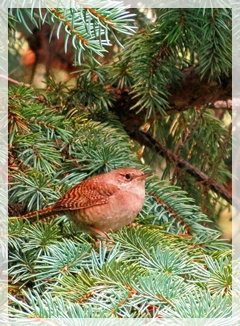
house wren

Unless a bird is impressive and memorable, I give it little notice and classify it broadly by size and color. Yesterday’s devotion reminded us that people aren’t nameless/faceless little brown birds to God. I then asked myself if they are to me. Do I truly see the people around me for the unique and beautiful individuals they are or are some just little brown birds? Think of the quiet unobtrusive people we see every day but barely notice: the bagger at the grocery, the busser at the restaurant, the lady with the schnauzer, the fast food cashier, the fellow stocking shelves, the landscaper, the old man at the coffee shop, or the parking lot attendant. Do we simply look past or even through them without a second glance? I hate to admit how many times wait staff and sales clerks have introduced themselves only to have me immediately forget both their names and faces.

Do we only take notice of the eagles, cardinals, and great blue herons of life? When Samuel anointed Israel’s first king, it was Saul. Described as the most handsome man in Israel and taller than anyone else in the land, he may have been as impressive as an eagle but he was a weak leader and a cowardly king. In contrast, Israel’s next king, David, was more like a little brown bird. He may have been handpicked by God but he was overlooked and ignored by everyone else. When Samuel came to Jesse in search of a new king, he invited Jesse and all of his boys to a sacrifice. It was only after every one of Jesse’s sons was rejected by the Lord that Samuel learned the youngest boy, David, hadn’t even been invited to the feast. In spite of being anointed by Samuel, David continued to be insignificant to his father and brothers until he defeated Goliath. It was the little brown bird rather than the showy eagle who saved the Israelites with a slingshot and a few well-placed stones.

A pharmaceutical ad begins with psoriasis patients saying the words, “See me.” It’s not just people with skin conditions who want to be seen as individuals; we all want to be seen as the unique people we are. Consider Jesus; there were many who met a poor itinerant rabbi, a carpenter’s son from Nazareth, and never really looked at Him or listened to His words. That unimpressive little brown bird they so easily dismissed was God!

We don’t need a scope or telephoto lens to help us see the little brown birds of daily life and we certainly don’t need an Audubon book to learn their identities. We just have to open our eyes to the people around us, really look at them, acknowledge their presence, and listen to their words. In actuality, rather than elegant egrets or gaudy peacocks, most of us are more like little brown birds—ordinary, inconspicuous, and easy to overlook. Nevertheless, we are extraordinary in our own ways and we all want to be seen for who we are. God doesn’t judge by outward appearance and neither should we. After all, it’s the little brown birds that sing the sweetest songs in the forest.

He grew up before him like a tender shoot, and like a root out of dry ground. He had no beauty or majesty to attract us to him, nothing in his appearance that we should desire him. He was despised and rejected by mankind, a man of suffering, and familiar with pain. Like one from whom people hide their faces he was despised, and we held him in low esteem. [Isaiah 53:2-3 (NIV)]

Copyright ©2018 jsjdevotions. All rights reserved.

IT TAKES ALL KINDS

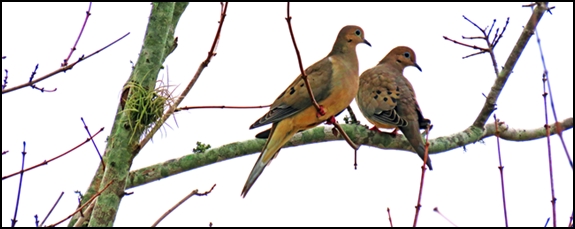
murning dovesBut whoever is building on this foundation must be very careful. For no one can lay any foundation other than the one we already have—Jesus Christ. [1 Corinthians3: 11 (NLT)]

Last Sunday, while worshipping in the beach gazebo, my attention was drawn to a nearby tree. A pair of doves kept disappearing into the branches only to reappear a few moments later. Back and forth they went, building their new house one twig at a time. Like the doves, those of us in the gazebo are slowly building something—a new church. Rather than twigs or bricks, we’re building it with people—one person at a time.

After worship two Sundays ago, we saw a fellow sitting alone on a park bench strumming his guitar. My husband walked over to him, listened for a while, and, introduced himself. The men chatted and the guitarist, Jimmy, said he was in the park that morning for his NA meeting. My husband then invited him to bring his guitar and join us for worship the next week. Self-taught, Jimmy is not much of a musician and both his story and attire told me that, while he’s not exactly homeless, he lives on the fringe of society. Lord, forgive me, I wasn’t happy about that invitation nor was I especially thrilled Sunday when our new friend was there at the gazebo. I’m ashamed to admit that I was afraid Jimmy’s presence would offend others in attendance.

While watching those doves build their nest, however, the Holy Spirit did some much needed work on my heart and I saw how judgmental and self-righteous I’d been. The birds didn’t examine each twig to see if it was perfect or ask its history or lineage. They just kept bringing twigs into the tree. Wondering how to build a church, I’d forgotten about the cornerstone: the first stone set into a foundation, the stone that keeps the walls upright and strong. The church’s cornerstone is Jesus and the answer to how to build a church is simple: Do what Jesus would do.

Jesus brought healing to the sick, forgiveness to the condemned, hope to those in despair, faith to those who doubted, and love to the unloved. Jesus neither ignored nor tolerated sin but He welcomed all sorts and conditions of people. He didn’t ask Peter, John or James about their pasts before calling them and not everyone around Him was what could be called “respectable.” Criticized by the Pharisees for the company He kept, He welcomed tax collectors, prostitutes, the unclean, zealots, Gentiles and Samaritans. He gladly spent time with sinners who wanted to learn from him or put their faith in him. Jesus welcomed me and I’m no different than Jimmy—my tarnished past just hasn’t taken the heavy toll on me that it has on him. Moreover, I still have plenty of work to do on the sin of self-righteousness!

So, how do we build a church? We do it by living the truth of the gospel, connecting with one another, serving, and speaking and acting in love. Most of all, we build a church by seeking the lost and welcoming all who come! When I asked my husband why he invited Jimmy, he answered, “That’s what Jesus would have done!” and he was right. Sunday, after Communion, I wondered how long it’s been since Jimmy felt welcome and appreciated, took the Sacrament, or was reminded that God loved him enough to die for him. As we finished our service and gathered our things to leave, his NA group came in to use the gazebo. We offered them our remaining coffee and rolls and invited them all to join us for worship next week. “Hope to see you next Sunday,” I called to Jimmy and, this time, I meant it!

For the Son of Man came to seek and save those who are lost. [Luke 19:10 (NLT)]

Jesus answered them, “Healthy people don’t need a doctor—sick people do. I have come to call not those who think they are righteous, but those who know they are sinners and need to repent.” [Luke 5:31-32 (NLT)]

Copyright ©2018 jsjdevotions. All rights reserved.

AGAPE

Coronado beach - Bil PavlackaJesus replied, “The most important commandment is this: ‘Listen, O Israel! The Lord our God is the one and only Lord. And you must love the Lord your God with all your heart, all your soul, all your mind, and all your strength.’ The second is equally important: ‘Love your neighbor as yourself.’ No other commandment is greater than these.” [Mark 1:29-31 (NLT)]

Last summer, we enjoyed beautiful sand sculptures created by Bil Pavlacka on Coronado beach. One had been constructed as a memorial to the seven sailors who died on the destroyer Fitzgerald that month. It was not Pavlacka’s first memorial; he’s sculpted sand to honor a Navy Seal killed in Iraq and to recognize the victims of the Orlando nightclub shooting and the Paris and Brussels attacks. Those sculptures were labors of love—love for people he never personally knew but people he knew were his neighbors.

What a contrast his work is to the bumper stickers I recently saw on a truck parked beside us. There didn’t seem to be a minority group the driver wasn’t anxious to hate, insult or possibly worse since the back window also sported a “License to Kill Arabs.” According to the Southern Poverty Law Center, 917 hate groups (such as white nationalists, black separatists, racist skinheads, the Ku Klux Klan, neo-Nazis, neo-Confederates, anti-Muslim, anti-LGBT and anti-Semitic zealots) currently operate in the United States. Based on his bumper stickers, the truck’s owner must have belonged to several of them. How easy it is to spout hate for people we don’t even know; yet, they are our neighbors!

We are called to love one another—not romantic (eros) or friendship (philia) love—but agape or unconditional sacrificial love—like the love God had for us when he sacrificed His son and the love the good Samaritan had for a total stranger. It has nothing to do with attraction, affection or even liking one another. Agape love isn’t emotional; it is a choice. It also happens be one of God’s commands.

Agape love is like building an intricate sandcastle; it takes time, effort, dedication and patience. On the other hand, hate is like those bumper stickers or a well-placed kick aimed at a sandcastle; it is thoughtless and destructive. Jesus doesn’t ask us to like everyone but He does expect us to love them—to be kind, considerate, understanding, patient, tolerant, polite, and good to them. Fortunately, we don’t have to do it on our own—the Holy Spirit empowers us to love one another as God loves us. Like building a sand castle, however, it doesn’t come easy and there will be times our efforts fail. Nevertheless, we must keep at it until we get it right. What we can’t do is take the easy way out with hate!

It is the duty of every Christian to be Christ to his neighbor. [Martin Luther]

We love each other because he loved us first. If someone says, “I love God,” but hates a fellow believer, that person is a liar; for if we don’t love people we can see, how can we love God, whom we cannot see? And he has given us this command: Those who love God must also love their fellow believers. [1 John 5:19-21 (NLT)]

Copyright ©2018 jsjdevotions. All rights reserved.