THE LIAR

Then he asked them, “Why are you afraid? Do you still have no faith?” [Mark 4:40 (NLT)]

Fear, he is a liar; He will take your breath;
Stop you in your steps. Fear, he is a liar;
He will rob your rest; Steal your happiness;
Cast your fear in the fire. Cause fear, he is a liar.
[Zach Williams, Jonathan Smith, Jason Ingram]
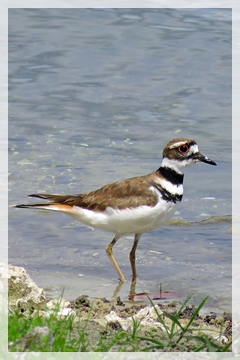
killdeerI was singing along with Zach Williams, “Fear, he is a liar,” when I recalled one of my memory verses: “The Lord is my light and my salvation—so why should I be afraid?” [Psalm 27:1] I then realized a commonality in the Bible verses I’ve been memorizing: fear. If asked, I wouldn’t say I’m a fearful person and yet the Bible verses I’ve been memorizing contradict me. I don’t suffer an assortment of phobias nor do I see a threat around every corner. I’m not unduly anxious—I don’t pace, bite my nails, stay awake all night, or binge eat. While I’m cautious when the situation calls for caution, I don’t consider myself irrationally fearful, so why did I choose to memorize so many Bible verses dealing with fear?

I’m not afraid of public places like the grocery, losing my cell phone, or reading books, and a walk through my house would tell you I’m not afraid of dust; clearly, I don’t have agoraphobia, nomophobia, bibliophobia or koniophobia. When thinking about fear, however, I was mistaking phobias for a common garden variety fear that can afflict us all. It can keep us imprisoned in much the same way as agoraphobia—only instead of being trapped in our homes, we’re trapped in our small comfort zones. It’s the fear that we’re not enough: not good enough, strong enough or smart enough. It’s the malicious voice that tells us we’re unworthy, unwelcome, unloved, and unfit. It’s the fear that we’re not up to the task, we’ll be embarrassed, or we should be ashamed. It’s the apprehension that we’re either too young or too old and the whisper that says we’re not dedicated, loving or virtuous enough to do God’s work. It’s the fear of failure and of the unknown. It’s the same fear that plagued Gideon and Moses: the fear that we’re inadequate to the task at hand.

In a way, fear does tell the truth—alone, we are not enough. Fear, however, is a liar because he doesn’t tell us the whole truth; we have a more-than-enough God. He has more than enough riches, wisdom, strength, and love for us all. If we live by God’s power, there is nothing to fear! When we place our not-enough-selves into His hand, we become His more-than-enough servants. Indeed, fear is a liar.

Remember: even the smallest drop of God’s strength is more than enough to cover our frailties, our shortcomings, and the places where we deem ourselves weak. [Lysa Terkeurst]

For God has not given us a spirit of fear and timidity, but of power, love and self-discipline. [2 Timothy 1:7 (NLT)]

I know the Lord is always with me. I will not be shaken, for He is right beside me. [Psalm 16:8 (NLT)]

For the Kingdom of God is not just a lot of talk; it is living by God’s power. [1 Corinthians 4:20 (NLT)]

Copyright ©2018 jsjdevotions. All rights reserved.

IT HURTS

I was given the gift of a handicap to keep me in constant touch with my limitations. Satan’s angel did his best to get me down; what he in fact did was push me to my knees. No danger then of walking around high and mighty! At first I didn’t think of it as a gift, and begged God to remove it. Three times I did that, and then he told me, “My grace is enough; it’s all you need. My strength comes into its own in your weakness.” [2 Corinthians 12:7-9 (MSG)]

oleander - rocky mt. bee plant

I recently read about a man who can’t feel pain because of a rare neurological condition called “congenital insensitivity to pain.” As someone who often reaches for the Ibuprofen because of assorted aches and pains, this sounded like a true blessing. In actuality, as nice as never having a headache, sciatica, or feeling the sting of fire ants initially sounds, it is life-threatening. Although this man can identify whether something is warm or cool, he can’t know that the coffee is burning his tongue, the stovetop is blistering his fingers, or the subzero temperatures have given him frostbite. He won’t feel the pain in his abdomen before his appendix bursts or the tightening in his heart signaling a heart attack. He chewed off part of his tongue when just a baby and has broken over seventy bones simply because he doesn’t know how to avoid injury. With no pain to restrain them, children with this condition tend to be daredevils. Pain is what teaches us to use our bodies correctly and safely. It warns of danger by telling us when something is too hot, cold, heavy, tight, hard or sharp and alerts us when something is wrong—a muscle is torn, a bone is broken, or an infection has set in.

Not only does pain protect and correct us, it certainly gets our attention, knocks us to our knees and turns us toward God. Moreover, it offers an opportunity both for our church family to draw near and comfort us and for us to witness to others in our pain.  As much as we don’t appreciate pain, it is a blessing rather than a burden. In reality, along with thanking God for the Ibuprofen, we should be thanking Him for the pain.

Pain insists upon being attended to. God whispers to us in our pleasures, speaks in our conscience, but shouts in our pain: it is His megaphone to rouse a deaf world. [C.S. Lewis]

Once I heard that, I was glad to let it happen. I quit focusing on the handicap and began appreciating the gift. It was a case of Christ’s strength moving in on my weakness. Now I take limitations in stride, and with good cheer, these limitations that cut me down to size—abuse, accidents, opposition, bad breaks. I just let Christ take over! And so the weaker I get, the stronger I become. [2 Corinthians 12:8-10 (MSG)]

Be cheerful no matter what; pray all the time; thank God no matter what happens. This is the way God wants you who belong to Christ Jesus to live. [1 Thessalonians 5:16-18 (MSG)]

Copyright ©2018 jsjdevotions. All rights reserved.

TRUSTING GOD

This I declare about the Lord: He alone is my refuge, my place of safety; he is my God, and I trust him. [Psalm 91:2 (NLT)]
The Lord is my light and my salvation—so why should I be afraid? The Lord is my fortress, protecting me from danger, so why should I tremble? [Psalm 27:1 (NLT)]

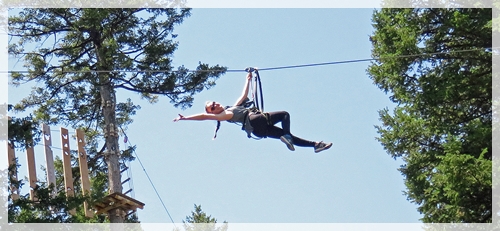
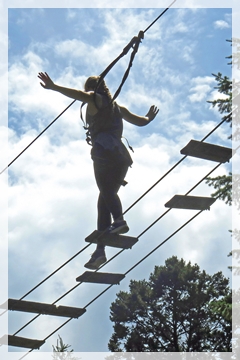
During our western trip with the grands, I wasn’t the only one to step out of my comfort zone. The two youngsters (fifteen and eighteen) took some big steps when they did a four-hour “Treetop Adventure” – think Swiss Family Robinson crossed with the X-Games or Tarzan meets American Ninja Warrior. After ascending the mountain, they had a short safety briefing, suited up in body harnesses with tethers, and set off on their aerial adventure. They maneuvered through the tree tops on elements like swaying bridges, z-shaped balance beams, high wires, hanging ropes, swinging logs, and flying skateboards. They climbed ladders, scrambled up and through cargo nets, rode thirteen zip lines, tree top adventure - jacksonand literally jumped through hoops; all of this took place some twelve to eighty feet above the forest floor.

Their equipment included a safety belay system which, in theory, always kept them clipped to a safety wire. Although participants could fall, the harness and tethers would keep them from falling more than a few feet. While it would be difficult, they could pull themselves back up and continue the course. If unable to get back up, injured, exhausted, or faint of heart, there were a few guides scattered about who could effect a rescue and lower them down to the ground. In spite of all the safety precautions, the detailed waiver we’d signed that morning made it clear there was an element of risk to the activity.

As we watched (and prayed) from the ground while the teens progressed through the course, I thought of my granddaughter’s words earlier that day: “I know it’s dangerous and that I might fall, but I also know that I’m tethered to the cable and can’t fall far.” That’s the sort of confidence we find in the Psalms. David, of course, faced far greater challenges than a ropes’ course and zip lines and, rather than trusting a cable and safety harness, he trusted God. Trusting God doesn’t mean there’s no risk or that we might not fall. Trusting God means that, like the safety harness, we know God’s there to catch us! Trusting God doesn’t mean that our journey will be easy or effortless. Trusting God means that while our journey may be challenging, like the arduous ropes’ course, getting through it is possible. Trusting God doesn’t mean we’ll never find ourselves in a dark valley. Just as the guides were there to help in an emergency, trusting God means we know we’ll never be in that dark place alone; God is always with us.

The kids completed their adventure without mishap (Praise God!). Their confidence in facing that extreme course made me wonder why I so often am hesitant about taking on much lesser challenges: not challenges requiring a liability waiver or a tethered safety harness but challenges that simply require trusting in the Lord.

If the Lord be with us, we have no cause of fear. His eye is upon us, His arm over us, His ear open to our prayer – His grace sufficient, His promise unchangeable. [John Newton]

Even when I walk through the darkest valley, I will not be afraid, for you are close beside me. Your rod and your staff protect and comfort me. [Psalm 23:4 (NLT)]

I entrust my spirit into your hand. Rescue me, Lord, for you are a faithful God. …  So be strong and courageous, all you who put your hope in the Lord! [Psalm 31:5,24 (NLT)]

Copyright ©2018 jsjdevotions. All rights reserved.

LEAVING THE COMFORT ZONE

snake river raftingHe said, “That’s what I mean: Risk your life and get more than you ever dreamed of. Play it safe and end up holding the bag.” [Luke 19:26 (MSG)]
If I am never tempted, and cannot even imagine myself being tempted, to gamble, this does not mean that I am better than those who are. The timidity and pessimism which exempt me from that temptation themselves tempt me to draw back from those risks and adventures which every man ought to take. [From “Reflections on the Psalms” by C.S. Lewis]

We were accompanied by two grandchildren, ages fifteen and eighteen, during part of our trip west. When my husband mentioned taking them on a raft trip, I pictured a scenic float down the Snake River and readily agreed. What got booked, however, was a white water adventure. Not a thrill seeker, adrenaline inducing adventures are not my thing. I was not happy about the scheduled activity and began thinking of ways to gracefully bow out of it. By coincidence (or what I call God-incidence), the above quote by C. S Lewis arrived in my email. I realized that my fear of stepping out of my rather narrow comfort zone was threatening to keep me from sharing this once-in-a-lifetime experience with my precious grands. Lewis’ words (and some much needed prayer) convinced me that this was one adventure I should not miss.

Prayer got me in the raft and I bravely paddled through the rapids. Even after we tipped and lost six of the eight passengers on the third set of rapids, witnessing the grins on the kids’ faces as they were pulled back into the raft made both the dunking and the adrenaline spike worth it. All’s well that ends well and, in spite of the soaking in the rapids, the rafting wasn’t nearly as terrifying as I’d imagined. When asked to name the highlight of their twelve days with us, our grands both mentioned the raft trip—and to think I nearly missed sharing that experience with them! The pictures taken from the photographer’s spot on shore would not have captured their smiles and whoops of delight at the rapids or the thrill of the ride!

While a certain amount of caution is wise, as C.S. Lewis pointed out, there are certain risks and adventures that none of us should miss. Timidity, pessimism, faint-heartedness, fear, and anxiety can keep us from unsafe behavior like drugs, gambling, or adultery but they shouldn’t make us retreat “from those risks and adventures which every man [and woman] ought to take.” Consider what they would have missed if Peter had allowed fear to keep him from stepping out of the boat onto the water, if David had allowed faint-heartedness to keep him from facing Goliath, or if Moses and Gideon had allowed their pessimism to prevent them from accepting the tasks given them by God.

God invites us to participate in world-changing adventures that probably have nothing to do with white water rafting. We mustn’t allow a reticence to step out of our comfort zones prevent us from accepting His invitation to go on that journey. While the adventure may involve an element of risk, the rewards will be well worth it!

Summing it all up, friends, I’d say you’ll do best by filling your minds and meditating on things true, noble, reputable, authentic, compelling, gracious—the best, not the worst; the beautiful, not the ugly; things to praise, not things to curse. Put into practice what you learned from me, what you heard and saw and realized. Do that, and God, who makes everything work together, will work you into his most excellent harmonies. … Whatever I have, wherever I am, I can make it through anything in the One who makes me who I am. [Philippians 4:8-9,13 (MSG)]

Copyright ©2018 jsjdevotions. All rights reserved.

WHAT DON’T YOU DO?

I have become all things to all people, that by all means I might save some. [1 Corinthians 9:22b (ESV)]

I can do all things through him who strengthens me. [Philippians 4:13 (ESV)]

“I don’t do desserts!” my neighbor said. My initial thought was, “Anyone can bake brownies!” As it turns out, my neighbor was absolutely right; a horrible cook, she is proof that not everyone can bake a tray of brownies! Unlike me, however, she has a gift with animals and volunteers at the Conservancy caring for injured wildlife.

God gave each of us the gift of doing some things well. As important as it is to know what those gifts are and to use them wisely, it’s just as important to know what our gifts aren’t! We’re not divine and there will always be some things we don’t do well, no matter how hard we try. When Paul said he’d become all things to all people, he meant he could find common ground with them and was sensitive to their needs, not that he could do all things for them. Moreover, when he said he could do all things through Christ, He wasn’t claiming to be a superman. He was speaking of the strength God gives us to faithfully endure the challenges of life. We can’t be all things to all people nor can we do all things for them. Trying to be Superman or Wonder Woman brings unnecessary stress to us and poor results to everyone else. Only God can do it all!

God has given each of us different ways to best serve Him and others. There are certain things, such as painting, public speaking, guitar playing, computer programming, teaching, and even baking, that some of us can do. There are a number of things, like gossiping, enabling, hating or belittling, that none of us should do. There also are specific things, like worshipping, praying and serving, that all of us can and should do.

Father, help us recognize both our gifts and limitations. Show us how to manage our talents in the best possible way to bring honor and glory to you.

For as in one body we have many members, and the members do not all have the same function… Having gifts that differ according to the grace given to us, let us use them. [Romans 12:4,6a (ESV)]

As each has received a gift, use it to serve one another, as good stewards of God’s varied grace: [1 Peter 4:10 (ESV)]

Copyright ©2018 jsjdevotions. All rights reserved.

OUR PRAYERS

Sing praises to God, sing praises; sing praises to our King, sing praises! For God is the King over all the earth. Praise him with a psalm. [Psalm 47:6-7 (NLT)]

O what peace we often forfeit, O what needless pain we bear, All because we do not carry Everything to God in prayer! Have we trials and temptations? Is there trouble anywhere? We should never be discouraged, Take it to the Lord in prayer. [“What a Friend We Have in Jesus” by Joseph Scriven]

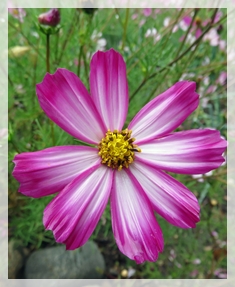
ZINNIA“That’s more like it!” I thought as I read Psalm 47; I certainly preferred it to the curses of the previous set of Psalms I’d read. I’m reading the Bible in chronological rather than in canonical order which means that the various books and chapters have been divided and rearranged. As a result, the psalms of lament and complaint were grouped together during David’s trials and the praise psalms were placed after the chapters outlining the duties in the Temple. These psalms of worship, adoration and thanksgiving seem more appropriate for Israel’s book of hymns than the earlier ones about wickedness, treachery, calamity and vengeance.

Although I prefer the joyful psalms, there is a reason Israel’s prayer book has lasted over 3,000 years and continues to be our prayer book today. Rather than a sappy feel-good book of poetry, Psalms reflects the gamut of human experience and emotions. When the disciples asked Jesus how to pray, I’m surprised He didn’t tell them they already knew and direct them to the Psalms for guidance. The Psalms’ words are intense, raw and honest; they conceal nothing. If the Psalmist is suffering, fearful, angry, depressed, or exhausted, he says so as readily as when he expresses his elation, adoration and thanksgiving. Never pretending that all is well when it isn’t, he fearlessly lays out his emotions before God. Wretchedness and joy, pain and jubilation, wickedness and virtue, despair and hope, grief and thanksgiving, fear and confidence: all are articulated. It is in that depth of personal expression and experience that we find words of consolation, faith, trust, and hope.

When I seriously evaluate my own prayer life, I’m nowhere near as honest and bold as the psalmists. Of course, God knows my personal struggles but, unlike David and the rest of the psalmists, I’m not as willing to lay them so passionately or openly at His feet. When Joseph Scriven wrote the words, “Take it to the Lord in prayer,” he meant all of it, not just the pretty stuff. I’m sure God would prefer honest words of grievance to false words of praise any day.

A human heart is like a ship on a wild sea, driven by the storm-winds from the four quarters of the world. Here it is struck with fear, and worry about coming disaster; there comes grief and sadness because of present evil. Here breathes a breeze of hope and of expectation of happiness to come; there blows security and joy in present blessings. These storm-winds teach us to speak with earnestness, and open the heart, and pour out what lies at the bottom of it. … What is the greatest thing in the Psalter but this earnest speaking amid these storm-winds of every kind? Where does one find such words of joy as in the psalms of praise and thanksgiving? … On the other hand, where do you find deeper, more sorrowful, more pitiful words of sadness than in the psalms of lamentation? … And, as was said, it is the best thing of all that they speak these words to God and with God. [Martin Luther, Preface to the Psalter]

The Lord is close to all who call on him, yes, to all who call on him in truth. [Psalm 145:18 (NLT)]

Copyright ©2018 jsjdevotions. All rights reserved.