
Give thanks to the Lord, for he is good! His faithful love endures forever. [Psalm 107:1 (NLT)]
It’s one thing to be grateful. It’s another to give thanks. Gratitude is what you feel. Thanksgiving is what you do. [Tim Keller]
 When I was a girl (back in the days of pen, paper, and postage stamps), my mother insisted that I write a “thank you” note for any gifts I received. Whether my birthday or Christmas, I was not allowed to enjoy any gifts until the necessary notes had been written. Moreover, each note had to be personal. I couldn’t just write a quick generic, “Thank you for the nice present.” I had to say something specific about the gift and, if it was money, I had to say how I planned on using it. Even if the present was something I really didn’t like or want (and we’ve all had those kinds of gifts), I had to express gratitude. My mother reminded me that, while I might not value the gift, someone else’s time, thought, love, and money had gone into getting it for me. Therefore, I should take the time to properly acknowledge and show my appreciation for the giver’s generosity. Her “thank you” note rule also applied whenever someone did something special for me. If a family took me to an event or I’d spent the night at a friend’s house, a note of thanks had to be written.
Eventually, once I was old enough to buy the gifts, host the guests, and do the good turns and favors, I appreciated the time, energy, money, thought, and love that goes into those things. My mind set changed from “I have to write a note” to “I want to write a note.” Rather than an obligation, thanking someone became a privilege.
Whenever I get a note of thanks, I relish it, especially when it’s from a grand. Misspellings or poor penmanship don’t matter to me; I love knowing that they (and their parents) appreciate the gift and the love that came with it. Unfortunately, nowadays, people rarely write “thank you” notes or even send “thank you” emails. We seem to take people, their gifts, and kindness to us, quite for granted.
As rare as hand-written notes are today, how much rarer is it for us to remember to send our thanks regularly to our Father in Heaven? What if we couldn’t play with our toys, enjoy our health, use our talents, spend our money, live in our homes, hug our family, eat our food, use our intellect, or accept God’s grace until we had properly thanked him? The fourth Thursday in November may be our national day of thanksgiving, but every day should be a day of giving thanks. That means seriously thinking about our many blessings, specifying the gifts for which we are grateful, and then actually giving God our thanks and praise.
Later today, when you take that walk in a vain attempt to work off the extra 2,000 or more calories you consumed at dinner, try listing your blessings and offering your thanks as you walk. Chances are that you’ll still be thanking God for His gifts by the time you return home.
Silent gratitude isn’t very much use to anyone. [Gertrude Stein]
 For those of us who attend liturgical churches, yesterday was the last Sunday of the liturgical (or church) year: Christ the King Sunday. A kind of liturgical “New Year’s Eve,” it is the climax and conclusion of the Church’s year.
 Our old friend Joe recently visited. Along with our friend Ric, he and my husband were partners in a manufacturing business in another state many years ago. Once a year, the three men would meet away from the business (with its phone calls and constant interruptions) to discuss their short-term and long-term business goals. While Ric and my husband were the legal, financial, and sales parts of the business, as a processing engineer, Joe oversaw manufacturing.
 A certain amount of discontent seems to be built into us, which isn’t all bad since discontent can be the incentive to make improvements. Dissatisfaction with the harpsichord’s inability to vary the intensity of its sound led Bartolomeo Cristofori to invent the piano around 1708. Benjamin Franklin’s annoyance at having to switch between two pairs of glasses led to his invention of bifocals and it probably was his discontent with a cold house that led to his invention of the metal-lined Franklin stove. The invention of the “ballbarrow,” with its rust-proof plastic bin and ball-shaped wheel that won’t sink into soft soil, is the result of James Dyson’s discontent with the traditional wheelbarrow. As Thomas Edison said, “Discontent is the first necessity of progress.”
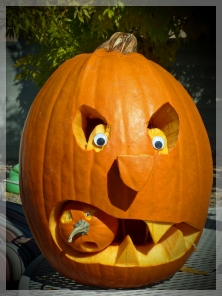 Just finishing its 5th season, the Food Network’s “Outrageous Pumpkins” features remarkable pumpkin artistry. This year’s competition matched up 14 of the nation’s best carvers into teams and challenged them to create over-the-top pumpkin creations. The pumpkin artists created horrific nightmares, constructed grisly crime scenes, and fashioned monstrous mechanical battling beasts. Using everything from melon ballers to huge saws, they they sculpted extraordinary and intricate ghouls, witches, wizards, goblins, werewolves, and monsters. As someone who is severely pumpkin-challenged (and eventually purchased a permanent Jack O-Lantern complete with an electric light), I’m amazed by the skill of these artists.
 Many years ago, my two boys were playing at their grandparents’ house. While Grandpa worked in the garden, the brothers climbed up into the apple tree and started to throw apples at him. A patient man, their grandfather told them to stop and, when more apples came whizzing at him, he offered a sterner warning. After briefly stopping their barrage, the rascals were unable to resist the temptation and chucked more apples at Grandpa. To their surprise, this gentle and loving man turned around, picked up some apples, and returned fire. Having played ball as a boy, Gramps had a strong throwing arm and excellent aim. He didn’t pull any punches as he pitched those apples back at his grandsons. The boys, unable to maneuver easily in the tree, quickly learned the meaning of “as easy as shooting fish in a rain barrel.” When they called, “Stop, Grandpa, it hurts!” he replied, “Yes, I know it does, but you needed to learn that!” It wasn’t until those hard apples hit their bodies that the youngsters understood how much their disobedience hurt their grandfather (both physically and emotionally).
 Devotions of the Heart