THE STRANGLER FIG

The seed cast in the weeds is the person who hears the kingdom news, but weeds of worry and illusions about getting more and wanting everything under the sun strangle what was heard, and nothing comes of it. [Matthew 13:22 (MSG)]

But blessed is the man who trusts me, God, the woman who sticks with God. They’re like trees replanted in Eden, putting down roots near the rivers—Never a worry through the hottest of summers, never dropping a leaf, Serene and calm through droughts, bearing fresh fruit every season. [Jeremiah 17:7-8 (MSG)]

strangler figMost trees begin life as a seed in the soil of the forest floor and most trees also observe proper forest etiquette by not killing one another. The strangler fig (Ficus aurea), however, is not your typical tree. Rather than starting in the soil where the fig’s seeds would struggle to germinate in the darkness of the dense forest’s floor, strangler figs usually begin life high up in the forest’s canopy. Blown there by the wind or deposited by animals in their droppings, the sticky fig seed usually begins its life in the bark crevices of a mature tree.

Starting out as what’s called an epiphyte or air plant, the fig seedling gets its nutrients from the sun, rain and any leave litter on its host. As the seedling matures, it sends aerial roots down the host tree’s trunk to the soil while, at the same time, it sprouts upward towards the light and sends out branches. With a potential height of over 70-feet and spread as wide as 70-feet, the fig frequently becomes bigger than its host. Its roots and branches wrap themselves around its host constricting its trunk like a boa constrictor. While strangling its host, the fig also starves it. Its lush foliage steals the host’s sunlight and rain and its complex root system steals its nourishing ground water.

Like a tiny fig seed that eventually can destroy a giant cypress, worry can do the same to us if we allow it to take root. Like fig seeds, worries are opportunistic—when they find a niche, they move right in and start growing. They seem harmless enough at first but, once they take root, they dig into us and branch out into even more worries. Rather than wrapping around our trunk, worry wraps around our spirit. Just as the fig’s massive canopy of bright green leaves steals the sunlight from its host, worry robs the light and joy from our lives. The fig embeds itself into its host and worry entrenches itself in our hearts. A silent assassin like the fig, worry attacks our roots with doubt, starves our spirit, and tries to rob us of the living water of Jesus. Figs can live centuries and, while it may take decades for the murderous tree to assassinate its host, worry is just as lethal, but it works a whole lot faster. Worry not only kills our joy, vitality, strength, spirit, and faith, but it also strangles the life right out of us with high blood pressure, heart disease, and other stress related diseases.

As destructive as they are, figs aren’t all bad but there’s no plus side to worry. At least figs produce fruit that feeds the forest’s residents but worry can keep us from bearing fruit in our lives. The fig tree’s many nooks and crannies offer homes to critters like frogs, bats, and lizards but worries only offer hospitality to nasty things like anxiety, fear, doubt, and tension. Before killing their hosts, figs may even help them survive the high winds of tropical storms. The framework of fig roots and branches surrounding the host can stabilize the tree and keep it from being uprooted. Worry, however, destabilizes us and makes it that much harder to survive the storms of life.

The forest’s oaks, cypress, and palms have no choice in the matter when a fig takes root. Fortunately, as Christians, we do have a choice when worry tries to invade our lives! We have a divine Gardener who can rid us of worry, but only if we trust Him to do His work. Before we allow worry to take root, we must prayerfully hand our concerns to God as soon as they drop into our lives. It’s only by trusting God with tomorrow that we can bear fruit today.

Perhaps what our Father would have us learn is that worry is not for Him to take away, but for us to give up. [Kathy Herman]

In simple humility, let our gardener, God, landscape you with the Word, making a salvation-garden of your life. [James 1:21 (MSG)]

Copyright ©2023 jsjdevotions. All rights reserved.

MEASURING OTHERS

Judge not, that you be not judged. For with the judgment you pronounce you will be judged, and with the measure you use it will be measured to you. [Matthew 7:1-2 (ESV]

yellow-crowned-night-heronIn a classic Peanuts comic (drawn by Charles Schulz), the meek Linus asked his bossy big sister Lucy, “Why are you always so anxious to criticize me?” She answered, “I just think I have a knack for seeing other peoples’ faults.” When Linus queried, “What about your own faults?” Lucy replied, “I have a knack for overlooking them.” Along with her over-sized ego, Lucy has what psychologists call “fundamental attribution error.”
Fundamental attribution error is the tendency people have of attributing other people’s actions to their character flaws while ignoring any impact the situation might have on their behavior. Rather than considering how circumstances can affect a person’s actions, we tend to think people do bad, rude, thoughtless, or foolish things simply because they’re bad, rude, thoughtless, or foolish people. On the other hand, although we attribute other people’s faulty behavior to shortcomings in their character, we typically attribute our failings to the challenges of our situation.

It’s not just Lucy who makes this error! When someone cuts us off, forgets something, or has a fit of pique, they’re a jerk, inconsiderate, or unpleasant but, when we do the same things, we excuse or defend our behavior because we were rushed, over-committed, or under stress! Flawed beings that we are, even the best of us manage to screw up now and then—let’s show some grace when others do! “Stop having a measuring rod for other people,” said Oswald Chambers before adding, “There is always one fact more in every man’s case about which we know nothing.”

When Jesus referred to measuring people, He was borrowing from a Jewish proverb usually applied to the markets: “It is measured to one according to the measure by which one measures.” In Jesus’ day, a  Roman inspector of measurement and weights (an agoranomos)  would be stationed in the marketplace. His measuring table and scale weights were used to calibrate vessels and balances to a standard measure. Rather than an agoranomos keeping watch on the fairness of our weights and measures, we have God. If we measure ourselves in yards, we can’t measure others in fractions of an inch and, if we round up when appraising ourselves, we can’t round down when appraising others! If we use a short measure or light weight when judging others, God will use that same short measure or balance when judging us! The standard we use for others is the standard God will use for us and I suspect the way we extend grace to others may affect the amount of grace He extends to us, as well.  

 There is a Chinese proverb that says, “Deal with the faults of others as gently as your own.” Rather than dealing with our faults, however, like Linus’ big sister Lucy, we have an uncanny knack for overlooking them completely. Jesus, however, tells us to deal with our own faults before we begin to deal with anyone else’s. Let us remember that the first principle of judgment is to start with the logs in our eyes before concerning ourselves with anyone else’s specks!

It is the peculiar quality of a fool to perceive the faults of others and to forget his own. You can‘t clear your own fields while you’re counting the rocks on your neighbor’s farm. [Cicero]

Why do you see the speck that is in your brother’s eye, but do not notice the log that is in your own eye? Or how can you say to your brother, “Let me take the speck out of your eye,” when there is the log in your own eye? You hypocrite, first take the log out of your own eye, and then you will see clearly to take the speck out of your brother’s eye. [Matthew 7:3-5 (ESV)]

Copyright ©2023 jsjdevotions. All rights reserved.

THE LAW AND THE PROPHETS

Don’t misunderstand why I have come. I did not come to abolish the law of Moses or the writings of the prophets. No, I came to accomplish their purpose. I tell you the truth, until heaven and earth disappear, not even the smallest detail of God’s law will disappear until its purpose is achieved. [Matthew 5:17-18 (NLT)]

You search the Scriptures because you think they give you eternal life. But the Scriptures point to me! [John 5:39 (NLT)]

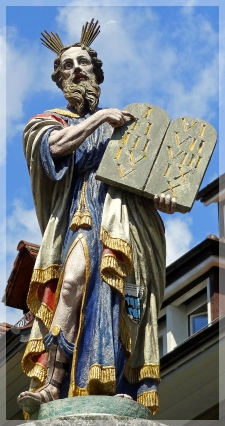
Moses Fountain - Bern - SwitzerlandOur Colorado church had a large worship center with excellent acoustics so, when the local Jewish congregation wanted to present a concert of Jewish music by a well-known Jewish performer, we were happy to offer our venue to them. The Christians in attendance never expected the evening to end with Jews and Christians joining hands and dancing the hora around the church while singing “Hava Nagilah” (Let Us Rejoice). What the Jews hadn’t expected were the Bibles on the back of every chair. Before the concert began, many intently looked through them and, after the concert, they expressed their surprise at finding their Hebrew Scriptures in our Christian Bibles!
While we call it the Old Testament, it isn’t called that by a Jew. When “testament” appears in the New Testament, it is a rendering of the Greek word diatheke, meaning covenant. While Christians recognize the old covenant God made with the Israelites, we also believe He made a new covenant (or testament) with the followers of Jesus. For a Jew, however, there’s nothing “old” about that covenant because there hasn’t been a new one. As a result, they much prefer the term Hebrew Bible or Hebrew Scriptures. The other term used for the Hebrew Bible is Tanakh—an acronym for its three categories: Torah (Law), Nevi’im (Prophets), and Ketuvim (Writings).

Even though the Hebrew Bible has 24 books divided into those three categories and our Old Testament has 39 books and four categories (Law, History, Wisdom and Poetry, and Prophecy), they both tell the same story, but in a different order. The number of books differs because the Hebrew Bible combines the first and second books of Samuel, Kings, and Chronicles, the books of Ezra and Nehemiah, and the 12 books of the minor prophets. Instead of ending with the Prophets as does our Old Testament, the Hebrew Bible ends with the Writings and the book of Chronicles.

The 1st century Jewish historian Flavius Josephus (37/38 – 100 AD) reported that there was an authoritative list of the twenty-two books Jews called “holy scriptures” that was determined by the time of Artaxerxes (464-424 BC). The book number differs because Ruth was attached to Judges and Lamentations to Jeremiah at that time. We know that the Scripture our Lord read, studied, and memorized as a boy in Galilee is the same Scripture we have today.

Jesus made frequent references to the Scriptures throughout His ministry and his enemies soon learned that they couldn’t argue the Word of God with the One who breathed that word! He defeated Satan’s temptations with words from Deuteronomy and, during his frequent confrontations with the Jewish rulers, Pharisees, and Sadducees, He made specific references to verses in Genesis, Leviticus, Deuteronomy, Exodus, Samuel, Isaiah, Hosea, and Psalms. He quoted from Malachi when speaking of John the Baptist and frequently quoted from Scripture to show how He would fulfill prophecies. He explained the writings of Moses and the prophets to Cleopas on the road to Emmaus. According to Liberty University’s Harold Willmington, of the 1,800 verses reporting Jesus’ words in the gospels, 180 verses are Old Testament quotes or allusions.

While I can understand a Jew’s unfamiliarity with a Christian Bible and surprise at finding the Hebrew Scriptures in it, I can’t understand why those of us who claim to follow Jesus are so unfamiliar with the words our Lord read, studied, quoted, and believed while He walked the earth! If it was important to Him, shouldn’t it be important to us?

Then he said, “When I was with you before, I told you that everything written about me in the law of Moses and the prophets and in the Psalms must be fulfilled.” Then he opened their minds to understand the Scriptures. [Luke 24:44-45 (NLT)]

Copyright ©2023 jsjdevotions. All rights reserved.

HIS SANCTUARY

Don’t you realize that your body is the temple of the Holy Spirit, who lives in you and was given to you by God? You do not belong to yourself, for God bought you with a high price. So you must honor God with your body. [1 Corinthians 6:19-20 (NLT)]

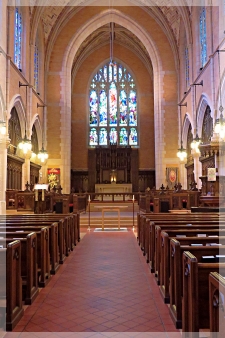
St. Paul's Cathedral - MNSince we both attended liturgical churches as girls, my friend and I were trying to recall the terms for the various parts of a traditional church building. We knew the foyer is called the narthex and the congregation sits the church’s nave. We also knew the altar rail usually separated the nave from the chancel in the front. It’s from the chancel that the service is conducted and where the altar, pulpit, and lectern are located. We even recalled that the sacristy was the room holding Communion supplies and linens. Since we were worshipping in a park that morning, my friend asked the location of our sanctuary. In historic usage, sanctuary and chancel were synonymous but, in modern usage, a sanctuary consists of the entire worship space of a church. With no building, we had no narthex, nave, or chancel but we did have a worship space; our sanctuary was a gazebo in a county park.

As God would have it, my next morning’s reading took me to today’s verse from 1 Corinthians. The Greek word usually translated as “temple” was naós, meaning a sanctuary, a divine dwelling-place, a temple, or place of divine manifestation. In Paul’s day, naós referred to the Temple proper, from the inner courts to the Holy Place with the seven-branched candlestick, golden incense altar, and showbread table all the way to the innermost area called the Holy of Holies—a place so sacred that it could be entered only by the High Priest once a year, on the Day of Atonement.

Having recently written about the lack of respect and reverence now common in a church sanctuary, Paul’s words gave me pause. The Temple and all its utensils—from the Ark, altars, and lamps to the snuffers, basins, oil, incense, and priest’s garments—were considered holy. Dedicated solely to serving God, they were not to be used for common or profane uses. If we are God’s sanctuary, a place of worship and the divine dwelling place of the Holy Spirit, do we treat ourselves with the reverence and respect due God’s temple? Are we solely dedicated to serving God? Are we ever used for vulgar, disrespectful, or profane purposes?

Do we ever desecrate our sanctuary by not treating our bodies properly? Do we treat them with the same care and regard we would Communion wafers, altar linens, or a Baptismal font? God’s sanctuary, however, is more than our physical bodies; it’s our entire being, our hearts and minds. Do we speak, read, look at, find humor in, think about, or do things we wouldn’t if we were in church? Do we always serve as a worship space of our amazing Triune God or just during prayers or worship service? Do we reflect the dignity, sanctity, and holiness that comes with being the house of God?

A great deal of responsibility comes with being God’s dwelling place. Just as the Temple was defiled in 168 BC when Antiochus Epiphanes sacrificed a pig on the altar of incense, our sins defile us. They are like obscene graffiti on a church walls, vandalism of the altar, defacement of the Bible, or leaving excrement on the pews. Preacher Harry Ironside reminds us, “How careful you and I ought to be that we grieve not that blessed One who dwells within, that we do not bring dishonor upon the name of the Savior who has sent His Spirit to live in our body.”

The Jews were so zealous about maintaining the purity of God’s sanctuary that a low fence  separated the court of the Gentiles from the rest of the Temple mount complex. Gentiles and ritually unclean Israelites were forbidden, on pain of death, from passing through its gates to the interior areas—the sanctuary of the Temple. Are we that zealous about keeping His dwelling place within us—His sanctuary—pure and undefiled?

For that matter, our brothers and sisters in Christ also serve as a dwelling place of God. Do we treat them with the same reverence and respect due God’s sanctuary? We should!

Don’t you realize that all of you together are the temple of God and that the Spirit of God lives in you?… All of you together are Christ’s body, and each of you is a part of it. [1 Corinthians 3:16,12:27 (NLT)]

Copyright ©2023 jsjdevotions. All rights reserved.

DESIGNED WITH A PURPOSE

You made all the delicate, inner parts of my body and knit me together in my mother’s womb. Thank you for making me so wonderfully complex! Your workmanship is marvelous—how well I know it.  [Psalm 139:13-14 (NLT)]

Effortlessly skimming over the water, the bird occasionally dipped its bill into the water before gracefully rising, circling the pond, and returning to skim along the water again. Even though I’d never seen one inland, the bird’s large bill, distinctive black and white coloring, and unique flight identified it as a black skimmer. Although skimmers usually spend their lives around sandy beaches and coastal islands, sometimes they feed in inland lakes during nesting season and I was thrilled to watch several skimming over our lake just before sunrise.

The skimmer’s beak is unique because its lower part is longer than its upper. As it skims over the water, the bird drags the bottom half of its beak through the water to collect small fish. When it contacts its prey, the skimmer bends its head forward and snaps the upper bill closed to catch its meal! Hunting solely by touch rather than by sight, skimmers feed from late evening until dawn when the waters are calm and the fish are closer to the surface.

Continuing my morning walk, I came upon a limpkin—another one of God’s creatures gifted with a unique and perfectly-designed beak. These wading birds eat snails and their bills are bent and twisted at the tip. With a gap just before the tip, the bill acts like tweezers. Curved slightly to the right, it easily slips into the right-handed curve of a snail’s shell.

I then spotted one of our resident brown pelicans nose-dive into the water for its breakfast and witnessed another one of God’s specialized bills. Unlike the skimmer who fishes by feel, a pelican can spot a fish from 60-feet up. When it plunges into the water, a large fibrous skin pouch dangling from its lower beak immediately opens and two to three gallons of water (along with any fish) are sucked in. The bird closes its beak, hangs its head down to let the water drain out the sides, and then flips up its beak and swallows the fish! God even provided the bird with a little hook on the tip of its upper beak to help it grip onto slippery fish!

Noticing a woodpecker drilling on a tree to get at insects under the bark, I saw how God tapered its beak to form a chisel perfectly designed for its task. With beaks clearly on my mind, I considered the aptly named roseate spoonbill with its spoon-like beak that serves as a strainer while it forages in the ponds; the hawk with its sharp hooked beak that enables it to catch, kill and tear up its prey; and the tiny hummingbird who can eat three times its body weight in a day. Its long needle-like bill fits deep into tubular flowers while its tongue darts in and out of the nectar about 13 times a second! God designed each of their bills with a specific purpose in mind.

While we people look more alike than do a skimmer and a spoonbill or hummingbird, God has endowed each one of us with unique capabilities perfectly designed for our specific purpose in life. Rather than a specialized beak, we have unique traits, talents, strengths, and abilities that set us apart from one another. Just as the bills of the skimmer and hummingbird were designed for the roles they play in the ecosystem, we have been specifically designed for the role that God has assigned us in the world—a role unlike that of anyone else.

Whether teacher, pastor, chef, clerk, janitor, farmer, dishwasher, programmer, carpenter, maintenance worker, musician, mail carrier, or barista, no one is insignificant. The very hairs on our head are numbered and Jesus told us we’re more valuable than a flock of sparrows (whose short cone-shaped beaks are perfectly designed to crack open seeds). The God who designed the spear-like bill of the anhinga to impale fish and the whimbrel’s curved bill to fit into a fiddler crab’s burrow knew exactly what He was doing when He designed each and every one of us. Designed for a purpose, we are one-of-a-kind creations made by the hands of God. May we serve Him well!

You are who you are for a reason.
You’re part of an intricate plan.
You’re a precious and perfect unique design,
Called “God’s special woman or man.”
You look like you look for a reason.
Our God made no mistake.
He knit you together within the womb,
You’re just what He wanted to make!
[Russell Kelfer]

For we are God’s masterpiece. He has created us anew in Christ Jesus, so we can do the good things he planned for us long ago. [Ephesians 2:10 (NLT)]

Copyright ©2023 jsjdevotions. All rights reserved.

PUT AWAY YOUR CALCULATORS AND CALENDARS! (Revelation – Part 3)

blood moon - lunar eclipse

Photo Courtesy Dennis Johnson


However, no one knows the day or hour when these things will happen, not even the angels in heaven or the Son himself. Only the Father knows. [Matthew 24:36 (NLT)]

I couldn’t finish writing about Revelation without a caution to beware of end times predictions. If someone claims to have secret knowledge or frightens you with their teaching—abandon them ASAP! If Jesus didn’t know when the end would occur, I can guarantee that no mortal will!

Nevertheless, in 1994, radio evangelist Harold Camping predicted the world would end on September 6. When it didn’t, explaining his mistake was a mathematical error, Camping got out his calculator again and predicted the apocalypse would begin precisely at 5:59 PM, May 21, 2011. At that time, those chosen by God would ascend to heaven in the Rapture and cataclysmic earthquakes would rock the earth. After finding himself still here May 22, Camping admitted his understanding of God’s plan was slightly off but continued predicting the world’s end on October 21. When October 22 dawned, the evangelist confessed such predictions were “incorrect and sinful” and finally conceded that God might not tell people the date of Christ’s return. Camping’s apology, however, was little comfort to his followers who’d given up jobs and families to warn people of God’s coming judgment!

Because Joel 2:31 and Revelation 6:12 describe the sun growing dark and the moon turning red as blood before the great day the Lord arrives, we frequently read of “blood moon” predictions! A “blood moon” is a total lunar eclipse during which we see the moon slowly darken and change color from bright white to an orange-red coppery color. Not a rare event, one occurred last November and another will in 2025. On September 28, 2015, however, the fourth such lunar eclipse occurred within two years (a “tetrad event”) and coincided with the Jewish celebration of Sukkot. The concurrence isn’t surprising since Sukkot always occurs on the first full moon following the autumn equinox. Nevertheless, this caused some Christian evangelists to warn of imminent world-shaking events or that the Four Horsemen of the Apocalypse would reveal their missions. They didn’t! Nevertheless, we’ll probably hear more tribulation prophecies in 2033 when the last full moon in the tetrad occurs on October 8—the first day of Sukkot!

Because Revelation calls “666” the number of the Beast, people try to use 666 to predict the end. Although Revelation’s message shouldn’t frighten believers, many Christians in 17th-century Europe feared the world’s end in 1666. When the Great London Fire that year destroyed much of the city, they thought it the end of the world but, since it lasted only four days and left only ten dead, that wasn’t much of an end!

To determine the Beast’s name, some people use gematria (a system of assigning numeric values to letters or words in the Hebrew language). Although originally limited to Hebrew, they also use Greek, Latin, English, or whatever suits them. Depending on the language, whether first and/or last name is used, and the number of mathematical applications employed, just about any name can be made to total 666 (including Nero Caesar, Julius Caesar, Domitian, Vespasian, Caligula, Mohammed, Pope Benedict IX, Luther, Ronald Reagan, and Mikhail Gorbachev). Don’t fret about 666 or its meaning. We aren’t going to know the Beast’s identity until it appears but we’ll recognize the Beast by the mark!

Last week I wrote about the Episcopal priest Jeopardy contestant and his easy dismissal of Revelation. His dismissal is understandable. False prophecies, outlandish predictions, and farfetched interpretations of Revelation bring shame and ridicule to John’s vision and, by extension, to Jesus. False rapture and end-of-the-world predictions do more than embarrass and discredit the false prophet, they dishonor the Lord and the Christian doctrine of Christ’s return!

It is only by studying Revelation that we can maintain both our hope in the return of Jesus and dispel the doomsday delusions of today’s false prophets. Let us remember that God doesn’t want us to speculate about the timing of His return; He wants us to remain faithful, righteous, watchful, and ready. In the meantime, rather than being sign watchers, we should be disciple makers!

So when the apostles were with Jesus, they kept asking him, “Lord, has the time come for you to free Israel and restore our kingdom?” He replied, “The Father alone has the authority to set those dates and times, and they are not for you to know. But you will receive power when the Holy Spirit comes upon you. And you will be my witnesses, telling people about me everywhere—in Jerusalem, throughout Judea, in Samaria, and to the ends of the earth.” [Acts 1:6-8 (NLT)]

Copyright ©2023 jsjdevotions. All rights reserved.