
Fear and trembling come upon me, and horror overwhelms me. And I say, “Oh, that I had wings like a dove! I would fly away and be at rest; yes, I would wander far away; I would lodge in the wilderness; I would hurry to find a shelter from the raging wind and tempest.” [Psalm 55:5-8 (ESV)]
 Wearing a stuffed backpack and carrying his Teddy bear, little Tommy walked past his neighbor’s house. A short while later, he walked by her house in the same direction. He disappeared around the corner only to reappear several minutes later. As he was passing her house for the fourth time, the neighbor asked him what he was doing. When Tommy explained he was running away, she asked why he was only circling the block. “Because I’m not allowed to cross the street!”
Have you ever wanted to run away from your problems? I certainly have and so did David. Desperate, he wanted to escape his situation and yearned to be a dove that could just fly away to a far away place. Neither David nor I were any more successful at fleeing our troubles than little Tommy!
The difficulty with running away is that our problems usually come along with us while new ones loom right around the corner. When Hagar ran away from Sarah’s cruelty and Abraham’s disregard, the lone pregnant woman simply exchanged one set of problems for an even greater one—that of survival in the wilderness—and God sent her back. Hagar, of course, wasn’t the only one who chose to run rather than face her problem head-on. Adam and Eve were the first. After tasting the forbidden fruit, they foolishly thought they could escape facing God by covering themselves with leaves and hiding in the trees. They could run, but they couldn’t hide!
When famine struck and Abraham ran away to Egypt, he simply traded one problem for another when he lied about his marriage and allowed Sarah to be taken as one of Pharaoh’s wives. Naomi and Boaz jumped out the frying pan right into the fire when they escaped from famine in Judah by going to the hostile pagan nation of Moab. Boaz died there as did both of their sons and Naomi was left a penniless widow in a foreign land. Jonah, of course, is the poster boy of runaways. Unwilling to obey God and pronounce judgment on Nineveh, the prophet immediately went in the opposite direction and ended up in the belly of sea creature. If we’re running from God, we’re going in the wrong direction; Satan, however, is more than happy to provide us with transportation!
Refusing to face our problems is just another way of running from them. When Saul and his army refused to face Goliath, the giant didn’t go away; he returned every morning to taunt them and their God! Displeased by Jeremiah’s words, King Jehoiakim of Judah burned the prophet’s scroll and King Zedekiah imprisoned him. Nevertheless, ignoring Jeremiah’s prophecies of disaster didn’t keep it from happening!
Running from the truth doesn’t make it less true and running from a problem doesn’t make it disappear! Trials are inescapable in this fallen world and dealing with them is a necessary part of being a believer. Our challenges shape us into the people God wants us to be. Whether it’s financial difficulties, a troubled marriage, a difficult boss, a rebellious child, a medical issue, a loved one’s mental illness, or our own addiction, problems must be faced.
Our loving God is sovereign over our lives. Rather than run from the troubles He’s allowed to be placed in our lives, He expects us to trust Him enough to stand firm and boldly confront them while wearing the armor of God. Although we have a belt, breastplate, shoes, shield, helmet, and sword, something is missing; there is no back plate to the breastplate of righteousness. I suspect that’s because we can’t win the Kingdom if we’re fleeing from the enemy!
 Things were going well for Moses in Midian: he was happily married, with a family, and tending his father-in-law’s sheep. Then God interrupted his comfortable life with a burning bush and a major task: free the Israelites. Moses reacted the way most of us would by questioning God. Who am I to do this? Who do I say sent me? What if they don’t believe me? He then told God he simply wasn’t up to the task. Not one to be thwarted, God responded to all of Moses’ concerns. He would be with him, provide the words, the proof, and even Aaron to do the talking. In short, God promised to provide and so Moses obeyed.
 “May the Holy Spirit give us grace to not begrudge the pedagogy of God,” wrote John Piper in the day’s devotion. A somewhat archaic word and not one I regularly use, I thought of a pedagogue as an old, boring, stodgy, and authoritarian teacher who never changed his lesson plan or lectures. Unsure what Piper meant, it seemed wise to consult the dictionary. “Pedagogy” comes from two Greek words: pais, meaning child, and agogos, meaning leader. A paidagogos was a slave who led the boys to and from school, taught them manners, and tutored them after school.
 I still go online to read the newspaper from what was our hometown for over fifty years. Last week, it was filled with news about the events of Fiesta Days. With its Car Show, Big Wheel Race, Duck Derby, Beach Bash, Street Fair, Music Fest, Art Show, Parade, Fireworks, and Carnival (complete with rides and funnel cakes), the festival is one of summer’s highlights.
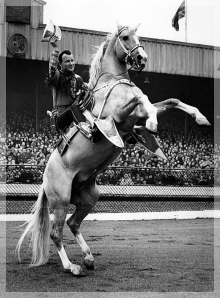 Several “Nancy” comics written and drawn by Guy Gilchrist have inspired my writing. Curious about the cartoonist, I was not surprised to learn that he is a Christian; that was not always true. As a boy, he was poor, lonely, abused, and searching for someone and something in which to believe. Missing a dad, he found a father figure in an unlikely place—television—and in a remarkable person—a radio, television and movie star by the name of Roy Rogers. When the young cartoonist was unsure how to behave, he’d look to the singing cowboy and ask himself, “What would Roy do?” He knew his cowboy hero always took the right course of action. Although Rogers was publicly vocal about his faith, Gilchrist didn’t know his hero was a Christ follower until many years later.
 When written by Guy Gilchrist, “Nancy” used to appear in the comics of our local paper. The slightly chubby, somewhat mischievous, eight-year-old girl with the red skirt and hair bow often prayed. In one comic, Nancy starts with a litany of thanks to God for always being there, showing her the way, filling her heart, and giving her just what she needs before she even knows she wants it. “You are an amazing God!” she offers in praise before closing her prayer with, “Could you throw me a couple answers before my math test tomorrow?”
