
Oh, that I had wings like a dove; then I would fly away and rest! I would fly far away to the quiet of the wilderness. How quickly I would escape—far from this wild storm of hatred [Psalm 57:6-8 (NLT)]
Good people must never expect to escape troubles; if they do, they will be disappointed, for none of their predecessors have been without them. [Charles Spurgeon]
 It wasn’t Hagar’s fault; she really had no choice in the matter. It was the barren Sarah who offered her maidservant Hagar to Abraham like a brood mare to a stallion to provide him with an heir. Having been used by both mistress and master, Scripture tells us that Hagar began to treat Sarah with disdain once she became pregnant. Rather than accept her part in the tense situation, Sarah blamed her husband, grew jealous of her maid, and treated the girl harshly. Sarah wasn’t just unpleasant to her servant. The Hebrew word used was anah, meaning oppressed or afflicted; it is the same word used to describe the way Egypt’s taskmasters treated their Israelite slaves. In short, Sarah wasn’t just stern, she was vindictive and cruel. Since Abraham had washed his hands of the matter, Hagar saw no reprieve. Wanting to escape her merciless mistress and the household turmoil, Hagar did what many of us do when faced with difficult and seemingly impossible circumstances—she fled.
It’s thought that Hagar wanted to return to her family in Egypt, which meant crossing the desert in the Wilderness of Shur—a dangerous prospect for a lone pregnant woman. It was on the road to Shur that the weary Hagar stopped by a well and met the Angel of the Lord. Rather than aiding in her escape or promising to alleviate the situation at Abraham’s home, He told her to return and “submit” to Sarah’s authority! He then blessed her with good news about her future. Having heard her cries of distress, He told her to name her son Ishmael, meaning “God hears.” From then on, Hagar called the Lord El-Roi, meaning the God who sees me.
We probably don’t flee into the desert to escape our troubles but, like Hagar, we want to flee some way or another. Some try escaping with drugs, alcohol, infidelity, or denial while others run away with work, spending, lethargy, food, or exercise. Like Hagar, we would prefer to be rescued from our troubles than to face them. We want the God who hears and sees us to cure the cancer, fix the infertility, make the chronic pain stop, and free us from our grief. We want Him to bring the lost child home, get the loved one sober, replenish the empty bank account, fix the broken marriage, and make the dysfunctional family functional. Given a choice, we would prefer God to make everything right than to face our troubles. We join with the psalmist in his desire to escape by flying away on the wings of a dove.
Hagar’s story, however, tells us that’s not how it works—rather than flying away, God expects us to face our troubles. He told Hagar to return to Abraham and submit to her mistress. Rather than rescuing Hagar from her trouble, God sustained and blessed her in it. The good news found in Hagar’s story is that God is aware of our suffering. He sees and hears us in the hospital room, courthouse, morgue, homeless shelter, prison cell, rehab unit, living room, football field, workplace, doctor’s office, and even the desert. No matter where we are or what what kind of trouble we’re facing, we are never lost, alone, or abandoned. Our God is El Roi – the God who sees us! While He may not free us from our troubles, He will sustain and bless us in them!
Don’t pray to escape trouble. Don’t pray to be comfortable in your emotions. Pray to do the will of God in every situation. Nothing else is worth praying for. [Samuel M. Shoemaker]
 Back in his college days, my husband and several friends were on a lonely stretch of road in what seemed the middle of nowhere when they stopped for a red light. Although the average red light lasts from 90 to 120 seconds, that seemed like an eternity to the impatient driver. After looking around and seeing no other cars, he proceeded through the intersection. There was, however, one other vehicle nearby—and it was a police car! Although that driver’s impatience cost him time and money, other drivers’ impatience can take lives! A typical commuter train, for example, usually passes through an intersection in two to three minutes. But, when we lived in Illinois, at least one or two impatient drivers tried (and failed) to beat the local commuter train across the tracks every year.
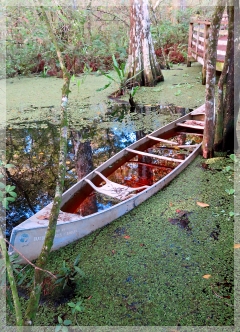 Whenever I saw the swamped canoe at the swamp/bird sanctuary, I remembered the old aluminum canoe we had at our cottage. Because it remained down at the lakefront all year long, the canoe served as winter home to the chipmunks and mice. After decades of rodents taking refuge there, the critters eventually chewed up all the foam flotation blocks in both ends of the craft. Since a boat will float only as long as it weighs less than the maximum amount of water it displaces, those empty chambers didn’t affect the canoe if it remained upright and relatively dry. But, if the craft capsized, its empty chambers would rapidly fill with water and, with the extra weight, sink. Knowing how easily the canoe could sink made us extra cautious—it was used only when the water was calm, no one deliberately tipped it, and lifejackets were required.
 When a servant comes in from plowing or taking care of sheep, does his master say, “Come in and eat with me”? No, he says, “Prepare my meal, put on your apron, and serve me while I eat. Then you can eat later.” And does the master thank the servant for doing what he was told to do? Of course not. In the same way, when you obey me you should say, “We are unworthy servants who have simply done our duty.” [Luke 17:7-10 (NLT)]
 Whenever we were with my mother-in-law, she would say, “Come, sit down, and rest for a bit.” Since I usually was busy preparing a meal or doing some task for her, I’d say, “Not now, Grandma, maybe later!” Now that she’s gone, I wish I’d spent a few more minutes sitting and resting with her. I thought of her this morning when reading Jesus’ words urging the disciples to find a quiet place to rest awhile.
 I trust you, O Lord. I said, “You are my God.” My future is in your hands. [Psalm 31:14-15a (GW)]
 Devotions of the Heart