
The next day he saw Jesus coming toward him, and said, “Behold, the Lamb of God, who takes away the sin of the world! … And John bore witness: “I saw the Spirit descend from heaven like a dove, and it remained on him. I myself did not know him, but he who sent me to baptize with water said to me, ‘He on whom you see the Spirit descend and remain, this is he who baptizes with the Holy Spirit.’ And I have seen and have borne witness that this is the Son of God.” [John 1:29,32-34 (ESV)]
After Jesus’ baptism, John the Baptizer seemed so sure that Jesus was the Christ, the promised Messiah! More than a year later, what caused him to wonder—to doubt what he’d seen, heard, and come to believe?
 At the time, Herod Antipas was the Tetrarch of Galilee and Perea. While married to the daughter of Aretas IV, king of Nabatea, Antipas visited his half-brother, Herod Philip and his wife Herodias (who was the daughter of another half-brother, Herod Aristobulus) in Rome. While there, Antipas became enamored with his brother’s wife. After divorcing their spouses, he and Herodias married and lived in Herod’s palace with Herodias’ daughter Salome. Their divorces and marriage were politically explosive and religiously scandalous and John the Baptizer was outspoken in his condemnation of their incestuous sinful relationship. While marrying a niece wasn’t uncommon, Mosaic law prohibited marrying a brother’s wife except in what was called a “levirate marriage” when a brother died childless. Philip, however, was very much alive at the time! Both Herod Antipas’ reputation and his political security were threatened by John’s public condemnation of his marriage as well as his Messianic message.
To silence the Baptizer, Herod imprisoned him underground at his palace in Macherus. Although John was silenced and out of the public eye, Herodias wanted him dead. Fearing a riot if the beloved holy man were to die, Antipas resisted his wife’s pleas. While Scripture is unclear, scholars believe John languished in his dark cell for about 15 months before Herod Antipas was tricked into ordering the Baptizer’s execution.
During the Baptizer’s imprisonment, his disciples visited him with news of Jesus. Like the rest of his countrymen, John probably expected a very different Messiah than the One who came. John preached in the wilderness; Jesus preached in homes, synagogues, cities, the countryside, and even the Temple. John lived the ascetic life of a Nazarene; Jesus freely mixed with people and openly ate and drank with tax collectors and other sinners. John spoke of repentance, God’s wrath, and a day of judgment and fire; Jesus spoke of love, forgiveness, the Kingdom of Heaven, and the ”year of the Lord’s favor.” Jesus and his disciples didn’t even fast the way John and his disciples did! Did John wonder why Jesus hadn’t proclaimed Himself the Messiah and King of Israel? Most of all, did John wonder why Jesus hadn’t freed him from prison?
Those 15 months were a long time to sit in the dark—a long time for doubts to creep into John’s mind. As the months wore on, John realized that nothing short of a miracle was going to free him but the miracle he hoped for wasn’t coming. It’s no wonder the man who once was so sure Jesus was the Christ sent his disciples to ask Jesus if he were the Messiah.
 While we now know what is meant by an iota and dot, jot and tittle, or yod and kots, we wonder what Jesus means by “the least of these commandments!” If the smallest letter is as important as the largest and the smallest flourish on the smallest letter in Scripture was not to be eliminated, how can there be a “lesser” commandment? The confusion again comes from reading an English translation of a Greek rendering of the original Hebrew. Jesus probably was using a popular Jewish idiom “mitsvot kalot” meaning “light” commandments, rather than “mitsvot ketanot,” meaning less important or small commandments. While this seems a bit like splitting hairs, it reflects Jewish thinking in Jesus’ day when a distinction was made between “light” and “weighty” commandments when comparing one to another.
 What is a jot or a tittle? Found in the King James version, the words “jot” and “tittle” date from the 15th and 16th centuries. “Jot” comes from jota, an alternate spelling of the Greek iota (the smallest letter in the Greek alphabet) and, at the time, meant something very small. “Tittle” was a translation of keraia, a Greek word meaning “a little horn” that referred to an accent mark over a vowel. While those English words were good translations of the New Testament’s Greek, Jesus wasn’t speaking Greek when He gave the Sermon on the Mount. He was speaking Hebrew or Aramaic and the words He used weren’t iota and keraia. He would have used yod, which was the smallest Hebrew letter, and kots, meaning thorn, which was the little curve or flourish at the yod’s top distinguishing it from other letters. The tenth letter of the Hebrew alphabet, yod sounds like a “y” and looks a bit like an apostrophe.
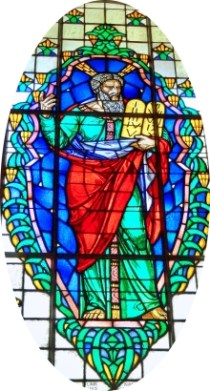 There are 613 commandments in the Torah/Pentateuch (the first five books of the Bible). But, as seen in Jesus’ interaction with the lawyer who wanted “neighbor” defined, there was room for interpretation. For example, what exactly does it mean to “honor” one’s parents? When Deuteronomy 11:18-20 says to bind “these words” to one’s hands and forehead and place them on doorposts and gates, exactly what words and how was it to be done? Work on the Sabbath is prohibited in twelve places but is the command limited to the few types of work mentioned? For that matter, what defines work?
 When a nomikós (Scripture lawyer, an expert in religious law) tested Jesus by asking what he must do to inherit eternal life, the Lord countered with his own question, “What does the law say?” When the man responds with the words of Deuteronomy 6:5 and Leviticus 19:18, Jesus says he’s answered correctly. Wanting clarification, he then asks, “Who is my neighbor?” His query tells us the nomikós is more interested in the letter of the law than its spirit. Apparently, he wouldn’t want to waste any love on someone who wasn’t his neighbor or miss loving someone who was! Jesus answers the man’s question with one of his best-known stories—the Parable of the Good Samaritan.
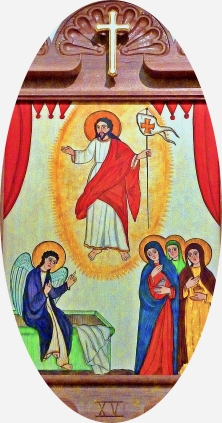 “Happy Easter,” said the Pastor as she welcomed us to worship. She was neither a week late nor four weeks early for Greek Orthodox Easter. While it’s no longer Easter Sunday and all the jelly beans, chocolate bunnies, and hard-boiled eggs have been eaten, it is Eastertide (“tide” just being an old-fashioned word for “season” or “time”). The Christian or liturgical calendar designates Eastertide as the fifty days from Easter/Resurrection Sunday to Pentecost (when we celebrate the outpouring of the Holy Spirit and the birth of the church).
 Devotions of the Heart