FEAST OF ST. NICHOLAS

Jesus told him, “If you want to be perfect, go and sell all your possessions and give the money to the poor, and you will have treasure in heaven. Then come, follow me.” [Matthew 19:21 (NLT)]

St. NicholasTomorrow, December 6, is the Feast of St. Nicholas (or Sinterklass). Although it is difficult to know fact from fiction, we do know that St. Nicholas was born around 270 AD in Patara, a city in Lycia (modern day Turkey). The son of wealthy and devout parents, it was his uncle, the Bishop of Patara, who took charge of his spiritual life. Nicholas became the Bishop of Myra in Turkey, quite likely attended the council of Nicaea, spent seven years imprisoned under Diocletian Persecution, and died on December 6, around 343 AD. While we don’t know much about the man, he must have had a great impact on the early Christian church because, by 450 AD, churches in Asia Minor and Greece were named in his honor and, by the mid-6th century, the Emperor Justinian dedicated a church to him in Constantinople.

When Nicholas’ parents died, legend has it that he distributed the money and property he inherited to those who begged him for help. Taking seriously Jesus’ command to sell his possessions and give to the poor, he selflessly gave away his entire wealth. It’s said that wherever he saw suffering or need, he gave in secret and expected nothing in return. The best-known story of this revered saint is that he secretly provided money for three girls whose father was so poor he couldn’t provide them with dowries. No dowries meant no marriages which meant they’d be sold into lives of servitude. Nicholas secretly provided each girl with a bag of gold (some say by putting it in their stockings that were drying by the fire). This legend evolved through the centuries into the custom of gift giving on the eve of his saint’s day.

Tonight, in memory of the cherished saint, children throughout Europe will put out shoes, boots, or stockings to be filled with small gifts like coins, oranges, nuts, candies, and cookies brought by the Saint. These little gifts are meant to be shared with others rather than kept for oneself. In some countries, the legendary saint is said to be accompanied by the demonic Krampus who leaves coal in the shoes and stockings of naughty children (or possibly beats them with a stick)!!

From what we know of him, Nicholas loved God more than anything. I wonder what he would think of the way his name, faith, and generosity have turned into such crass commercialism. While he is the patron saint of children, seamen, brides, the hungry, and scholars, he is not the patron saint of credit card companies, malls, shoppers, catalogues, or Amazon! Nicholas certainly wouldn’t approve of the way Santa Claus has eclipsed the Christ child in the hearts of many.

As we move into this holiday season, perhaps we should emulate St. Nicholas, the original Santa Claus. His life wasn’t about how many presents were stacked under his tree; it was about dedicating his life to serving God and helping those in need. Perhaps we should pare down our Christmas list so that our gifts are as simple as fruit and nuts and must fit into a shoe or stocking. Let us also remember that those holiday gifts are to be shared. After all, it is Jesus, not Santa, who is the reason for the season!
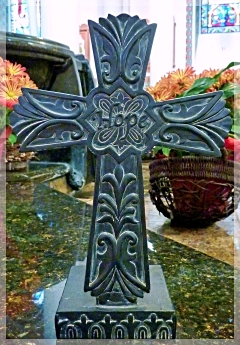
Give generously to the poor, not grudgingly, for the Lord your God will bless you in everything you do. There will always be some in the land who are poor. That is why I am commanding you to share freely with the poor and with other Israelites in need. [Deuteronomy 15:10-11 (NLT)]

Blessed are those who are generous, because they feed the poor. [Proverbs 22:9 (NLT)]

Copyright ©2024 jsjdevotions. All rights reserved.

ADVENT HOPE

I pray that your hearts will be flooded with light so that you can understand the confident hope he has given to those he called—his holy people who are his rich and glorious inheritance. I also pray that you will understand the incredible greatness of God’s power for us who believe him. This is the same mighty power that raised Christ from the dead and seated him in the place of honor at God’s right hand in the heavenly realms. [Ephesians 1:18-20 (NLT)]

Without Christ there is no hope. [Charles Spurgeon]

According to the Greek myth, when Zeus presented a beautiful jar to Pandora as part of her dowry, he forbade her to open it. Curiosity, however, got the best of her. When she lifted its lid to peek into the jar, all the malevolence and afflictions Zeus hid inside were released. As evils like sickness, chaos, death, conflict, hatred, jealousy, sorrow, envy, lust, famine, and violence came rushing out , the terrified woman quickly replaced its lid. All that remained in the jar was hope—the only consolation humans have for the trouble and suffering Pandora let loose upon the world.

Of course, it wasn’t Pandora who brought misery into the world—it was Adam and Eve who brought sin, misery, and death into the world with their disobedience. Rather than remaining in Pandora’s jar, hope came to the world in a baby born in Bethlehem about 2,000 years ago.

How many times this past week did you hope? Did you hope the family would arrive safely, the turkey would be done on time, the rolls wouldn’t burn, or that no one would argue about politics at dinner? We hope for things both large and small—getting a raise, excellent grades, better health, reconciliation, a good night’s sleep, a winning season for our team, a cure for cancer, an on-time departure, finding the perfect gift, world peace, the winning lottery ticket, or a better tomorrow.

Biblical hope, however, isn’t about expecting better circumstances. Biblical hope is living through the storms, loss, pain, and disorder of this life while holding on to the hope that God will show up right in the middle of our mess! In the darkness of our lives and today’s troubled world, Christ’s followers have hope regardless of whether our circumstances change for the better or the worse. We have hope because we know the One who holds our future in His hands. We have hope because we know that He is with us every step of the way. Best of all, we have hope because we know how the story ends—and its end is better than anything we possibly could imagine!

Yesterday was the first Sunday in Advent—the four-week season in the Church calendar dedicated as much to the Messiah’s second arrival as to His first! In observance of this season of preparation, last night we lit the first candle (the candle of hope) in our Advent wreath. A circular garland of evergreen, the wreath’s greens represent eternal life and its round shape represents God’s unending love. Often called the prophecy candle, it reminds us that the Messiah’s arrival, death, resurrection, and return in final victory were prophesied hundreds of years before His birth. This first candle represents mankind’s past hope for the coming of the promised Messiah, our present hope because of Jesus’ presence in our lives, and our future hope for His promised return.

Hope came into the world with the birth of Jesus—Immanuel—God with us. God gave us hope with His forgiveness of sins, our salvation, and His promise of peace. He gave us hope with the resurrection of the dead, the communion of saints, the redemption of creation, the Holy Spirit, the return of Christ, and the life of the world to come. Thank you, Heavenly Father, for the gift of hope.

The Christmas message is that there is hope for a ruined humanity—hope of pardon, hope of peace with God, hope of glory—because, at the Father’s will, Jesus became poor and was born in a stable so that thirty years later He might hang on a cross. [J.I. Packer]

I pray that God, the source of hope, will fill you completely with joy and peace because you trust in him. Then you will overflow with confident hope through the power of the Holy Spirit. [Romans 15:13 (NLT)]

THANK YOU NOTES

Give thanks to the Lord, for he is good! His faithful love endures forever. [Psalm 107:1 (NLT)]

It’s one thing to be grateful. It’s another to give thanks. Gratitude is what you feel. Thanksgiving is what you do. [Tim Keller]

wild turkeyWhen I was a girl (back in the days of pen, paper, and postage stamps), my mother insisted that I write a “thank you” note for any gifts I received. Whether my birthday or Christmas, I was not allowed to enjoy any gifts until the necessary notes had been written. Moreover, each note had to be personal. I couldn’t just write a quick generic, “Thank you for the nice present.” I had to say something specific about the gift and, if it was money, I had to say how I planned on using it. Even if the present was something I really didn’t like or want (and we’ve all had those kinds of gifts), I had to express gratitude. My mother reminded me that, while I might not value the gift, someone else’s time, thought, love, and money had gone into getting it for me. Therefore, I should take the time to properly acknowledge and show my appreciation for the giver’s generosity. Her “thank you” note rule also applied whenever someone did something special for me. If a family took me to an event or I’d spent the night at a friend’s house, a note of thanks had to be written.
Eventually, once I was old enough to buy the gifts, host the guests, and do the good turns and favors, I appreciated the time, energy, money, thought, and love that goes into those things. My mind set changed from “I have to write a note” to “I want to write a note.” Rather than an obligation, thanking someone became a privilege.

Whenever I get a note of thanks, I relish it, especially when it’s from a grand. Misspellings or poor penmanship don’t matter to me; I love knowing that they (and their parents) appreciate the gift and the love that came with it. Unfortunately, nowadays, people rarely write “thank you” notes or even send “thank you” emails. We seem to take people, their gifts, and kindness to us, quite for granted.

As rare as hand-written notes are today, how much rarer is it for us to remember to send our thanks regularly to our Father in Heaven? What if we couldn’t play with our toys, enjoy our health, use our talents, spend our money, live in our homes, hug our family, eat our food, use our intellect, or accept God’s grace until we had properly thanked him? The fourth Thursday in November may be our national day of thanksgiving, but every day should be a day of giving thanks. That means seriously thinking about our many blessings, specifying the gifts for which we are grateful, and then actually giving God our thanks and praise.

Later today, when you take that walk in a vain attempt to work off the extra 2,000 or more calories you consumed at dinner, try listing your blessings and offering your thanks as you walk. Chances are that you’ll still be thanking God for His gifts by the time you return home.

Silent gratitude isn’t very much use to anyone. [Gertrude Stein]

Enter his gates with thanksgiving; go into his courts with praise. Give thanks to him and praise his name. For the Lord is good. His unfailing love continues forever, and his faithfulness continues to each generation. [Psalm 100:4-5 (NLT)]

Copyright ©2024 jsjdevotions. All rights reserved.

CHRIST THE KING

“My kingdom isn’t the sort that grows in this world,” replied Jesus. “If my kingdom were from this world, my supporters would have fought, to stop me being handed over to the Judaeans. So then, my kingdom is not the sort that comes from here.” [John 18:36 (NTE)]

God’s kingdom, you see, isn’t about food and drink, but about justice, peace, and joy in the holy spirit. [Romans 14:17 (NTE)]

For those of us who attend liturgical churches, yesterday was the last Sunday of the liturgical (or church) year: Christ the King Sunday. A kind of liturgical “New Year’s Eve,” it is the climax and conclusion of the Church’s year.

Starting with Advent, the first half of the church year focuses on the events of Jesus’ life: His incarnation, birth, manifestation, temptation, suffering, death, resurrection, and ascension. The second half of the church year begins on Pentecost (with the outpouring of the Holy Spirit) and, depending on Easter’s date, lasts 23 to 28 Sundays. Sometimes called Ordinary Time, this season focuses on the teachings of Jesus. Next Sunday, we start a new year with the first Sunday in Advent and begin another journey through Scripture to remind us of who we are and to whom we belong.

Like the rest of the liturgical church calendar, Christ the King Sunday is man-made rather than ordained by God. Nevertheless, having attended a liturgical church most of my life, I find comfort in regularly celebrating not just Christmas and Easter but the entire mystery of Jesus—from His incarnation through His death, resurrection, and ascension, to the gifting of the Holy Spirit and the expectation of His glorious return.

When I first saw the words “Christ the King” on the church hymn board years ago, I didn’t know that this observance is a modern addition to the church year. It was instituted in 1925 by Pope Pius XI in response to the growth of communism, fascism, atheism, and secular ultra-nationalism in Europe at that time. Although first observed by the Roman Catholic church, Protestant denominations such as the Lutheran, Anglican, Moravian, Methodist, Nazarene, and Presbyterian churches have joined in observing this day as a reminder that Christ reigns above all earthly rulers.

In the past, cults of personality have formed around leaders like Mussolini, Hitler, Stalin, Mao Zedong, and they continue to form around some world leaders today. Christ the King Sunday is a vivid reminder that our allegiance belongs to our spiritual ruler in heaven as opposed to any earthly political “messiah.” While temporal powers will fade away, Christ’s reign and His kingdom remain eternal. Whether Roman Catholic, Orthodox, or Protestant, observing Christ the King helps to move us from the politics of people to the politics of heaven.

Indeed, Jesus is unlike any other head of state in history. While most leaders are concerned with gaining, increasing, and maintaining power, Jesus gave up His divine power to live as a man among the poor and humble and to die a criminal’s death. While the world’s “kings” strive to amass wealth; King Jesus deliberately left the grandeur of Heaven to be born in a stable and live in a small village as a carpenter’s son. Believing that might makes right, the world’s leaders use economic and military might to enforce their will but Jesus chose to love and forgive his enemies. Jesus’ kingly degrees are unlike those of any earthly ruler: love God, love our neighbors, do unto others as we would have them do to us, pray for our enemies, turn the other cheek, go the extra mile, live in peace with one another, and invite the poor, crippled, lame and blind to our banquets—hardly the typical political platform!

The Kingdom of God is a present reality in our lives and yet, at the same time, the completed Kingdom is yet to come. Theologians describe it as our living in the already—what Christ has done—and the not yet—what He is yet to do when He returns in majesty and glory. Until that day, however, there will be a struggle between the kingdoms of this world and God’s Kingdom. We might want to ask ourselves to which kingdom we owe our allegiance and evaluate whether our actions, attitudes, and words reflect that allegiance. May we always remember that Jesus is our only king; indeed, He is the King of Kings and Lord of Lords!

Then I heard something like the sound of a great crowd, like the sound of many waters, and like the sound of strong thunder, saying, “Alleluia! The Lord our God, the Almighty, has become king! Let us celebrate and rejoice and give him the glory, because the marriage of the lamb has come, and his bride has prepared herself. … On his robe, and on his thigh, is written a name: King of kings, and Lord of lords. [Revelation 19:6-7,19 (NTE)]

Copyright ©2024 jsjdevotions. All rights reserved.

THE TRILEMMA

The Father and I are one. [John 10:30 (NLT)]

Jesus told him, “I am the way, the truth, and the life. No one can come to the Father except through me. … Just believe that I am in the Father and the Father is in me. … And remember, my words are not my own. What I am telling you is from the Father who sent me. [John 14:6,11a,24b (NLT)]

snowy egretsIn C.S. Lewis’ children’s fantasy novel The Lion, the Witch and the Wardrobe, the youngest child, Lucy Pevensie, happens upon an enchanted armoire and steps into the magical world of Narnia. Upon returning, she rushes to tell her siblings of her astonishing adventure. Hearing such a tall tale and finding no concrete proof of its truth, her older siblings assume the story to be a figment of her imagination. They take their concern over her falsehood to their wise elderly uncle. He cautions them to use logic and consider Lucy’s story carefully. He points out there are only three possibilities: either she’s lying, crazy, or telling the truth. After pointing out that lies usually are more plausible than Lucy’s inexplicable tale, he asks if she’s lied before. The children admit she’s always been truthful. After pointing out that none of Lucy’s behavior indicates mental illness, they all agree she can’t have gone mad. He then suggests that since she’s neither a liar nor crazy, they could consider the possibility that Lucy’s story is true.

Interestingly, this is the same line of reasoning Lewis uses in what is called the “Lewis trilemma” or his “Liar, Lunatic, or Lord” argument found in Mere Christianity. Lewis uses this logical argument when people claim to believe in the existence of Jesus as a great moral teacher but not as God (which, unfortunately, many people do). Jesus certainly talked as if He were God. He professed to be able to forgive sins and to be the only way to the Father. He claimed to have existed since the beginning of time, that He was a heavenly king who offered everlasting life, that to know Him was to know God, and that He would judge the world at the end of time. He called Himself the Lord of the Sabbath, the true vine, the bread of life, the resurrection and the life, and the way and the truth and the life.

Lewis points out that we have only three choices about those fantastic claims: Jesus was either a liar who perpetrated a fraud, a madman with delusions of grandeur, or the Lord. If His claims were untrue, the one thing Jesus couldn’t have been was a principled man or an excellent teacher of morals and ethics!

There are many people who consider Jesus simply to be a Jewish version of Buddha or Socrates: a great man, filled with compassion and love, who had some profound and noble ideas. That whole Messiah/Son of God thing, however, just doesn’t sit well with them. We should remind them that neither Buddha nor Socrates claimed to be God but Jesus did! The Pevensie children soon learned the truth of Lucy’s claim and, hopefully, others will see the logic and truth of Jesus, as well!

A man who was merely a man and said the sort of things Jesus said would not be a great moral teacher. He would either be a lunatic — on the level with the man who says he is a poached egg — or else he would be the Devil of Hell. You must make your choice. Either this man was, and is, the Son of God, or else a madman or something worse. You can shut him up for a fool, you can spit at him and kill him as a demon or you can fall at his feet and call him Lord and God, but let us not come with any patronizing nonsense about his being a great human teacher. He has not left that open to us. He did not intend to. [C.S. Lewis]

We use God’s mighty weapons, not worldly weapons, to knock down the strongholds of human reasoning and to destroy false arguments. We destroy every proud obstacle that keeps people from knowing God. We capture their rebellious thoughts and teach them to obey Christ. [2 Corinthians 10:4-5 (NLT)]

Copyright ©2024 jsjdevotions. All rights reserved.

TRUSTING JOE

For my thoughts are not your thoughts, neither are your ways my ways, declares the Lord. For as the heavens are higher than the earth, so are my ways higher than your ways and my thoughts than your thoughts. [Isaiah 55:8-9 (ESV)]

green heron - corkscrew sanctuaryOur old friend Joe recently visited. Along with our friend Ric, he and my husband were partners in a manufacturing business in another state many years ago. Once a year, the three men would meet away from the business (with its phone calls and constant interruptions) to discuss their short-term and long-term business goals. While Ric and my husband were the legal, financial, and sales parts of the business, as a processing engineer, Joe oversaw manufacturing.

Although Joe is a genius when it comes to engineering, electronics, production, and machinery, the innovative thinker had difficulty verbalizing his long-range manufacturing plans to his technology and machinery-challenged partners. Often unable to visualize what Joe had in mind, they sometimes had difficulty understanding his reasoning behind wanting to alter existing equipment, create new machinery, remove or install racks, re-arrange the factory, revise old procedures, or inaugurate new ones. Joe, however, knew exactly what he was doing. Inevitably, a new system would be in place that always resulted in faster and more efficient production, a better-quality product, and a safer work place for their employees. Although my husband and Ric didn’t fully comprehend Joe’s proposals, they knew there always was a method to what sometimes appeared to be madness. Having faith in Joe’s expertise and knowing his concern was for the welfare of their business and employees, they simply had to trust Joe to do his job in the factory while they did theirs in the office!

Just as my husband and Ric rarely understood Joe’s visions, we often have difficulty understanding what God is doing in our lives. We tend to be creatures of habit and prefer doing things the old familiar way rather than learning a new and better way. God, however, is never satisfied with our just being OK; He has great plans for us—to give us “a future and a hope.”

The words of Isaiah 55:8-9 remind us that we must put our complete trust in God; His ways always are better than our own. Because He loves us, we can know that everything in His plans is for our greater good. It’s rarely easy to understand why things (both pleasant and unpleasant) happen the way they do. Nevertheless, it all is part of God’s plan—a plan we cannot fully comprehend. It is only in hindsight that we finally understand why our lives took the twists and turns they did.

Looking back, I see how various difficulties and challenges caused me to mature in my faith, develop character and strength, and become more patient, peaceful, and thankful. Those changes and the circumstances that caused them (most of which I didn’t appreciate at the time) enabled me to withstand the challenges of today. Moreover, the troubles of today will empower me to better withstand the challenges that are sure to arrive tomorrow or the day after. Just as Joe transformed the factory and its manufacturing processes, God wants to transform and perfect us. Let us trust Him even more than Ric and my husband trusted Joe!

Father, thank you for transforming our lives so that we can grow more like Christ. Forgive us when we rebel and question your plan. Remind us to look back and reflect on the many blessings we’ve received that originally came packaged as trouble, sorrow, and difficulty. Thank you for never giving up on us.

Faith looks back upon the past, for her battles have strengthened her, and her victories have given her courage. She remembers that God has never failed her. … Therefore faith…can say, “Surely goodness and mercy shall follow me all the days of my life!” [Charles Spurgeon]

Surely goodness and mercy shall follow me all the days of my life, and I shall dwell in the house of the Lord forever. [Psalm 23:6 (ESV)]

For I know the plans I have for you, declares the Lord, plans for welfare and not for evil, to give you a future and a hope. [Jeremiah 29:11 (ESV)]

Copyright ©2024 jsjdevotions. All rights reserved.