
So the Word became human and made his home among us. He was full of unfailing love and faithfulness. And we have seen his glory, the glory of the Father’s one and only Son. [John 1:14 (NLT)]

Today is the Feast of Epiphany, the twelfth day of Christmas. For me, this is the day the holiday CDs return to the back of the cabinet and the last of our holiday decorations disappear. The tree is stripped, disassembled, and crammed in its box and the ornaments, stockings, nativity scenes, and Christmas books returned to their plastic tubs. Once everything is packed up, we’ll haul the boxes back to the storage unit where they will remain until next November. Except for some left-over Christmas candy and a few spritz cookies, the only remnants of Christmas will be a few needles from the tree and bits of sparkle from the holiday flower arrangements that will elude my vacuum for weeks.
Although the outer trapping of Christmas will vanish, we must never let the message of Christmas depart from our lives. Christmas didn’t come in a box from Amazon; it came with a baby in a manger. Yet, Christmas really isn’t about a baby; it’s about a God whose greatness was reduced to a microscopic fertilized egg and born of a virgin. Christmas isn’t about a wreath hanging on the door or Christmas cards and carols; it’s about the love and sacrifice that led to Jesus hanging on a cross. It’s more than the Grinch, Santa, Rudolph, or Scrooge because it says that God’s love for us was so great that he laid aside His divine privileges to live and die as a man. Christmas isn’t about brightly colored lights or holiday candles; it’s about the light of the world. Christmas lasts more than twelve days because that baby’s name was Immanuel (meaning God with us). Jesus was with us then, as a man, and He continues to be with us today, as the Holy Spirit.
A few years ago, after everything Christmassy had been crated and stowed, I discovered one small figure of Mary, Joseph, and Jesus that I’d forgotten to put away. Rather than pack it up, I moved it to my desk where it remains regardless of the season. The outer trappings of Christmas won’t return for another eleven months but that carving of the holy family reminds me that Christmas doesn’t end on January 6. The message of Christmas must remain in our hearts all year long.
May you have the gladness of Christmas which is hope; The spirit of Christmas which is peace; The heart of Christmas which is love. (Ada V. Hendricks)
 After hearing people say, “It’s a miracle!” regarding the speedy development of the COVID-19 vaccines, I began to wonder what constitutes a miracle. In his book Systematic Theology, Wayne Grudem defines a miracle as “a less common kind of God’s activity in which he arouses people’s awe and wonder and bears witness to himself.” I’m not a theologian but his definition seems to qualify a miraculous event by its infrequency and awesomeness rather than its nature. By his definition, last month’s “great” conjunction of Jupiter and Saturn might qualify. It certainly was awesome and, since that hasn’t happened at night for nearly 800 years, it certainly qualifies as uncommon. It was, however, predictable and the two planets will be even closer together the night of December 25, 2874. I prefer Pastor Taylor Krug’s definition: “A miracle is a particular event that occurs within the natural world that cannot be sufficiently explained with a perfect science and an exhaustive understanding of the cosmos.”
 When we spent our winters in the mountains, we often provided dinners for a local skateboard ministry. Offering a safe and sober refuge (along with the love of Jesus) to the area’s teens and young adults, this SK8 church defies definition. It’s an amazing combination of indoor skatepark/teen rec center and non-denomination Christian ministry where unconditional love mixes with rad skate ramps, both grip tape and Bibles are plentiful, conversations range from ollies and railslides to John 3:16, 360s and service projects are regular events, and, while you may hear some Christian rap or metal you’ll not hear bad language.
 Several years ago, one of my children asked if, with the benefit of hindsight, would I do it all over again—leave school, get married at twenty, have three children, and be a stay-at-home mom. Admitting that I had no idea what marriage and motherhood entailed when I did it, I would have enjoyed having had a life of my own, a career, and an opportunity to live without parental responsibility. Nevertheless, I added, in spite of the sacrifices, challenges, and trials over the years, I wouldn’t trade the life I’ve lived or the children God gave me for anything.
 Yesterday, I mentioned Dr. Frank Crane’s comments about the wonders of everyday life. After saying, “The miracle of miracles is life,” Crane adds, “The most amazing, baffling, mysterious thing in all the universe is a seed.” While cutting into an orange this morning, I looked at the seeds hidden in the juicy fruit and recalled his words. Think how a single orange seed can grow into an orange tree that produces countless flowers that almost miraculously transform into oranges that will then produce even more seeds. The amazing power and potential held in the core of one small seed is there because it was designed by God.
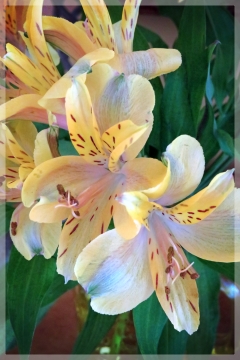 In one of his four-minute essays, Dr. Frank Crane posited that that the Seven Wonders of the World weren’t the most wonderful things in the world; the wonders of everyday life were! I have to agree. The seven wonders are man-made and, of the original seven, only the great pyramid in Giza remains. On the other hand, the night sky has been there since God created it when time began. Within our galaxy there are some 300 billion stars. The Milky Way, however, is just one of some 2 trillion galaxies (making for a total stellar population of roughly 70 billion trillion.) Since that’s just in the observable universe, there probably are plenty more that haven’t yet been detected. That those trillions of stars are orbiting around an ever expanding universe boggles the mind! Nothing made by man even comes close.
 Devotions of the Heart