KEYSTONES – EARTH DAY (April 22)

God spoke: “Earth, generate life! Every sort and kind: cattle and reptiles and wild animals—all kinds.” And there it was: wild animals of every kind, cattle of all kinds, every sort of reptile and bug. God saw that it was good. [Genesis 1:24-25 (MSG)]

When the grands visit, we usually take them to a nearby preserve where we walk the boardwalk and hope to catch sight of one of the more than 150 gopher tortoises living there. We watch them lumber through the sand, munch on prickly pear cactus, or sun on the apron of their burrows.

The gopher tortoise is what’s called a “keystone species,” meaning it plays a unique and crucial role in holding together a habitat. A keystone species can be a plant, animal, fungi, or even bacteria. It isn’t necessarily the largest or most plentiful species in an ecosystem but, if it were to disappear, the ecosystem would be dramatically different or cease to exist altogether.

Gopher tortoises are considered keystones because they are ecosystem engineers capable of digging tunnels forty feet long and ten feet deep. Their burrows provide refuge for some 350 to 400 other species, including snakes, rodents, armadillos, rabbits, lizards, worms, spiders and bugs. Some animals use the burrows as homes and others hide there from predators. In the case of fire, animals can escape the blaze in the deep tunnels.

Although these prehistoric looking creatures have lived on the earth millions of years, their survival is now endangered by predators, herbicides, and habitat destruction (better known as “progress”). Their population has declined by 80% in the last century and the gopher tortoise’s extinction is a real possibility. Sadly, its disappearance would lead to the disappearance of those other species that share its habitat. The gopher tortoise carries more than a carapace on his back—he carries the future of his ecosystem!

Other keystone species include sea otters, mangroves, prairie dogs, wolves, salmon, saguaro cactus, and bees. Not all are ecosystem engineers like the gopher tortoise but each is essential to its specific habitat and fulfills a critical ecological role that no other species can accomplish. It’s amazing how intricate God’s creation is and how interdependent various species are. Every living thing seems to uniquely mesh with others, much like the pieces of a jigsaw puzzle. When a piece goes missing, however, the puzzle ceases to come together as it should.

Although mankind clearly has a huge impact on the environment, we’re not a keystone species. In fact, some scientists argue that, if we were to disappear, the environment would improve! With the cessation of so many human activities because of COVID lockdowns, greenhouse gas emissions reduced, water quality improved, noise pollution lessened, air quality improved, and nature began healing. The break, however, was short-lived and now that many restrictions have been lifted, pollution has returned to pre-pandemic levels in most areas.

After God created the world and everything in it, He found it all to be good. He then gave mankind the responsibility for His beautiful creation. I wonder if He is as pleased with the state of our world today as he was when He turned its care over to us. Let us remember that each one of God’s creatures (whether bee, gopher tortoise, or mangrove) is His handiwork and precious to Him. Today (and everyday), let us consider what we can do to keep His creation functioning as He meant it to do!

Father of all, Creator and ruler of the universe, You entrusted your world to us as a gift. Help us to care for it and all people, that we may live in right relationship—with You, with ourselves, with one another, and with creation. [From the United States Conference of Catholic Bishops]
God spoke: “Let us make human beings in our image, make them reflecting our nature So they can be responsible for the fish in the sea, the birds in the air, the cattle, And, yes, Earth itself, and every animal that moves on the face of Earth.” God created human beings; he created them godlike, Reflecting God’s nature. He created them male and female. God blessed them: “Prosper! Reproduce! Fill Earth! Take charge! Be responsible for fish in the sea and birds in the air, for every living thing that moves on the face of Earth.” [Genesis 1:26-28 (MSG)]

Copyright ©2021 jsjdevotions. All rights reserved.

JUST DO IT (Part 3)

“Teacher, which command in God’s Law is the most important?” Jesus said, “‘Love the Lord your God with all your passion and prayer and intelligence.’ This is the most important, the first on any list. But there is a second to set alongside it: ‘Love others as well as you love yourself.’ These two commands are pegs; everything in God’s Law and the Prophets hangs from them.” [Matthew 22:36-40 (MSG)]

IMG_2710awDecades ago, I found an interesting article in a parenting magazine having to do with negative and positive commands. Because our brains tend to best process the end of a sentence rather than its beginning, when a mother says, “Don’t tease your sister,” the child tends to hear “Tease your sister!” Moreover, telling children not to do something requires them to double process. First, they have to figure out what it is they’re not supposed to do and then they have to figure out what it is they’re supposed to do instead! While there are an infinite number of alternatives to not doing something, there is only one alternative when told what to do! Since vague instructions like “Behave!” leave a lot of gray area, a clear course of action should be given.

I recalled that advice when writing about the 615 Old Testament mitzvoth. 365 of those laws were negative commands, one for every day of the year, and that’s a whole lot of “don’ts” and “shalt nots” to remember. Any reading of the Old Testament tells us the Israelites weren’t any more successful in obeying them than were my children when I told them not to do something.

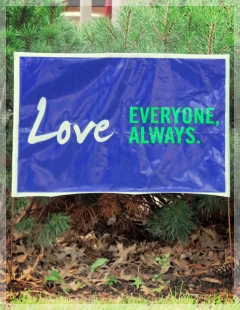
Perhaps those psychologists were familiar with the Bible and the way Jesus put a positive spin on things when he summed up the law in the one word—love—and the two commands—love God and love your neighbor. Two direct laws, stated in a positive way, with no need to split hairs because there are no exceptions. Love—it’s what we do and the power of the Holy Spirit is how we do it

For years, I misunderstood Jesus’ words in Matthew 11 about taking on his yoke. Always anxious to unload my burdens and get some rest, I was happy to dump my problems on Him. This verse, however, isn’t about the burdens of our troubles and fears; it is about the burden of the law laid upon the Jews by the scribes and Pharisees. When following a set of laws is considered the path to salvation, it does, indeed, become a heavy burden. In contrast, Jesus’ yoke is easy because his teaching equips us to live our lives in God’s will. The yoke of discipleship is a light one; it is simply walking with Jesus and allowing him to teach us moment by moment how to live His way. Even though my initial interpretation was incorrect, that verse continues to give me comfort. If love leads my actions, I don’t have to worry about doing the wrong thing. Instead, when led by love, I become the right person—the person God wants me to be.

Don’t run up debts, except for the huge debt of love you owe each other. When you love others, you complete what the law has been after all along. The law code—don’t sleep with another person’s spouse, don’t take someone’s life, don’t take what isn’t yours, don’t always be wanting what you don’t have, and any other “don’t” you can think of—finally adds up to this: Love other people as well as you do yourself. You can’t go wrong when you love others. When you add up everything in the law code, the sum total is love. [Romans 13:8-10 (MSG)]

Copyright ©2021 jsjdevotions. All rights reserved.


COMPLICATING IT (Part 2)

For I am not ashamed of this Good News about Christ. It is the power of God at work, saving everyone who believes—the Jew first and also the Gentile. This Good News tells us how God makes us right in his sight. This is accomplished from start to finish by faith. As the Scriptures say, “It is through faith that a righteous person has life.” [Romans 1:16-17 (NLT)]

tri-colored heronAmong the 613 mitzvot were laws about not adding to or detracting from the commandments. Unfortunately, man’s need for rules and regulations must be ingrained. Finding the original 613 laws an insufficient guide to Jewish life, the religious leaders stayed busy for the next several centuries clarifying the law by creating even more laws about how to keep the initial ones and then determining the proper way to atone for every infraction.
For example, finding the simple prohibition of work on the Sabbath too general, thirty-nine categories of work were created which led to sub-categories and then more laws about handling any of the implements used in such work. Among the work subcategories were sewing two stitches and hammering which meant handling needles or hammers on the Sabbath also was prohibited. There were, however, exceptions to the rules. If necessary, you could move a needle to open your prayer book and, if you had nothing else, a hammer could be used to crack nuts!

The laws in Leviticus said a priest with a physical defect could not serve in the sanctuary but, since a “defect” was not explicitly defined, 140 disqualifying physical blemishes were categorized that covered everything from head to toe (and even body odor). Even the size of a disqualifying mole was specified (but, if a mole had any hair, it was prohibited regardless of  size).

True to form, when an expert in religious law spoke with Jesus about the law of loving his neighbor, he wanted to define who his neighbor might be. While a fellow Jew surely would be a neighbor, what about a convert, an Edomite or an Egyptian? Would Moabites and Ammonites (who were barred from citizenship) be considered neighbors? And what about those hated Samaritans?

Interpreting those 615 laws became as difficult as understanding today’s complicated tax code. Eventually, it became more about doing a deed than following a creed—more about works than worship—rules than relationship—laws than love—penalties rather than penitence—and thinking it possible to save oneself rather than be saved.  Jesus brought a covenant that fulfilled the true intent and purpose of the law—one in which our salvation rests solely with God by grace through faith. There’s a lot we can do for ourselves but one thing we can’t do is to save ourselves by following rules. Salvation is God’s business; ours is getting saved, not by laws but by faith.

For Christ has already accomplished the purpose for which the law was given. As a result, all who believe in him are made right with God. [Romans 10:4 (NLT)]

Copyright ©2021 jsjdevotions. All rights reserved.

WHAT REASON? (Part 1)

If you obey my decrees and my regulations, you will find life through them. I am the Lord. [Leviticus 18:5 (NLT)]

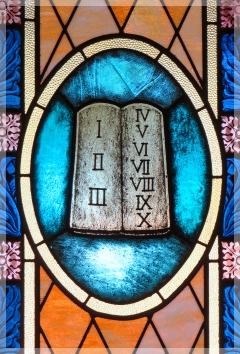
Ten COmmandments windowThe Ten Commandments are the foundation of both Jewish and Christian principles, conduct, and accountability, but they are just ten of the 613 mitzvot or commandments given to the Jewish people. In light of the big ten, many of those commands, such as using accurate scales and weights and fulfilling our promises make perfect sense as do prohibitions about speaking derogatorily of others or standing idly by if another person’s life is in danger. Moreover, laws regarding boundary markers, evidence, assessing property damages, and not perverting justice or accepting bribes certainly were necessary in a new nation. Some laws, like the ones regarding latrine placement, covering excrement, and making a guard rail around a flat roof seem reasonable from a health and safety viewpoint. Other laws may have served as a way to separate the Jews from their pagan neighbors. Perhaps it was because the Hittites, Elamites, and Sumerians were clean-shaven and the Egyptians often were clean shaven or had shaped goatees that Jewish men were not to trim the hair on their temples or shape their beards. Many laws, such as the intricate laws of sacrifice, the blue tassels on hems, reciting the Shema twice a day, and saying a blessing after meals, were related to worship and God.

Many of those laws, however, seem inexplicable. What, for example, makes land animals that don’t chew the cud and have completely split hooves (like the pig) unacceptable food? Why eat only fish with fins and scales but no shellfish or mollusks? If locusts can be eaten, why not ants? Why can’t linen be woven with wool? Why can’t a Nazarite eat grapes or raisins or cut his hair and why did every sacrifice require salt?

As I looked through these ancient laws and tried to understand God’s reasoning behind them, I missed the point. The first rule God made was the simple one he gave to Adam and Eve: don’t eat from that tree. Although He warned that death would be the result of disobedience, God didn’t explain His reasons for the prohibition because obedience to God isn’t supposed depend upon human reasoning. If we have to understand before we obey, rather than obedience, it becomes agreement and dependent on us! God, however, doesn’t require our understanding or agreement; He requires our obedience.

Abraham didn’t know where he was going when he packed up his family nor did he question God’s reasoning when he placed his son on a sacrificial altar. Building an enormous ark on dry land probably made no sense to Noah, wearing out his troops by marching around Jericho for a week seemed a questionable battle plan to Joshua, and Mary didn’t understand God’s reasoning behind her pregnancy; nevertheless, they all obeyed without understanding.

Obedience shows reliance and trust—an acceptance that God knows more than we can ever know or understand—that God is God and we are not! I don’t know God’s reasoning behind those mitzvot nor do I need to. It’s enough that God made them and expected the Israelites to abide by them. The only thing we must understand about God’s commands is that they are divinely decreed and, as such, are to be unquestionably obeyed. Rather than leading us away from God’s blessings, obedience will lead us to them.

Loving God means keeping his commandments, and his commandments are not burdensome. [1 John 5:3 (NLT)]

Trust in the Lord with all your heart; do not depend on your own understanding.  Seek his will in all you do, and he will show you which path to take. [Proverbs 3:5-6 (NLT)]

Copyright ©2021 jsjdevotions. All rights reserved.

RENDER UNTO GOD (PART 2)

The point is this: whoever sows sparingly will also reap sparingly, and whoever sows bountifully will also reap bountifully. Each one must give as he has decided in his heart, not reluctantly or under compulsion, for God loves a cheerful giver. And God is able to make all grace abound to you, so that having all sufficiency in all things at all times, you may abound in every good work. [2 Corinthians 9:6-8 (ESV)]

Yesterday was tax day: the day we rendered unto Washington what is theirs. In case we weren’t sure how much that was, we had 1099s, W-2s, 1040s, TurboTax, various receipts, H & R Block, and accountants to help us figure it out. Since Jesus told us to give God what is His, how much is that? God doesn’t send out W-2s listing our year’s many blessings, supply us with 1040s to fill out, or give us deductions for medical expenses, charitable donations, mortgage interest, property taxes, or gambling losses. Rather than a CPA or the IRS, we need to consult our Bibles for the answer to that question.

“Tithe” is an Old Testament term for the 10% gifts the Israelites were required to pay to support the Levites, provide for the Temple, and relieve the poor. A series of complicated rules regarding which tithes were made in what year and the amount tithed ended up making the tithe more like 23.3%. Although the New Testament never commands (or even recommends) a tithing system, Christians often refer to a tithe (or 10% of one’s earnings) as being the right donation to the church. In reality, for some, 10% would be unwise and for others, 10% is hardly enough!

Rather than a fixed percentage, the New Testament calls us to give regularly, according to our means, generously and joyously (even sacrificially at times), and out of love for God and others. While this requirement is vague about the actual amount, it actually is stricter than a fixed 10% because it is a matter of obedience and trust. What we give is a matter of prayer. It is an issue between God and us and we must be willing to give whatever it is He asks—be it time, talents, or finances—in the amount he desires.

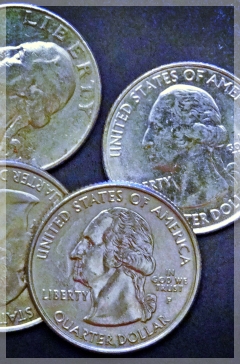
Because Caesar’s image was on the coin, it belonged to him. Let’s not forget that we are made in God’s image and it is His face that is stamped upon us. We belong to Him and whatever we give to God already is His. We simply are returning it to the rightful owner. Moreover, the list of what we should render unto God goes far beyond money. We should give Him our worship, service, obedience, praise, love, respect, gratitude, and fidelity. In short, we owe Him everything and not just on Sundays—we owe Him everything all of the time.

As John Wesley said, the question isn’t “how much of my money will I give to God, but, how much of God’s money will I keep for myself?” Although there is no need to worry about a letter from God questioning our deductions or demanding an audit, we must remember that one day we will be called in for an accounting of how we used His gifts.

Come, you who are blessed by my Father, inherit the kingdom prepared for you from the foundation of the world. For I was hungry and you gave me food, I was thirsty and you gave me drink, I was a stranger and you welcomed me, I was naked and you clothed me, I was sick and you visited me, I was in prison and you came to me. [Matthew 25:34-36 (ESV)]

Do not be conformed to this world, but be transformed by the renewal of your mind, that by testing you may discern what is the will of God, what is good and acceptable and perfect. [Romans 12: 2 (ESV)]

Copyright ©2021 jsjdevotions. All rights reserved.

RENDERING UNTO CAESAR (Part 1)

And Jesus said to them, “Whose likeness and inscription is this?” They said, “Caesar’s.” Then he said to them, “Therefore render to Caesar the things that are Caesar’s, and to God the things that are God’s.” When they heard it, they marveled. And they left him and went away. [Matthew 22:20-22 (ESV)]

The Pharisees and Herodians set out to trap Jesus into saying something that would offend either the people or Rome. By prefacing their question with flattery about His impartiality and integrity, they pressured Him into giving an answer to their politically charged question—was it right to pay taxes to Caesar. The tax about which they were asking was the tributum capitis, a sort of head tax that had to be paid by every male over fourteen and every female over twelve. Already heavily taxed by Rome, this tax was especially hated by the Judeans because they saw it as a symbol of their servitude and submission to their foreign rulers. 

Jesus’ questioners were sure they’d backed Him into a corner where He’d offend people regardless of His answer. If He said to pay taxes to Caesar, He would be denying God’s sovereign reign over Israel, supporting the hated Roman rulers, and alienating his fellow Jews. On the other hand, if He said not to pay taxes, Jesus would offend Rome and lay himself open to a charge of treason. Requesting to see a denarius, Jesus exposed his questioners’ hypocrisy when they had one. No truly devout Jew would carry a Roman coin with its idolatrous portrait of Tiberius Caesar and inscription that called him the “son of the divine Augustus.” Instead of falling into their trap, Jesus then employed a typical rabbinical technique by answering their question with one of his own. He asked whose picture was on the coin. They had to admit it was the emperor’s. Since, in the ancient world, an image on an object indicated ownership, it clearly belonged to Caesar. “Therefore,” said Jesus, “render to Caesar the things that are Caesar’s, and to God the things that are God’s.” Caught in their own trap, they didn’t yet understand that we can’t outsmart God!

On the surface, Jesus’ answer points out the obligations of dual citizenship—that obligations to both government and God must be fulfilled. Like Jesus’ questioners, we have a dual citizenship and, as citizens of both the Kingdom of God and our nation, we must fulfill our obligations to both. We are to render to whatever Caesar is in power that which is his without turning from our obligations to God. Hidden in Jesus’ answer, however, is the idea that Caesar is only entitled to what is his; he cannot claim what belongs to God! In both Jewish and Christian theology, however, God has dominion and authority over everything. In short, all things belong to God!

Nevertheless, when loyalty to government is not incompatible with loyalty to God, it appears that support of the state is part of being obedient to the Lord. Like it or not, today is tax day and, unless you filed for an extension, today is the last day to do your rendering unto Washington!

For because of this you also pay taxes, for the authorities are ministers of God, attending to this very thing. Pay to all what is owed to them: taxes to whom taxes are owed, revenue to whom revenue is owed, respect to whom respect is owed, honor to whom honor is owed. [Romans 13:6-7 (ESV)]

Copyright ©2021 jsjdevotions. All rights reserved.