
Your own ear will hear him. Right behind you a voice will say, “This is the way you should go, whether to the left or to the right.” [Isaiah 30:21 (NLT)]
The righteous person faces many troubles, but the Lord comes to the rescue each time. [Psalm 34:19 (NLT)]
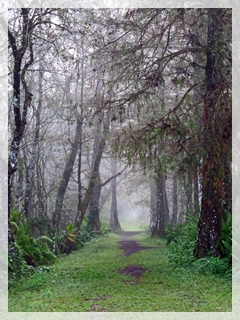 Within a day of having written yesterday’s words about trusting Jesus and following Him, God reminded me how difficult it is to actually do that. Granted, it wasn’t God’s voice we were following but His point was well taken. Mid-way through our 1,400 mile drive north, the GPS cautioned us of one accident after another within a few miles ahead of us. After the first such warning, I studied the map trying to find a detour but couldn’t seem to find a route that wouldn’t lead us right back into the accident area and the promised lane closures. When five accidents lay right in our path, not wanting to spend hours in a traffic jam, we reluctantly decided to let the GPS lead us around the congestion. Following its guidance, my husband exited the interstate while I kept trying to figure out what route we’d be taking. Although the GPS screen always indicated the direction of the next turn, we never knew the long-range plan for returning to the highway. We simply had to trust the GPS and take it one turn at a time. Of course, with my trusty map, I tried to second-guess the GPS the entire way. I just couldn’t cede complete control to that sweet calm voice directing us. Without any help from me, however, that voice got us back on the interstate well north of all of the accidents and congestion.
Had I been alone in the car, without someone riding shotgun with map in hand, I probably wouldn’t have trusted the GPS to lead me off the highway. Reluctant to abandon my original plan, I would have ignored its repeated warnings and driven into trouble. Unwilling to navigate knowing only one turn at a time, I would have encountered bumper-to-bumper traffic.
On occasion, the GPS has let me down so my trepidation about it is understandable. God, on the other hand, had never failed me and yet I fight His detours all of the time. As hesitant as I was about navigating just one turn at a time, I’m even more hesitant to live my life that way. Of course, we know God’s long range plan for all of us—salvation—but His route rarely seems direct. God-ordained detours that direct us off the path we’ve been taking occur all of the time and they rarely come with a detailed explanation. Taking God’s detours requires trusting a loving God to get us where we’re supposed to be without us knowing how He’s going to do it.
Heavenly Father, intellectually, we know your plan is a good one; help us to truly believe that spiritually. Thank you for the reminder that what may seem like a detour to us is just part of the route you’ve already mapped out for us. Give us faith enough to hear your voice and heed your directions. Release us from our fear when we can’t see what lies ahead—may we trust your infinite wisdom in giving us only one day at a time.

 The Philistine army, hoping to capture King David, raided the valley of Rephaim. Before responding to the attack, David stopped and asked God what action he should take. He didn’t present his battle plan for God’s consideration nor did he take action before receiving God’s instruction. God told David to go to battle, assuring him of victory over the Philistines. When the battle went as God had promised, David wisely did not take credit for the victory. “God did it!” he exclaimed, giving credit where credit was due. The Philistines, however, returned and raided the valley again. Although David had previously defeated them, he didn’t assume a similar victory the second time. Again, the shepherd king paused, looked to God for his battle plan and listened to His advice. This time, God gave him a new strategy, telling David to circle his army around behind the Philistines and wait for a sound like marching feet in the trees before attacking. David followed God’s advice and was victorious once again.
 I recently received an email from a Christian bookstore apologizing for one of their advertisements. Apparently, there had been objections to their “journaling” Bible ad, not because of the possible defacing of a Bible with doodles but because of the ad’s subject line: “Channel Your Inner Creative.” Customers protested their use of “inappropriate” New Age language. While the store’s goal had been to “embrace and celebrate the gift of creativity,” some people thought they were touting “channeling,” a New Age form of spiritualism. When channeling, people yield control of their discerning and reasoning faculties and enter a meditative or trancelike state in order to receive messages from a spiritual guide. When I first saw the ad, I gave no thought to its wording; I simply thought they were offering Bibles with extra wide margins so the reader could write notes or prayers on the pages. In their apology, the store promised to be “more vigilant and discerning” about their messaging. My first reaction upon receiving the apology was, ”Come on people—get a life!” I considered the complainers to be the kind of prissy judgmental people who give Christians a bad name.
 Ralph Waldo Emerson said, “Life is a journey, not a destination;” I thought of that quote when reading an article about a local man who attempted an unsupported solo ski trek from the edge of the Antarctic to the South Pole. This experienced adventurer spent several years preparing for the expedition and rigorously testing his equipment. With extras of nearly everything, he was sure he’d planned for every eventuality. What he hadn’t anticipated was encountering one of the worst summers the Antarctic has experienced, an issue with a ski that caused him constant soreness in his right foot, and a cracked teapot! The teapot (the lone one he had) was the only way he could melt snow and, without it, he’d have no water. Reluctantly, he asked a support plane to airdrop a new pot and, in spite of his best intentions, the trek changed from unsupported to supported. Then, a combination of wind and foot pain took their toll. Although he’d planned on making ten to twelve miles a day, no matter how hard he pushed himself, he averaged only eight and his supplies dwindled. After over 300 miles and thirty-six days alone on the ice, he approached an area where a plane could safely land. If he continued at his pace, he would definitely need more supplies. Moreover, there was an excellent chance that, if and when he arrived at the South Pole, extraction planes would no longer be flying. Although he’d have bragging rights for attaining his goal, penguins could be the only ones who’d ever hear his boasting. Weighing his options, he decided it was time to leave. “For me, turning back is never the wrong decision,” he said.
 Having been raised in the Episcopal Church, I’ve always observed Lent and practiced some sort of self-denial during the six weeks from Ash Wednesday to Easter. According to Christianity Today, nearly one in five Americans observed Lent in 2015. In a survey this year, more than 400,000 tweeted about their fasts and food or drink and technology were the most popular categories of denial.
