
The Father and I are one. [John 10:30 (NLT)]
Jesus told him, “I am the way, the truth, and the life. No one can come to the Father except through me. … Just believe that I am in the Father and the Father is in me. … And remember, my words are not my own. What I am telling you is from the Father who sent me. [John 14:6,11a,24b (NLT)]
 In C.S. Lewis’ children’s fantasy novel The Lion, the Witch and the Wardrobe, the youngest child, Lucy Pevensie, happens upon an enchanted armoire and steps into the magical world of Narnia. Upon returning, she rushes to tell her siblings of her astonishing adventure. Hearing such a tall tale and finding no concrete proof of its truth, her older siblings assume the story to be a figment of her imagination. They take their concern over her falsehood to their wise elderly uncle. He cautions them to use logic and consider Lucy’s story carefully. He points out there are only three possibilities: either she’s lying, crazy, or telling the truth. After pointing out that lies usually are more plausible than Lucy’s inexplicable tale, he asks if she’s lied before. The children admit she’s always been truthful. After pointing out that none of Lucy’s behavior indicates mental illness, they all agree she can’t have gone mad. He then suggests that since she’s neither a liar nor crazy, they could consider the possibility that Lucy’s story is true.
Interestingly, this is the same line of reasoning Lewis uses in what is called the “Lewis trilemma” or his “Liar, Lunatic, or Lord” argument found in Mere Christianity. Lewis uses this logical argument when people claim to believe in the existence of Jesus as a great moral teacher but not as God (which, unfortunately, many people do). Jesus certainly talked as if He were God. He professed to be able to forgive sins and to be the only way to the Father. He claimed to have existed since the beginning of time, that He was a heavenly king who offered everlasting life, that to know Him was to know God, and that He would judge the world at the end of time. He called Himself the Lord of the Sabbath, the true vine, the bread of life, the resurrection and the life, and the way and the truth and the life.
Lewis points out that we have only three choices about those fantastic claims: Jesus was either a liar who perpetrated a fraud, a madman with delusions of grandeur, or the Lord. If His claims were untrue, the one thing Jesus couldn’t have been was a principled man or an excellent teacher of morals and ethics!
There are many people who consider Jesus simply to be a Jewish version of Buddha or Socrates: a great man, filled with compassion and love, who had some profound and noble ideas. That whole Messiah/Son of God thing, however, just doesn’t sit well with them. We should remind them that neither Buddha nor Socrates claimed to be God but Jesus did! The Pevensie children soon learned the truth of Lucy’s claim and, hopefully, others will see the logic and truth of Jesus, as well!
A man who was merely a man and said the sort of things Jesus said would not be a great moral teacher. He would either be a lunatic — on the level with the man who says he is a poached egg — or else he would be the Devil of Hell. You must make your choice. Either this man was, and is, the Son of God, or else a madman or something worse. You can shut him up for a fool, you can spit at him and kill him as a demon or you can fall at his feet and call him Lord and God, but let us not come with any patronizing nonsense about his being a great human teacher. He has not left that open to us. He did not intend to. [C.S. Lewis]
 Pope Francis recently visited Singapore and, when speaking to young people at an interfaith meeting, he is reported to have said “All religions are paths to God.” After comparing the various religions to “different languages that express the divine,” he added, “There is only one God, and each of us has a language to arrive at God. Some are Sheik, Muslim, Hindu, Christian, and they are different paths [to God].” While the pontiff was encouraging interfaith dialogue, his words are troubling. I will not presume to know the Pope’s meaning or intention with his comments. Nevertheless, I find it important to address how the world understood the pontiff’s message.
 I was married fifty-seven years ago today. When I promised to love, comfort, honor, cherish, forsake all others, and to have and to hold my husband “for better for worse, for richer for poorer, in sickness and in health” until we parted at death, I had no idea just how bad “for worse” could get, how little money “for poorer” might be, or that sickness could mean much more than a case of the flu. I certainly never pictured us growing old with wrinkles, white hair, hearing aids, bifocals, arthritis, and the limitations that come advanced years.
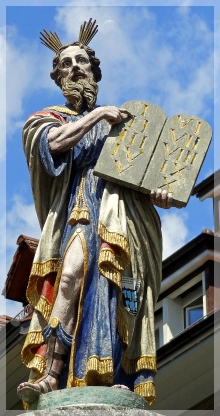 Although three places in Scripture tell us that the Lord proclaimed ten commandments and wrote them on stone tablets, those tablets weren’t numbered (especially not with Roman numerals)! The original languages of the Bible (Hebrew, Aramaic, and Greek) didn’t contain punctuation and the earliest manuscripts didn’t even have spaces between the words. While the words in Scripture are God-breathed, the punctuation was at the discretion of later copyists and translators. Without numbering, punctuation, or paragraphs, we can’t know for sure where one commandment ends and the other begins. As a result, while Jews, Roman Catholics, Protestants, and Orthodox Christians all observe the Ten Commandments, their commandments are not all the same!
 While reading about David and Goliath, I realized that it’s not just our seniors who can be undervalued or overlooked. It’s as wrong to disregard the youth in our midst as it is to discount the old. Likewise, just as some seniors may underestimate their gifts, the same could be said for those who still count the years rather than the decades! Age is just a number to God—He’s more interested in willing hearts than number of years!
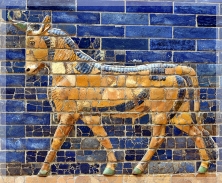 Some believers insist that unicorns actually existed because they are mentioned nine times in the Old Testament. Claiming the Bible is completely without error, they insist that you must believe the same thing—including the unicorns! On the other hand, some people disparage believers and discount all of Scripture because of those same unicorns! Do we blindly believe or do we “throw out the baby with the bathwater” because of one word?
 Devotions of the Heart