BATTLES

Can anything ever separate us from Christ’s love? Does it mean he no longer loves us if we have trouble or calamity, or are persecuted, or hungry, or destitute, or in danger, or threatened with death? … No, despite all these things, overwhelming victory is ours through Christ, who loved us. [Romans 8:35,37 (NLT)]

columbineI prayed for Pearl for over a year. This beautiful toddler had Stage-4 cancer and her bones, brain, and internal organs were riddled with the disease’s treacherous cells. Her prognosis was bleak and there were times she nearly lost her life to the effects of the various remedies rather than the cancer. That Pearl is alive and cancer free today is nothing short of a miracle. Nevertheless, she and her family went through a very dark valley to get to this place of victory. I’m sure, if given a choice, they would have preferred God to have miraculously healed her prior to the long battle she fought for over a year.

The Old Testament is filled with conflicts. In a few instances, the Israelites were given victory without ever having to go into combat. 2 Chronicles 20 tells of the time God promised Jehoshaphat the battle was God’s. At the very moment the people began to praise Him, the armies of Ammon, Moab, and Mt. Seir started fighting among themselves. By the time the army of Judah arrived, every one of their enemies was dead. 2 Kings 19 tells of a night when 185,000 enemy Assyrian soldiers were struck dead by an angel of the Lord. When the survivors awoke to the corpse-filled camp, they retreated to Nineveh where they remained. Because God took His people around the dark valley those times, the battles were won without engaging in combat or suffering loss.

For the most part, however, God’s assurance of victory rarely meant there would be no struggle. Yes, the walls of Jericho fell but, when the Israelites charged into the city with their swords and captured it, it’s hard to believe the people of Jericho didn’t defend themselves vigorously. Although the Israelites defeated them, Scripture never tells us they suffered no battle injuries or fatalities. In Joshua 10:2, God assured Joshua of victory over the Amorites but that conquest didn’t come easily. They fought so long and hard that Joshua had to ask God to prolong the day until they’d defeated their enemies. The spoils of war may have gone to the victors but, surely, they came at a cost and not every Israelite safely returned home that day. Even when we’re victorious, every battle leaves scars of one kind or another.

God could defeat armies without using any of His soldiers but He often sent His people into battle. I have no doubt that God could have miraculously cured Pearl without her and her family having to suffer through a year of painful expensive treatment and the agony of never knowing what the next procedure or test would bring. But, like the armies of Israel and Judah, they had to go through the dark valley and into battle before victoriously coming out on the other side.

The Apostle Paul tells us to rejoice in our troubles and trials because they lead to patient endurance which leads to maturity of character. I imagine Pearl’s family felt there had been more than enough character building long before her suffering ended. Nevertheless, they remained faithful and hopeful because they knew they were never alone in that dark valley. The battle was neither Pearl’s nor theirs; it was God’s.

We do not live in a perfect world. Although we are assured of victory, we are not assured of a battle-free life nor are we assured of victory while on this side of the grass. We will be faced with trials, temptations, loss, struggle, disease, suffering, and death. That God has won the war does not mean His Christian soldiers won’t ever have to fight! Nevertheless, we are victorious!

For every child of God defeats this evil world, and we achieve this victory through our faith. And who can win this battle against the world? Only those who believe that Jesus is the Son of God. [1 John 5:4-5 (NLT)]

Copyright ©2019 jsjdevotions. All rights reserved.


IN PREPARATION FOR THE JOURNEY

We broke camp at the Ahava Canal on April 19 and started off to Jerusalem. And the gracious hand of our God protected us and saved us from enemies and bandits along the way. So we arrived safely in Jerusalem. [Ezra 8:31-32a (NLT)]

Bryce - Losee CanyonAfter years of exile, the Jews were finally returning home from their captivity in Babylon. Ezra assembled a group of 1,500 men and their families and led the second emigration back to Jerusalem. It would take about four months for the over 5,000 people to make the 900 mile journey across the desert. Since they were transporting about 30 tons of silver, gold, and bronze along with wheat, wine, olive oil, and salt, there was serious danger from marauding bandits.

When Persia’s King Artaxerxes offered Ezra an armed escort, he refused. Having assured the king that God’s hand of protection was all they needed, it would have been embarrassing and hypocritical to then accept military help. The Judeans couldn’t just “talk the talk” about the Hebrew God, they had to “walk the walk” and live as if they truly believed Ezra’s words and God’s promises.

Instead of trusting in soldiers, Ezra chose to trust in God. Although he was confident in God, Ezra did not take His protection for granted. He gave orders for the people to fast and earnestly pray that God would take care of them. Knowing the trip could be disastrous without God’s protection, they committed themselves to trusting in God alone. This choice was a strong test of everyone’s faith. It’s remarkable that two chapters in the book of Ezra are written about their preparation for the trip, but just a few sentences tell about the journey itself and their safe arrival. Perhaps, if we spent more time in prayer and faith preparing for our life’s journeys, they would be as free of difficulty as Ezra’s.

Prayer is the key to Heaven,
But faith unlocks the door;
Words are so easily spoken,
Prayer without faith is like a boat without an oar.
Have faith when you speak to the Master,
That’s all he asks you for.
Prayer is the key to Heaven,
But faith unlocks the door.
[Samuel T. Scott & Robert L. Sande]

But when you ask him, be sure that your faith is in God alone. Do not waver, for a person with divided loyalty is as unsettled as a wave of the sea that is blown and tossed by the wind. Such people should not expect to receive anything from the Lord. [James 1:6-7 (NLT)]

Copyright ©2019 jsjdevotions. All rights reserved.

LIVING WITH AMBIGUITY

For we live by faith, not by sight. [2 Corinthians 5:7 (NIV)]

Lowdermilk Park rainbowAn early morning rainstorm left a rainbow over the Gulf. “Oh, thank you, Lord,” I said, “That’s just what I needed.” You see, I was suffering from a serious case of the glums and gloomies. Having recently undergone foot surgery, I knew some of my blues had to do with pain, poor sleep, the nuisance of immobility, undone tasks, and “cabin fever.” Nevertheless, that didn’t seem to fully explain my melancholy. Struggling to discern its underlying cause, I’d prayed that God would lead me to the root of the problem. In my darkness, I’d also asked Him to give me a little sign that He heard my pleas. God is big on rainbows—just ask Noah—and it felt like He hung that rainbow out just for me and hope was on the horizon.
Later that day, I came across an article listing the qualities of the prodigal son’s father. It included “willing to live with ambiguity” which struck a chord with me. Perhaps my prayers had been answered with that simple phrase. Preferring certainty to ambiguity, I knew that several unresolved issues, unanswered questions, and unclear courses were troubling me. Perhaps, my sadness was because, wary of living with the unknown, I wanted to walk by sight rather than faith!

Out of curiosity, I took an on-line test as to whether or not I’m a risk taker (someone willing to live with ambiguity). By this point in life, I knew the answer and the test results concurred with my assessment. “While you may take risks on rare occasions, you usually choose the well-traveled path,” it said while adding that I prefer a “stable environment in which changes are made gradually and with ample warning.” Telling me that I rarely seek out situations with uncertain outcomes was just another way of saying I don’t like to live with ambiguity. I’m not comfortable unless I know what’s around the next corner!

If I’d been Elisha, before joining Elijah as a prophet, I would have asked a neighbor to care for my plow and oxen rather than cooking the oxen over a plow-fueled fire. If I’d been Peter, I might not have stepped out of the boat. If I’d been Mary, I would have asked Gabriel a whole host of questions before saying I’d be the Lord’s servant. If I’d been Ruth, rather than go to Judah, I probably would have stayed in Moab. And, if I’d been Moses, I would have asked God for a detailed itinerary and map to the Promised Land. All of these people lived with ambiguity and answered God’s call without being given a step-by-step plan or knowing the outcome. They could live with ambiguity because they wholly trusted in the Lord.

Life is filled with unanswered questions and unknown outcomes. While I tend to think of risk and uncertainty as leading to things like loss, sorrow, weakness, insufficiency, insecurity, sickness, trouble, and failure, they also can lead to gain, joy, strength, plenty, confidence, health, opportunity, and success. Elisha, Peter, Mary, Ruth, and Moses all took risks and were blessed for it! Wanting a divine road map, I’d forgotten that I already have one in my Bible where I’m told to trust in God’s plan and reassured that He’s always with me.

Rather than seek to know what the future holds for us, we can seek God’s will and let Him show us where to go. We may not know what tomorrow brings but we know the One who holds our tomorrows in His hands. We can’t control every situation but, by the grace of God, we can control our attitude in every situation and learn to embrace the ambiguity of life.

It is not the cares of today, but the cares of tomorrow, that weigh a man down. For the needs of today we have corresponding strength given. For the morrow we are told to trust. It is not ours yet. It is when tomorrow’s burden is added to the burden of today that the weight is more than a man can bear. [George Macdonald]

May the God of hope fill you with all joy and peace as you trust in him, so that you may overflow with hope by the power of the Holy Spirit. [Romans 15:13 (NIV)]

Copyright ©2019 jsjdevotions. All rights reserved.

WHAT HAPPENED TO THE GREAT COMMISSION?

And then he told them, “Go into all the world and preach the Good News to everyone. Anyone who believes and is baptized will be saved. But anyone who refuses to believe will be condemned. [Mark 16:15-16 (NLT)]

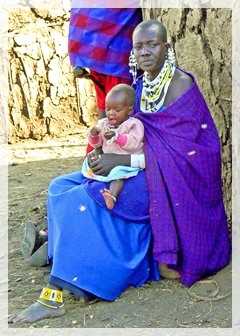
Masai - TanzaniaYesterday’s devotion made me do some hard thinking about my commitment to Christian missions. Unfortunately, there are large segments of the world’s population that have never heard of Jesus. According to the Joshua Project (an organization that gathers, integrates and shares information to facilitate the implementation of the Great Commission), 41.6 % of the world’s population is considered “unreached,” meaning they have little or no history of Christianity and the number of native Christians and available resources are so minimal that outside assistance is necessary if the Gospel is going to be heard.

Most of the people untouched by the Gospel live in what’s called the “10/40 Window:” an area of land stretching across Africa, the Middle East, and Asia that is approximately between 10 and 40 degrees north latitude. Two-thirds of the world’s people live here; 61% of them are “unreached” and 90% are considered “unevangelized,” defined as having minimal knowledge of the gospel with no valid opportunity to respond to it.

When I looked at some of the figures, I began to wonder how committed we are to saving souls. In 2015, out of the $700 billion given to Christian causes (which is about what we Americans spend on Christmas), only $45 billion (6.4%) of that went to missions! That’s less than what we spend on gym memberships and weight-loss programs. Most of that money went to churches and missions in Christian nations. Only a little over $2.5 billion (less than .4%) of those funds went to serve the unevangelized and unreached peoples of the world.

In March of 2018, the Barna Group (a research organization focused on the intersection of faith and culture) released a rather shocking finding. When asked if they’d ever heard of “the Great Commission,” 51% of church-goers were completely unfamiliar with the term. Sadly, the other 49% weren’t much better! 6% weren’t sure if they’d heard the term and 25% said that, while it “rang a bell,” they didn’t know what it was. Only 17% actually knew what it said! Sadly, even knowing what the Great Commission is doesn’t necessarily equate with a commitment to it.

We all don’t have to pack up and go on a mission trip but I don’t think we can continue to do as little as we are doing. Because of government restrictions, open evangelism from the US and Europe is difficult in many 10/40 Window countries. Christian missionaries from South American and Africa, however, often are welcome in those nations. There are other ways to reach these people, as well. We can minister to refugees as a young woman from our church will do this fall. She is going to Germany to serve the 3.2 million unreached Arab, Kurd, Turk, Assyrian and other refugees from the Syrian civil war. Like most other missionaries, she is expected to raise 100% of her expenses. With one million international students coming to the US every year (64% of whom are from the 10/40 Window and will be returning to their homelands), campus ministries are another way to spread God’s word to the unreached. At least 1.5 million people are without a full Bible in their first language, one-third of the world can’t read the language they speak, and another third learn best through non-written methods.

Yes, we support missionaries with our prayers but now is the time to look closely at how we support them with our finances. We must start supporting mission ministries that reach out to the unreached and unevangelized and support Bible translation and oral learning Bible projects.  Moreover, since 85% of those living in the 10/40 Window are among the poorest of the world’s poor, we must also support efforts to provide health care, safe water, food, and clothing to them.

Rather than expressing concern over the exclusive claims to salvation found in Christianity, perhaps we could better use our energy and resources to reach those who are unreached! We have been called to care for the poor, strengthen other believers, and save the lost. I’m not sure Christians in the free world have done a very good job of any of those tasks. When we come face to face with God, the onus for so many people never hearing about Jesus will fall on us: the people who failed to live out the Great Commission.

Christ has no body on earth but yours, no hands but yours, no feet but yours. Yours are the eyes through which Christ’s compassion for the world is to look out; yours are the feet with which He is to go about doing good; and yours are the hands with which He is to bless us now. [Teresa of Avila]

Don’t fail to do something because you can’t do everything. [Bob Pierce (World Vision founder)]

Jesus came and told his disciples, “I have been given all authority in heaven and on earth. Therefore, go and make disciples of all the nations, baptizing them in the name of the Father and the Son and the Holy Spirit. Teach these new disciples to obey all the commands I have given you. And be sure of this: I am with you always, even to the end of the age.” [Matthew 28:18-20 (NLT)]

Copyright ©2019 jsjdevotions. All rights reserved.

LIKE IT OR NOT

For this is how God loved the world: He gave his one and only Son, so that everyone who believes in him will not perish but have eternal life. God sent his Son into the world not to judge the world, but to save the world through him. There is no judgment against anyone who believes in him. But anyone who does not believe in him has already been judged for not believing in God’s one and only Son. [John 3:16-18 (NLT)]

Jesus told him, “I am the way, the truth, and the life. No one can come to the Father except through me. [John 14:6 (NLT)]

monarch butterflyLast week, in That Was God, I wrote these words: “For those who do not believe in Jesus Christ as their Savior, death means punishment and eternal separation from God,” but reminded readers that the exclusive truths of Christianity don’t mean that we are exclusive in our love; everyone is our neighbor and a person to be loved! Finding the devotion thought provoking, a friend forwarded it to the members of his small group. One man found the message contradictory and responded this way: “In other words, if you weren’t lucky enough to be born a Christian, you’re screwed. But, we still love you, neighbor!”

In actuality, none of us are born Christian; it is when we accept Christ that we are reborn as Christians. Salvation is not a birthright. Moreover, all are welcome in Christ’s Church. After all, the early church was made up entirely of converts!

Granted, it’s far easier to be a Christian in the US than in nations like North Korea, Sudan, or India. Nevertheless, in spite of facing great persecution, there are Christian converts in all of those countries. Jesus never promised His way would be easy; in fact, He said it would be difficult! Open Doors reports that eleven Christians lose their lives every day because of their faith. With John being the only Apostle not martyred, it wasn’t easy for the early Christians either; yet, look at how rapidly the Church grew!

I have no doubt that God loves all of His children. Jesus told us that God so “loved the world…” and continued with the promise that “everyone who believes” would have eternal life. He didn’t say God only loved some of the world or just the Jews, Romans or Greeks. God’s gift of His son was for everyone and for all time. As the Holy Spirit moves throughout the world drawing people to Christ, God has revealed Himself to people in ways we can’t understand.

In Matthew 7:7, we are told, “Ask and it will be given…seek and you will find…” Mark Mittleberg points out that anyone who genuinely seeks God will be led to Him. When people sincerely seek the truth, they will find it only in Christ. In his book, Seeking Allah, Finding Jesus, Nabeel Qureshi sought the truth about Mohammed; instead, he found Jesus! When skeptics Josh McDowell, Lee Strobel, and David Limbaugh went looking for the truth, they also found it in Jesus. God will reveal Himself to those who want to find Him.

“What about those who didn’t have the opportunity to hear about Jesus?” is one of those questions no Christian wants to be asked. Admittedly, not everyone has equal access to the gospel. Luke 12:48 tells us that from the one given much, much will be demanded. The inverse must also be true: from the one given little, little will be asked. We each are responsible for following whatever light God has given us.

When I think of infants like my nephew who never lived long enough to know his mother (let alone Jesus) or those people completely unreached by the Gospel, I am as disturbed as the man who didn’t like my words. Nevertheless, Jesus didn’t leave much in the way of wiggle room when He said He was “the way” rather than “one of the ways” to the Father. While contrary beliefs are possible, contrary truths are not and there seem to be some undeniably exclusive truths in Scripture as to salvation and eternal life. Like them or not, we are neither to add nor subtract from God’s Word. It’s not a buffet where we can pick and choose only the things we like nor is it a potluck where we get to bring in concepts that make it more palatable. At some point, everyone will answer to God and He will separate the sheep from the goats. Scripture doesn’t elaborate on how that will happen but I’m sure our loving and merciful God has it worked out in a way that only He can understand.

And a servant who knows what the master wants, but isn’t prepared and doesn’t carry out those instructions, will be severely punished. But someone who does not know, and then does something wrong, will be punished only lightly. When someone has been given much, much will be required in return; and when someone has been entrusted with much, even more will be required. [Luke 12:47-48 (NLT)]

Copyright ©2019 jsjdevotions. All rights reserved.

HE ALWAYS ANSWERS

Keep on asking, and you will receive what you ask for. Keep on seeking, and you will find. Keep on knocking, and the door will be opened to you. For everyone who asks, receives. Everyone who seeks, finds. And to everyone who knocks, the door will be opened. You parents—if your children ask for a loaf of bread, do you give them a stone instead? Or if they ask for a fish, do you give them a snake? Of course not! So if you sinful people know how to give good gifts to your children, how much more will your heavenly Father give good gifts to those who ask him. [Matthew 7:7-11 (NLT)]

Holy Name Catholic church - Steamboat Spgs.Thrilled at the result of her biopsy, Mary joyfully announced, “God is good and God always answers prayers!” Indeed, He is and does but we must remember that God does not always answer prayers the way we want Him to. I recently wrote that God is not a miser and our prayers should not be puny half-hearted ones. Nevertheless, regardless of the size of our petitions, we must remember that it is God’s will, not ours, that will be done. In spite of fervent prayers, some biopsies will say “malignant,” some prodigals will never return, some marriages will fail, and some people will not recover.

People often claim that Jesus’s words in Matthew 7 are a promise that God will give us anything we ask. But, seen in context, this verse is about seeking and finding God rather than having all of our wishes fulfilled. If we ask for things like His wisdom, discernment, patience, love, compassion, peace, and understanding, He will give them to us. That promise, however, does not mean God will answer all of our prayers with a “Yes!”

Just as loving parents wouldn’t give their children something bad when they ask for something good, Jesus tells us neither will God. But, what if, in his naiveté, the child unwittingly asks for something that isn’t what’s best? When my son was a teenager, he pled for a shiny new sports car; we answered with a second-hand Ford Tempo. Older and wiser, we knew a sixteen-year old boy didn’t belong behind the wheel of a Corvette. Now that he has a sixteen-year-old boy of his own, our son understands. A loving parent, like God, knows how to say “No!”

God is God and we are not. It is His will that reigns and our prayers are answered according to His plan rather than our wants. Both Elijah and Jonah asked God to take their lives, but He refused. God denied King Zedekiah’s prayer for help in defeating Nebuchadnezzar. When Jesus prayed in the garden, Paul prayed to be rid of the thorn in his flesh and David wanted to build the temple, God said “No” to them. When the disciples wanted Jesus to go back and heal in Capernaum, when a man asked Him to intervene in a family dispute, and when James and John wanted places of honor in heaven, our Lord answered them all with, “No!”

God always answers prayers but frequently not the way we expect or desire. Just because we don’t get what we want, however, doesn’t mean we get nothing. Although God’s answers often are mysterious and even heart-breaking, they always are purposeful. God’s “No!” is His “Yes!” for a far greater end, be it protection, teaching, spiritual growth, or guidance. Let us be thankful that God keeps us from what we thought we wanted and blesses us with what we didn’t know we needed!

When God says no, we are sometimes tempted to wonder if He loves us. In reality, it’s because He loves us, He sometimes says no. [Lysa TerKeurst]

Father, if you are willing, please take this cup of suffering away from me. Yet I want your will to be done, not mine. [Luke 22:42 (NLT)]

Copyright ©2019 jsjdevotions. All rights reserved.