INADEQUATE AND UNQUALIFIED

I came to you in weakness—timid and trembling. And my message and my preaching were very plain. Rather than using clever and persuasive speeches, I relied only on the power of the Holy Spirit. [1 Corinthians 2:3-4 (NLT)]

buttercupWhen I sit in front of my computer to start writing, I often wonder what makes me think I am qualified to spread the good news of the Gospel. I take comfort in the Apostle Paul’s similar feelings of inadequacy. Of all the people we meet in Scripture, Paul’s credentials (other than those of Jesus) seem to be the most impressive. Fluent in Hebrew, Aramaic, and Greek, from the tribe of Benjamin, and a second-generation Pharisee who had studied and trained under the respected Gamaliel, Paul was well-versed in the Hebrew Bible and passionate for Jesus. Yet, we know that even he sometimes felt inadequate to the task. Although extremely knowledgeable, by his own admission, his preaching ability left much to be desired.
Then again, an 80-year old man who stammered was called to lead his people out of slavery, a shepherd boy was called to be a king, and a housewife was called to be a prophetess and judge. Samuel was just a boy when he first prophesized, Jeremiah little more than a teen when God called him, and the disciples were just ordinary people like you and me. None of them had impressive resumes. Yet God, knowing exactly who they were, their ages, skills, capabilities, and shortcomings, called them! And He calls us!

In 1 Corinthians, Paul wrote that, rather than calling the qualified, God choses to qualify those he calls: “God chose the things the world considers foolish in order to shame those who think they are wise.” [1:27] Paul reassured the Corinthians in a later letter that, “God will generously provide all you need. Then you will always have everything you need and plenty left over to share with others.” [2 Corinthians 9:8] While the Apostle was referring to material gifts for the believers in Jerusalem, his words hold true for the other gifts with which God has blessed us. Sometimes, we don’t even know we have those gifts until God calls us to use them!

Whether God calls us to lead two million across the desert or lead a small group, to compose letters to the new church or write a blog, to speak to kings or a troubled teen, to build a temple or the set for the Christmas pageant, none of us can do it alone; we must depend on God and believe his promises. We continually underrate ourselves because we’re thinking small; we think we have to go it alone, under our own power, but we don’t. When God called the young Jeremiah to be His prophet, He didn’t promise that it would be easy or that he’d never get discouraged or frustrated. What God promised was His protection, provision, and supervision. Those promises apply to us, as well. God is the source of our ability and it is His power that will enable us to do His work. We are merely God’s tools; He is the builder and we must let Him use us to build His Kingdom.

Loving God, His word, and His children hardly qualifies me to write and yet, with over 1,800 devotions written, as unqualified as I am, through God’s power, it’s been done. He has, indeed, generously provided. We must trust the God who calls us to reach beyond where we think we can grasp, to climb higher than we’ve ever been, or to dig deeper than we thought possible. He will enable us to do whatever He asks us to do. While we may not do it perfectly, all God asks is that we answer Him, obey His call to the best of our ability, and trust in His provision. The outcome is His responsibility!

We are confident of all this because of our great trust in God through Christ. It is not that we think we are qualified to do anything on our own. Our qualification comes from God. He has enabled us to be ministers of his new covenant. [2 Corinthians 3:4-6a (NLT)]

For the Kingdom of God is not just a lot of talk; it is living by God’s power. [1 Corinthians 4:20 (NLT)]

Copyright ©2019 jsjdevotions. All rights reserved.

DO YOU BELIEVE IN YOUR PRODUCT?

So go and make followers of all people in the world. Baptize them in the name of the Father and the Son and the Holy Spirit.”   [Matthew 28:19 (NCV)]

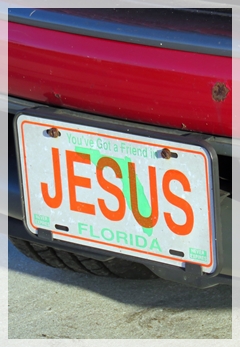
Jesus license plateDorian has departed and we Floridians are taking down hurricane shutters and removing plywood from our windows. Some people avoided that task by having high-impact windows and doors that combine specially glazed impact-resistant glass with heavy duty frames that keep the glass from breaking away from its frame; while the glass may crack from a direct hit, it will not break. In theory, when a home or business has such glass installed, no additional shutters, screens, or plywood are necessary to protect it from the ravages of a hurricane.

A friend recently sent me a meme with the words, “Do you believe in your own product?” It showed a business near West Palm Beach; the sign above the door said it sold “Impact Windows & Doors!” Since all of its windows were covered with plywood, the picture wasn’t a good testimony to the business owner’s confidence in his own product. Any potential customer seeing the plywood covering the glass might question the truth of his claims about its ability to weather a storm.

I suspect I know why there was plywood over those windows. I know of people whose supposedly impact-resistant window frames were bowed by Hurricane Irma’s forceful winds. While their windows remained intact (as promised), the rain blew in through gaps in the twisted frames. It could be that, while he touts the benefits of his product, the business owner knows that it’s not 100% trustworthy. When facing the likes of Dorian, complete faith in his windows failed.

Having been instructed to make disciples, we share the gospel message in the hope that people will want to have Jesus in their lives. In effect, our Christian witness is a little like selling a product. The meme and the question it posed made me wonder if our lives truly support our faith in the effectiveness of our product. Do we act as if we believe in Him and His promises? We say we trust God completely and yet, just in case He doesn’t come through, we tend to worry, fret, and fuss which isn’t much different than putting up plywood over the glass we claim to be impact resistant. Either we believe, trust, and place our lives in God’s hands or we don’t! If we truly trust Him, we must depend on Him in more than just the sunshine, summer showers and gentle winds we encounter. We must have faith in the thunderstorms, blizzards, tsunamis, tornadoes and hurricanes of life, as well!

It’s been said that people can tell the size of our God by the length of our worry list: the shorter the list, the greater our God. When life’s storms are brewing, do we worry or pray? Do we put our faith in God or ourselves? Unlike the not-so-confident business owner, we can be confident in our God; He is 100% effective and trustworthy. But, when we worry,  we’re a poor witness for our product. It’s not enough to speak of our impact-resistant God; we must live as if we truly believe that He can still any storm.

The great act of faith is when man decides that he is not God. [Oliver Wendell Holmes]

Jesus stood up and commanded the wind and said to the waves, “Quiet! Be still!” Then the wind stopped, and it became completely calm. Jesus said to his followers, “Why are you afraid? Do you still have no faith?” The followers were very afraid and asked each other, “Who is this? Even the wind and the waves obey him!” [Mark 4:39-41 (NCV)]

Do not worry about anything, but pray and ask God for everything you need, always giving thanks. And God’s peace, which is so great we cannot understand it, will keep your hearts and minds in Christ Jesus. [Philippians 4:6-7(NCV)]

Copyright ©2019 jsjdevotions. All rights reserved.

IT COULD BE WORSE

Why are you down in the dumps, dear soul? Why are you crying the blues? Fix my eyes on God—soon I’ll be praising again. He puts a smile on my face. He’s my God. [Psalm 42:11 (MSG)]

cardinalThe story is told of a circuit-riding preacher who never failed to thank God for the day’s weather. One Sunday, after battling through wind and sleet to his preaching appointment in a distant town, the congregation wondered how he could be thankful in such dreadful weather. When it came time for prayer, however, he said, “This is a wretched day, dear Lord, no doubt about it. But, we thank Thee, Lord, that every day isn’t as bad as this one!”

There certainly are times when it is difficult to praise the Lord, and not just because of the weather. We’ve all had days, weeks, months or maybe even years, when every time we turn around, something else seems to have gone wrong. A financial, health, family or business crisis seems to lurk around every corner. In fact, it’s so bad that the light at the end of the tunnel is just an oncoming train! God knows, it’s not easy to get through those times. It is tempting to stop thanking and start complaining: to allow our prayers to reflect our circumstances rather than our faith.

Another story is told about Matthew Henry, a 17th century preacher and Bible commentator. One evening, on his way home after preaching in London, Henry was accosted by four thieves. His response is said to have been this prayer: “Lord, I thank Thee first because I was never robbed before; second, because although they took my purse they did not take my life; third, because although they took my all, it was not much; and fourth because it was I who was robbed, and not I who robbed.”

While I would prefer to be neither, I have to agree with Matthew Henry that I’d rather be the one robbed than the robber. At least the robbed has not offended God or his fellow man. As these two stories illustrate, there is always something for which to be thankful, if only because it could be worse!

Father, forgive us if we lose sight of you when we are beset by trouble. Give us the ability to rejoice, not for our difficulties, but for the knowledge that we are not alone and that you are greater than any problems we may encounter. Give us thankful hearts for all of your mercies—even when that means we’re thankful that we were the ones robbed rather than the robbers or that every day does not bring a raging storm! When necessary, remind us that it could be worse!

Gratitude is an offering precious in the sight of God, and it is one that the poorest of us can make and be not poorer, but richer for having made it. [A.W. Tozer]

Be cheerful no matter what; pray all the time; thank God no matter what happens. This is the way God wants you who belong to Christ Jesus to live. [1 Thessalonians 5:16-18 (MSG)]

Thank God! Pray to him by name! Tell everyone you meet what he has done! Sing him songs, belt out hymns, translate his wonders into music! Honor his holy name with Hallelujahs, you who seek God. Live a happy life! Keep your eyes open for God, watch for his works; be alert for signs of his presence. [Psalm 105:1-3 (MSG)]

Copyright ©2019 jsjdevotions. All rights reserved.

ONE BOX AT A TIME

Give your entire attention to what God is doing right now, and don’t get worked up about what may or may not happen tomorrow. God will help you deal with whatever hard things come up when the time comes. [Matthew 6:34 (NLT)]

Steamboat SkiA few years ago, while skiing, I got lost during a snowstorm and ended up on a double-black diamond run. In knee-deep powder, I faced a narrow steep trail that was covered with ferocious-looking moguls. Looking down at the daunting terrain, tears filled my eyes. Picturing all that could go wrong, I wanted to quit but, unless I planned on staying there until the spring thaw, I had no option. If I wanted to get to the base, I had to get down that run and so I prayed for guidance. Words spoken by a ski instructor came to mind: “You can get down anything if you take it one turn at a time.” While I couldn’t picture doing the whole run, I could picture making just one turn and so I made that turn. Then I made another and another and got down that intimidating slope simply by taking one turn at a time.

I thought about taking life one turn at a time as I looked at the pile of boxes in our garage. How will we fit them all into the pod and cars, let alone unpack them at the other end? Even though I know the answer, the task is daunting. Nevertheless, I know it can be done—one prayer and one box at a time!

Sometimes, looking at the big picture is overwhelming and we end up conceding defeat without even trying. For example, we have friends who desperately want to down-size but, apprehensive about the enormity of the task, still remain in the house they want to leave! When they wonder how to get rid of all their furniture, shred years of old files, clean out every cupboard, pack up and move, my answer is to do it one chair, one stack of paper, one shelf, one trash bag, and one box at a time.

It’s not just moving that can seem overwhelming. “How will I ever get through the terrible twos?” cries the frustrated mother; she does it one temper tantrum at a time. “How will I ever get the Bible read?” asks the new Christian; he does it one page at a time. “How will I get through several months of chemo-therapy?” asks the patient; it’s done one session at a time. How do we climb to the top of a mountain, get through a lifetime of sobriety, face the loss of a spouse, or endure chronic pain? We do it one step, one day or even one hour at a time. As insurmountable as any challenge may seem, it is merely a succession of small manageable bits and pieces. How do we do it? We do it one prayer at a time.

As He did with manna for the Israelites, God will give us what we need for the moment and that’s all we really need. We don’t have to become anxious about finishing when what we need to do is just get started and, once started, move forward, a step at a time. We aren’t alone; He’s right there with us and, when we tire, we can rest in God’s presence until He strengthens and restores us enough to continue. Our progress may not be fast or graceful and there may be a few stumbles or setbacks along the way. Nevertheless, with faith in every step, it will get accomplished, whether it’s one turn or one box at a time.

If you’re running a 26-mile marathon, remember that every mile is run one step at a time. If you are writing a book, do it one page at a time. If you’re trying to master a new language, try it one word at a time. There are 365 days in the average year. Divide any project by 365 and you’ll find that no job is all that intimidating. [Charles R. Swindoll]

God is striding ahead of you. He’s right there with you. He won’t let you down; he won’t leave you. Don’t be intimidated. Don’t worry. [Deuteronomy 31:8 (MSG)]

Copyright ©2019 jsjdevotions. All rights reserved.


WHERE IS HE?

As the deer longs for streams of water, so I long for you, O God. I thirst for God, the living God. When can I go and stand before him? Day and night I have only tears for food, while my enemies continually taunt me, saying, “Where is this God of yours?” [Psalm 42:1-3 (NLT)]

white-tailed deer - FloridaNot so long ago, it was hard to face my computer with any enthusiasm. Every beginning led to a dead end or took me down a rabbit hole of confusion. The paragraphs over which I’d struggled had come to nothing and my hours at the keyboard seemed an exercise in futility. It’s as if I had little scraps of useless fabric but couldn’t find a way to quilt them together. I wondered where God was when I so desperately needed His guidance.

The best place to go when feeling hollow or hopeless is God’s word and Psalms is where I usually begin. David certainly had plenty of times of downheartedness and he wasn’t afraid to express his exhaustion, frustration, or despair and yet there always seems to be a ray of hope in his words. I turned to Psalm 42 and, having hit a “dry spell,” I knew what the psalmist meant when comparing himself to a deer panting for water and thirsting for God. Like him, I felt like I was dying of thirst.

It was the psalm’s mention of enemies with their taunts of, “Where is this God of yours?” that really hit home. I don’t share David’s flesh and blood enemies but all of us share a common unseen enemy: the doubt and anxiety that comes from spiritual depression.

The palmist asks why God has forgotten him and I think we all know that feeling. While I can get it when I’m staring at an empty page, that sense of desolation may visit others as they wait for the return of a prodigal, sit in a hospital room, endure chronic pain, look at the empty chair once occupied by a spouse, or have too much month left at the end of their money. We’ve all had times when it feels like God has turned a deaf ear to our prayers or has closed His eyes to our situation.

“Where is this God of yours?” is the enemy’s voice. Wanting us to lose faith or wallow in despair, he causes us to question God’s presence in our lives. God hasn’t forgotten about us; even the psalmist, as depressed as he was, acknowledges that God pours out His unfailing love each day. Nevertheless, sometimes, it feels as if God is looking the other way. Feeling defeated, discouraged, lonely, weary, or insecure, it’s easy to forget that our feelings can’t always be trusted. God, however, always is steadfast and trustworty!

In a gentle reproach, the psalmist asks why he is so downcast and reminds himself of the hope he has in God. That we don’t sense God’s presence, feel His love, see His hand, or hear His voice doesn’t mean that our loving God isn’t there. When asked, “Where is this God of yours?” let us never forget that He dwells, not just in heaven above, but also in our broken spirits. There always will be dark valleys to traverse but we are never alone; we have hope in God and, for that, we praise him.

A loss of the present sense of God’s love is not a loss of that love itself; the jewel is there, though it gleams not on our breast; hope…expects the promised boon though present providence stands before her with empty hands. [Charles Spurgeon]

Why am I discouraged? Why is my heart so sad? I will put my hope in God! I will praise him again—my Savior and my God! [Psalm 42:11 (NLT)]

Copyright ©2019 jsjdevotions. All rights reserved.

SHUT THE DOOR (Elisha – 5)

And Elisha said, “Borrow as many empty jars as you can from your friends and neighbors. Then go into your house with your sons and shut the door behind you. Pour olive oil from your flask into the jars, setting each one aside when it is filled. [2 Kings 4:3-4 (NLT)]

naples doorwayHer neighbors probably thought she’d lost her mind when she sent her boys out to ask for empty containers. Shutting the door certainly kept out the creditors, naysayers, and doubters along with any talk of unbelief that could hinder the widow’s faith. That closed door shut out interruptions, distractions, anxieties, and whatever else that might have kept the widow from focusing on God. Because that shut door even kept out Elisha, there was no mistaking who was responsible for the flowing oil: God!

Not every miracle is meant to be as public and impressive as the parting of the Red Sea. With the door open, once others saw what was happening, they even may have brought their own jars to cash in on the widow’s seemingly unlimited supply of oil. The closed door meant that, rather than a public display of God’s power, this miracle was to be a private demonstration of God’s mercy and grace. There are many other private miracles throughout Scripture. When Elisha restored the Shunammite woman’s son to life, he did it behind closed doors. Elijah’s resurrection of the widow from Zarephath’s son also was done privately and only Peter, James and John witnessed Jesus’s resurrection of Jairus’s daughter. Many miracles, like Jesus’s healing of the daughter of the Syrophoenician woman or the Roman officer’s servant were done from a distance with no witnesses. While these instances of God’s miraculous provision and healing eventually became known far and wide (we still read of them today), at the time, they were a personal matter of one person’s faith and God’s amazing power.

Because it cut out other options, shutting the door showed the widow’s total trust in God. Leaving the door open would have implied that she wasn’t quite sure about Elisha’s promise. With an open door, once she saw the oil pouring, the woman could have sent her boys out for more jars; something tells me that the oil would have stopped flowing the moment she did. After the door was closed, the number of jars indicated her faith. Shutting the door meant she’d shut the door on other people and other options. Having opened her life to God, she was all in and committed to Him.

Do we truly trust God’s provision? When He calls us to do something, are we all in? Do we ignore the skeptics and pessimists? Do we focus on God or our fears? Do we give God credit for our blessings or do we tend to chalk them up to coincidence or good fortune. Do we trust in God even when what He tells us to do seems impractical or implausible? Do we put all of our faith in God or do we rely on ourselves and keep a backup plan handy? Peter certainly shut the door when (without a life-jacket) he stepped out of that boat onto the water!

I guess it comes right back to Monday’s message, “Any Bridges to Burn?” The widow trusted God enough to shut the door on her neighbors and any other options and Elisha trusted God enough to shut the door by burning his plow and cooking his oxen. Having faith is believing that God will do what He says He will. Do we have enough faith to shut the door?

Faith shows the reality of what we hope for; it is the evidence of things we cannot see. [Hebrews 11:1 (NLT)]

But blessed are those who trust in the Lord and have made the Lord their hope and confidence. [[Jeremiah 17:7 (NLT)]

Copyright ©2019 jsjdevotions. All rights reserved.