THE PEACE STORE

I have told you all this so that you may have peace in me. Here on earth you will have many trials and sorrows. But take heart, because I have overcome the world. [John 16:33 (NLT)]
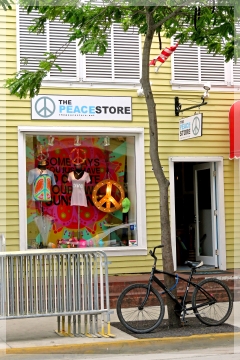
Peace Store - Key West, FLBetween demonstrations that turn into brawls or rioting, incidents of mask rage, shootings, negative and misleading political ads, quarrelsome legislators, nations accusing one another of espionage and fraud, and the assorted armed conflicts throughout the world, I wish we could purchase peace as easily as we can items from Key West’s Peace Store. Actually, given the anger and nastiness so prevalent in the world today, I’m afraid wearing one of their tee-shirts politely requesting “Peace Please” or a face mask with the peace symbol could cause conflict rather than promote peace! Real peace, however, is more than the absence of conflict and it’s not something that can be purchased in Key West or anywhere else.

The Greek word usually translated as peace in the New Testament is eirēnē. In classic Greek, it meant the absence of war but, when found in the New Testament, eirēnē has a far broader meaning. This expanded meaning is because Jesus didn’t speak Greek and the word He would have used was shalom, which meant well-being in the widest sense of the word. In the Hebrew Scriptures, along with the lack of conflict, shalom was used for prosperity, physical health, contentedness both when going to sleep and at death, good relationships between nations and people, and salvation. When Gideon built an altar to the Lord, he named it Yahweh-Shalom, which meant “the Lord is peace.” For a Jew, shalom was the sense of general well-being that came from God alone.

When Jesus promised us peace or shalom, along with absence of discord, He included a sense of wholeness, health, welfare, safety, rest, soundness, tranquility, prosperity, perfectness, fullness, freedom from care, acceptance, and harmony. If we could purchase any or all of those at the Peace Store, their website would crash, the line out the door would be a mile long, and the store owners would be among the Fortune 500!

We can’t purchase peace because Jesus, the Prince of Peace, purchased it for us; shalom is ours simply for the asking. That peace doesn’t mean lack of hardship, sickness, death, grief, or difficulties. In fact, Jesus pretty much guaranteed we’d have those. He did, however, promise peace in every one of those situations.

If you’re ever in Key West, you can check out the Peace Store where they say, “Peace is always in fashion.” If, however, you’re looking for true peace, the kind of peace that far exceeds our understanding, you’ll find that only in a relationship with God. If we remain in Christ, keep the Holy Spirit within us, are obedient to His word, study and pray, serve and love, the shalom promised by the Prince of Peace will remain bright within our hearts and souls. Calling Key West “the gateway to paradise,” the Peace Store was wrong; the true path to paradise is found only in Jesus and His gospel of peace.

God cannot give us a happiness and peace apart from Himself, because it is not there. There is no such thing. [C.S. Lewis]
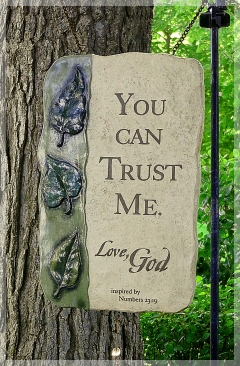
I am leaving you with a gift—peace of mind and heart. And the peace I give is a gift the world cannot give. So don’t be troubled or afraid. [John 14:27 (NLT)]

This is the message of Good News for the people of Israel—that there is peace with God through Jesus Christ, who is Lord of all. [Acts 10:36 (NLT)]

Copyright ©2020 jsjdevotions. All rights reserved.

THE SCARLET CORD

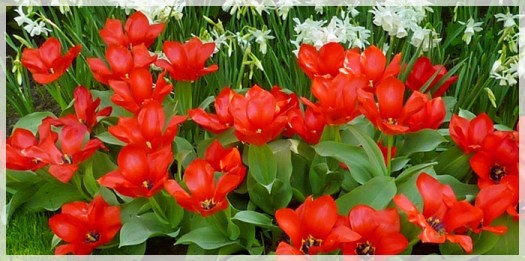
tulip kaufmanniana - fire ball

Faith shows the reality of what we hope for; it is the evidence of things we cannot see. Through their faith, the people in days of old earned a good reputation. [Hebrews 11:1-2 (NLT)]

One of only two women listed in the book of Hebrews’ “Hall of Faith,” Rahab married Salmon, was the mother of Boaz (who married Ruth), a great-great grandmother to David, and one of Jesus’ ancestors. Not an Israelite, she was a prostitute from Jericho who collaborated with her nation’s enemy. Yet, her faith is commended in Hebrews, Matthew makes specific mention of her in Jesus’ genealogy, and James speaks highly of her in his epistle. Why?

Rahab met many travelers in her dubious profession and heard how the Israelites passed through the Red Sea, defeated the Amorite kings Sihon and Og, and slaughtered all of their people. Recognizing the Israelites’ God as supreme, she anticipated Jericho’s defeat and the perceptive woman judiciously aligned herself with the winning side. After protecting two Israelite spies by hiding them from the king’s men, she requested the same loyalty to her that she’d given them and negotiated for the safety of herself and her family. As Rahab lowered the spies to safety on a scarlet cord, they warned that her protection was only ensured if she had that same cord visible on the day of their attack. True to their word, when Jericho fell, Rahab and her family were saved. Was it Rahab’s treason to Jericho that caused her to be mentioned so highly in a gospel and two epistles or was there more?

After leaving Rahab’s house, the spies hid in the hills for three days before returning to camp and reporting to Joshua. After that, the Israelites broke camp and moved to the banks of the Jordan where they stayed another three days before crossing the river. Once across, they erected memorials to commemorate their crossing by God’s power. Four days later, the people celebrated the first night of Passover and, at some point, all of the men were circumcised. While the Israelites observed the eight days of Passover and Feast of Unleavened Bread and the men recovered from their surgery, the invincible city of Jericho closed its gates and readied itself for battle. By then, Rahab had waited at least two weeks for the Israelites and her rescue. Did she begin to doubt the two spies and their God? Had they forgotten about her or did she pick the wrong ally? Did she consider bringing in that scarlet cord and making an alliance with a protector in Jericho? Was she tempted to lose faith in the God of the Israelites?

Eventually, the Israelites set off to conquer Jericho but they didn’t assault the town or lay siege to it. Instead, seven priests blowing rams’ horns followed by 40,000 silent soldiers paraded once around the walled city with the Ark of the Covenant before returning to their camp. For six days, Rahab watched from her window as the Israelites marched once around Jericho and returned to their camp without ever lifting a weapon or shouting a war cry. Was her faith shaken by their strange behavior? Were the Israelites too afraid to attack? What kind of God used such a bizarre battle plan? On the seventh day, when she watched the Israelites parade seven times around the city, did she abandon all hope as she witnessed what appeared to be another day of even more pointless marching? Apparently not; that scarlet cord, the sign of her faith in the God of the Israelites, was still hanging from her window. When the army finally shouted, the walls of the unconquerable city collapsed and Rahab and her family were saved.

The walls of Jericho were leveled by faith in God. Rahab helped two strangers and kept that scarlet cord dangling from her window by that same faith. When God’s plan seems inexplicable or a long time in coming, do we exhibit a similar kind of faith? When things seem at a standstill, when we can’t see His plan, do we despair or do we hang out a scarlet cord of faith in God?

It was by faith that the people of Israel marched around Jericho for seven days, and the walls came crashing down. It was by faith that Rahab the prostitute was not destroyed with the people in her city who refused to obey God. For she had given a friendly welcome to the spies. [Hebrews 11:30-31 (NLT)]

Copyright ©2020 jsjdevotions. All rights reserved.

THE ARTIST

And yet, O LORD, you are our Father. We are the clay, and you are the potter. We all are formed by your hand. [Isaiah 64:8 (NLT)]

What sorrow awaits those who argue with their Creator. Does a clay pot argue with its maker? Does the clay dispute with the one who shapes it, saying, “Stop, you’re doing it wrong!” Does the pot exclaim, “How clumsy can you be?” [Isaiah 45:9 (NLT)]

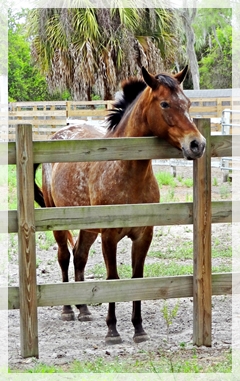
horseSeveral years ago, while spending the winter in the mountains, our morning walk took us by an art gallery. We frequently stopped to chat with the owner, look at the latest acquisitions and watch the progress of a local sculptor who had set up shop in the gallery. Working in clay, he was crafting the model for what would eventually be a cast bronze sculpture. As the final shape began to emerge, the artist continued to tweak it with small changes, a little pinch here or a small adjustment there, each time making it a better representation of a cowboy and his string of horses. Envisioning the final product and assured that it was nearly ready for casting, my husband and I made a pre-cast purchase of the piece.
We returned to our Midwest home and waited for the bronze to be completed. Nearly a year later, the gallery informed us that the piece remained a work in progress. They offered us a refund and, impatient and unsure of ever seeing the completed work, we accepted. Two years later, we walked into another mountain gallery and saw the finished piece. While the original concept was still recognizable, the beautiful final product was different (and better) than what we’d expected (and we regretted our impatience).

Works of art rarely are created overnight; they require time and fine-tuning. God, like the unhurried sculptor, doesn’t rush as He works on us. Wanting a masterpiece, He isn’t going to complete us in a few months and the process of sanctification goes on for a lifetime. There is always something in us that needs some modification, even if it means a little squeezing, twisting or pulling one way or another. Just as my husband and I couldn’t visualize exactly how the completed sculpture would look, we’re never quite sure what it is God has in plan for us or how He is going to accomplish it.

Although we didn’t trust the sculptor’s skill, we must trust in God’s heavenly artistry as His expert hands do their holy work on us. While the artist eventually was satisfied enough to cast his work in bronze, God is never quite finished with us; we remain a work in progress until our very last day.

Let us be clay in His hands!

And I am certain that God, who began the good work within you, will continue his work until it is finally finished on the day when Christ Jesus returns. [Philippians 1:6 (NLT)]

For we are God’s masterpiece. He has created us anew in Christ Jesus, so we can do the good things he planned for us long ago. [Ephesians 2:10 (NLT)]

Copyright ©2020 jsjdevotions. All rights reserved.

CARKING CARE

Give your burdens to the Lord, and he will take care of you. He will not permit the godly to slip and fall. [Psalm 55:22 (NLT)]

The Valley of Vision is a collection of Puritan prayers spanning from the sixteenth through the late nineteenth centuries. Having grown up with the King James Bible, its antiquated thees and thous along with verbs forms like wilt, didst, and makest don’t bother me. Their formality actually adds to the beauty and charm of the prayers. Although context usually explained outdated words like nethermost, subserve, and extenuations, I had to look up a few new words like peradventure.
Although I’d never seen the word carking, I immediately knew what the author meant when writing, “Deliver me from carking care…” Sounding like a crow’s unpleasant cry, the phrase “carking care” sounds as disagreeable as what it describes: oppressive worry!

The word cark comes from the Old North French carkier (to load, burden) from the Late Latin carcare (to load a wagon or cart). Carcare is also the source of the word cargo. In English, carking literally means putting on a load or burden and carking cares are concerns that have become burdensome. It’s as if we’ve loaded all of our worries into a wagon and are carting around that troubling cargo. Although we grow weary of the heavy burden, we continue carrying it in our hearts and souls.

Right now, I imagine we all have some major concerns. We fret about children who have missed out on school and family members who must fly, care for the sick, or meet the public in their jobs. We’re in another unpleasant season of politics and the media is filled with incidents of mask rage, protests, civil unrest, and financial woes. If we’re not out of work, we have friends or family who are. Loved ones remain isolated in retirement and nursing homes, bills are piling up, supply chains are broken, businesses are closing, and some people still haven’t gotten their unemployment checks. Vacations, weddings, reunions and even memorial services have been put on indefinite hold, no one knows how schools will function safely, and the COVID dashboards seem to have nothing but bad news. Here in Florida, with hurricane season upon us, we also have the dubious honor of being called the “epicenter” of the latest coronavirus surge. We find ourselves weighing the risks before having a repair man in the house, getting carry-out, or venturing out to the beach or grocery. We’re moving into our fifth month of this pandemic and, with no end in sight, people everywhere are feeling assaulted on all sides. Regardless of their faith, I doubt that anyone feels completely free of cares.

Living in a fallen world, we always will have troubles and concerns. The good news is that they don’t have to be carking ones—we don’t have to carry that cart of cares because God will carry them for us. For that to happen, however, we have to unload our wagon of cares and give them to God through prayer. John Calvin wrote of believers relieving “themselves of their anxieties by pouring them into his bosom…that they may declare that from him alone they hope and expect, both for themselves and for others, all good things.” As we pour our concerns into God’s bosom, let us join with the anonymous writer in his prayer: “Deliver me from carking care, and make me a happy holy person….Teach me to laud, adore, and magnify thee, with the music of heaven, And make me a perfume of praiseful gratitude to thee.”

Perhaps what our Father would have us learn is that worry is not for Him to take away, but for us to give up. [Kathy Herman]

Give all your worries and cares to God, for he cares about you. [1 Peter 5:7 (NLT)]

And I am convinced that nothing can ever separate us from God’s love. Neither death nor life, neither angels nor demons, neither our fears for today nor our worries about tomorrow—not even the powers of hell can separate us from God’s love. [Romans 8:38 (NLT)]

Copyright ©2020 jsjdevotions. All rights reserved.

BAKING A PRAYER

Once Jesus was praying in a particular place. When he had finished, one of his disciples approached. “Teach us to pray, Master,” he said, “just like John taught his disciples.” [Luke 11:1 (NTE)]

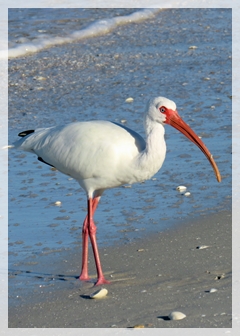
ibisI used to look forward to our occasional stops in the bank where a tray of homemade cookies always was laid out for their customers. I admit to having no will-power when it came to their white chocolate chip/macadamia nut cookies. With a hint of lemon, they were so delicious that I searched the internet to find the recipe so I could skip the bank visit. Several recipes came close but none were quite right so, using those as a guide, I developed a recipe that met the taste test!
When the disciples asked Jesus to teach them how to pray, He recited what we call “The Lord’s Prayer.” It’s important to remember that the disciples asked how to pray but not what exact words to use. Being a good teacher, instead of a lecture on praying, Jesus gave them a model prayer, but certainly not the only prayer to be said.

My recipe search told me the basic ingredients I needed for the cookies: flour, baking powder, brown and granulated sugars, butter, eggs, and lemon extract. Jesus’ model prayer included basics like praise, an acknowledgement of God’s holiness, acceptance of His will, confession, forgiveness, and petitions for daily provision and protection from evil. I found other recipes that included ingredients like cornstarch, lemon zest, nuts, and vanilla extract. If we look at other prayers said by Jesus, we find things like thanksgiving, a desire to bring God glory, and pleas for others and for the church.

When Jesus showed the disciples how to pray, He gave them an outline (or a basic recipe) rather than a comprehensive list of components. Like a recipe, it’s up to us to put them all together. Some days, I give God an extra cupful of thanks and praise because, unlike salt, we can never overdo those ingredients. It’s often easy to skip the confession and forgiving but, like forgetting the baking powder in cookies, prayers don’t seem to come out right without them. While it’s possible to add too much flour to a cookie recipe, our prayers seem to improve the more we pray for the needs of others. God, however, probably won’t find our prayers very appetizing if we spend more time mixing in petitions for ourselves than for others! Unlike a cookie recipe, there is no set amount of time for baking the perfect prayer; that’s a judgment call. As for me, I often find it necessary to bake my prayers a long time before acceptance of God’s plan forms in my heart.

When we grow bored with the food we’ve been preparing, we create new recipes or tweak the old ones by adding something extra like dried cherries or cinnamon chips to oatmeal cookies. The same goes for our prayers. If prayer seems boring, we need to change it up by gathering the ingredients and presenting them to God in a different way. Just as there are countless ingredients with which to bake delicious cookies, there are countless components that can go into our prayers. Regardless of the recipe, my grands are pleased whenever I bake; I think God feels the same way about our prayers!

Believers do not pray, with the view of informing God about things unknown to him, or of exciting him to do his duty, or of urging him as though he were reluctant. On the contrary, they pray, in order that they may arouse themselves to seek him, that they may exercise their faith in meditating on his promises, that they may relieve themselves from their anxieties by pouring them into his bosom; in a word, that they may declare that from him alone they hope and expect, both for themselves and for others, all good things. [John Calvin]

“So this is how you should pray: Our father in heaven, may your name be honoured may your kingdom come may your will be done as in heaven, so on earth. Give us today the bread we need now; and forgive us the things we owe, as we too have forgiven what was owed to us. Don’t bring us into the great trial, but rescue us from evil.” [Matthew 6:9-13 (NTE)]

Copyright ©2020 jsjdevotions. All rights reserved.

THE RAINBOW

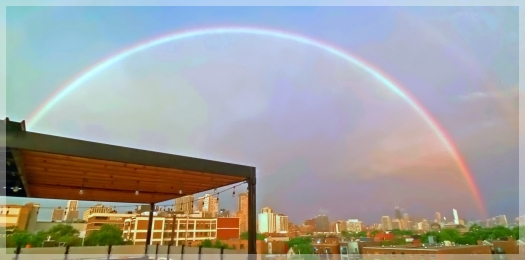
chicago rainbowI will never again curse the ground because of the human race, even though everything they think or imagine is bent toward evil from childhood. I will never again destroy all living things. As long as the earth remains, there will be planting and harvest, cold and heat, summer and winter, day and night. [Genesis 8:21-22 (NLT)]

Tears are the material out of which heaven weaves its brightest rainbow. [F.B. Meyer]

With everyone stuck inside because of the rain, the day had been challenging as my son and his wife tried to get in eight hours of Zoom meetings, conference calls, report writing and computer programming while keeping their two youngsters busy (and relatively quiet). The rain finally stopped shortly before dusk and, when my grand ran out onto the rooftop deck to celebrate her freedom, she stopped in amazement. There, above the city, a city plagued not just by COVID-19 but also by gang violence, shootings, racism, rioting, and poverty, was a beautiful ray of hope: a double rainbow.

Rainbows are among my favorite things. The glory of the Lord “looked like a rainbow shining in the clouds on a rainy day,” to Ezekiel and John described the Lord’s glory circling Him like a rainbow and glowing like an emerald in Revelation. The rainbow shows us God’s light in the darkness of our troubled world and is probably the closest thing we have to seeing His radiance while we’re on this side of the grass.

Scripture’s first mention of a rainbow is in Genesis 9. Once the floodwaters had receded and the earth was dry enough, God told Noah to leave the ark and release all of the animals. Even though God knew mankind’s heart was still inclined toward evil, He gave us another chance with His promises to never again destroy every living thing by flood and that the normal cycles of nature would continue as long as the earth existed. The rainbow provided Noah and future generations with a sign of God’s covenant.

After a rain storm, with its clouds, thunder, and lightning, we frequently are blessed with a rainbow: a beautiful reminder of God’s love, mercy and faithfulness. It reminds us of both God’s grace and our sinfulness; after all, it was mankind’s sin that caused the flood in the first place! Rather than saving us by putting us on an ark of cypress wood, God saved us by putting Jesus on a cross. The rainbow reminds us of our redemption and salvation; because of Jesus, we have an opportunity for a new beginning. God packed a whole lot of supernatural meaning into a natural phenomenon when He hung the rainbow in the sky!

Before Noah and his family left that ark, they’d been in close quarters with one another and all of those animals for a year. If we think sheltering in place is challenging, imagine doing it with four families and an enormous menagerie but without the internet, Amazon, Netflix or Door Dash. Today’s bad news, like rain, keeps showering down and we’re in a season that seems to have no end. The storm clouds of life can obscure God’s presence but, when we remember that He is in the storm with us, we might just see a rainbow! Like my grand, I love seeing rainbows; they remind me that God is faithful to His promises for “all generations to come.”

And when it rains on your parade, look up rather than down. Without the rain, there would be no rainbow. [G.K. Chesterton]

I am giving you a sign of my covenant with you and with all living creatures, for all generations to come. I have placed my rainbow in the clouds. It is the sign of my covenant with you and with all the earth. When I send clouds over the earth, the rainbow will appear in the clouds, and I will remember my covenant with you and with all living creatures. Never again will the floodwaters destroy all life. [Genesis 9:12-15 (NLT)]

Copyright ©2020 jsjdevotions. All rights reserved.